 Aiko Tanaka
There is no Whoosh train to Surabaya yet, and there is no ticket you can buy for one. What exists today is a study-stage extension of the Jakarta to Bandung high-speed line, with three route options under review, a preferred southern alignment via Yogyakarta, and a government instruction that the project must not burden the state budget. The train you can ride now still runs only between Halim in Jakarta and Tegalluar Summarecon near Bandung, and this guide separates that working service, its filing sequence and its fares, from the Surabaya plan that remains years from construction.
Quick Facts
- Line open today: Jakarta Halim to Tegalluar Summarecon via Karawang and Padalarang, 142.3 km, opened 2 October 2023.
- Top speed: 350 km/h in service, with Halim to Padalarang in about 30 to 35 minutes and Halim to Tegalluar in about 45 minutes.
- Surabaya extension status: Pre-feasibility and feasibility study stage only. No construction contract, no opening date, no fares published.
- Route options studied: Southern via Kroya and Yogyakarta at 629.5 km and about 180 minutes; central via Cirebon and Purwokerto at 679.2 km and about 193 minutes; northern via Cirebon and Semarang at 642 km and about 184 minutes.
- Current fares: Premium Economy uses dynamic pricing, published in a Rp150,000 to Rp250,000 band when dynamic fares launched, with Business fixed at Rp450,000 and First at Rp600,000 in the January 2025 KCIC notice. Always confirm the live price in the booking screen.
- Operator: PT Kereta Cepat Indonesia China (KCIC). Book in the Whoosh app or at ticket.kcic.co.id.
- Central Bandung access: Leave the train at Padalarang and take the free KA Feeder to Cimahi and Bandung station, about 18 minutes, timed to meet Whoosh arrivals.
What is actually decided about the Surabaya extension, and what is not?
The honest answer is that the direction is decided and almost everything else is not. Reporting through 2025 shows the government advancing a study on extending the Jakarta to Bandung line to Surabaya to improve mobility across Java, with Coordinating Minister for Infrastructure and Regional Development Agus Harimurti Yudhoyono tasked with overseeing the plan. In November 2025 President Prabowo Subianto spoke of extending the line beyond Surabaya to Banyuwangi at the eastern tip of Java, but no routing, construction process or timeline was provided with that vision.
Three practical blockers explain the slow pace. First, money: the Jakarta to Bandung line cost about US$7.3 billion, carries heavy debt, and is not projected to break even for decades, so the transport ministry has stressed that the extension must not burden the state budget and would need private or creative financing. Second, the operator position: KCIC has said government funding is key and that it cannot fund the extension alone, even while a preliminary study continues. Third, process: a new presidential regulation and a dedicated task force have been described as prerequisites before the project can move from study to procurement. Until those steps land, any website selling a Jakarta to Surabaya high-speed ticket, or quoting an opening year as fact, is ahead of the evidence.
Which route would a Jakarta to Surabaya Whoosh take?
KCIC study work has prepared three alignments east from the Bandung area. The southern route runs via Kroya and Yogyakarta, covers 629.5 km with 13 stations, and targets about 180 minutes. The central route runs via Cirebon and Purwokerto, covers 679.2 km with 15 stations, and targets about 193 minutes. The northern route runs via Cirebon and Semarang, covers 642 km with 14 stations, and targets about 184 minutes. Consultant recommendations reported from the KCIC study favour the southern route, mainly because it cuts the Jakarta to Surabaya journey from about 10 hours by conventional train to about 3 hours while serving Yogyakarta and Solo, two major demand centres the northern route misses.
For travellers, the comparison that matters today is with the conventional railway. A regular Jakarta to Surabaya train takes roughly 8 to 10 hours depending on the service. A completed high-speed line at about 3 to 3.5 hours would change Java trip planning completely, turning a two-flight or overnight-train itinerary into a same-day rail journey. That is the promise. It is not a product, and no part of this article should be read as a booking guide for it.
How does the Whoosh service you can ride today actually work?
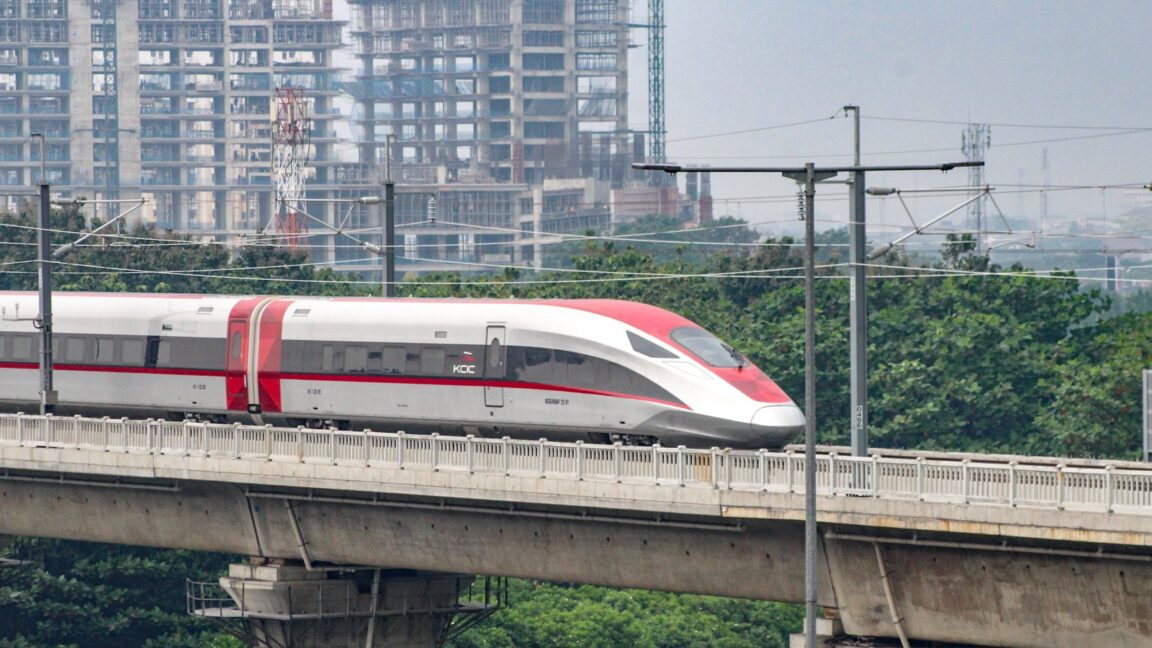
Whoosh is Southeast Asia’s first high-speed railway. Trains run from Halim station in East Jakarta, not from Gambir or Pasar Senen in the centre, and that single fact causes more missed trains than any other. The four stations are Halim, Karawang, Padalarang and Tegalluar Summarecon. A trainset carries 601 passengers in three classes: First, Business and Premium Economy. KCIC has operated intensive timetables of up to 62 trains a day in recent schedules, although service levels have been temporarily reduced during infrastructure works, so the timetable for your exact date is the only one that counts.
Reaching Halim is part of the journey. The Jabodebek LRT Bekasi line serves Halim with a direct skybridge connection into the high-speed station, which is usually the most predictable route from central Jakarta. By road, allow generous time: East Jakarta traffic can erase the time the train saves. At the Bandung end, the mirror-image trap waits. Tegalluar Summarecon suits the east side of the Bandung area. Most visitors want Padalarang instead, where the free feeder train continues to Cimahi and Bandung station in the centre. The combined Halim to Bandung station journey is about 50 minutes on board plus the transfer, before the time you spend reaching Halim.
If you enjoy comparing new rail openings, our explainer on the European Sleeper Brussels to Prague night train and our guide to Sweden’s Snalltaget Stockholm to Hamburg night train show how differently Europe handles the same station-to-centre problem.
What is the filing sequence for a Whoosh ticket, step by step?
The title of this article promises a sequence, so here it is for the service that exists. Step one: choose your Bandung-end station first, Padalarang for central Bandung or Tegalluar Summarecon for the east side, because it decides your onward journey. Step two: book in the Whoosh app or at ticket.kcic.co.id with the passenger name exactly as it appears on the ID the passenger will carry; Whoosh tickets are named tickets. Step three: pay promptly inside the payment window the booking holds for you, using the bank transfer, QRIS, e-wallet or card options the checkout offers, and keep the booking code. Step four: on the travel day, arrive at Halim well before departure, pass the ticket and ID check, and be through the gate before it closes; high-speed stations run airport-style discipline, not turn-up-and-jump-on discipline. Step five: at Padalarang, follow the feeder signs immediately on arrival, because the KA Feeder is timed to the high-speed train and does not wait for stragglers.
Two arrival-day checks protect the whole trip. Check the operating timetable again on the morning of travel, because reduced-service periods have changed first and last train times at short notice in the past. Then check your onward plan from the arrival station before you board, not after: a 45-minute train followed by an unplanned hour in a taxi queue is still a slow journey. Travellers entering Indonesia for this trip should also read our guide to the Indonesia All-Indonesia Arrival Card, which replaced three separate arrival forms with one.
What will the Surabaya extension cost, and who pays?
No official extension budget has been published, and travellers should treat any precise figure with caution. Secondary reporting has floated preliminary estimates in the US$25 billion to US$30 billion range depending on route and financing model, but those are estimates attached to a study, not an approved budget. The firmer facts are structural: the existing line’s debt is being restructured, the government has ruled out simply loading the extension onto the state budget, KCIC says it cannot carry the cost alone, and ministers have pitched the project to private investors. A traveller does not need to resolve Indonesian infrastructure finance, but should understand why the study phase is long: the argument is not about whether Java needs the line, it is about who carries three decades of cost.
Frequently Asked Questions
Can I book a Whoosh train from Jakarta to Surabaya now?
No. The extension is at study stage with no construction contract, timetable or fares. Any Jakarta to Surabaya journey today uses conventional KAI trains, a flight, or a combination of Whoosh to Bandung plus onward conventional rail.
How long would Jakarta to Surabaya take by high-speed rail if built?
The KCIC study options target about 180 to 193 minutes depending on alignment, against roughly 8 to 10 hours by conventional train. These are study targets, not scheduled times.
Which Whoosh station is best for central Bandung?
Padalarang. The free KA Feeder runs from Padalarang to Cimahi and Bandung station in about 18 minutes and is timed to meet Whoosh trains. Tegalluar Summarecon suits destinations on the east side of Bandung.
How much is a Whoosh ticket today?
Premium Economy is dynamically priced; KCIC published a Rp150,000 to Rp250,000 band when dynamic pricing launched and higher holiday starting prices since. Business was fixed at Rp450,000 and First at Rp600,000 in the January 2025 notice. The booking screen price for your train is the real price.
Where does Whoosh leave from in Jakarta?
Halim station in East Jakarta, connected by skybridge to the Jabodebek LRT Halim station. It does not leave from Gambir. Build the trip to Halim into your timing.
When will the Surabaya extension open?
No opening date has been announced. Reporting through late 2025 and early 2026 describes committee formation, regulation drafting and financing debate, not construction. Treat any specific year quoted without an official source as speculation.
Facts checked 16 November 2026 against KCIC service information as reported in current operator guides, Indonesian government statements carried in national reporting, and the KCIC route study figures summarised in the Jakarta to Surabaya high-speed railway project record. Fares and timetables change; confirm both in the Whoosh app before travel.