 Thandiwe Nkosi
There are no tickets at Ostrog, and that is the first thing to get right. Entry to Montenegro’s great cliff monastery is free for everyone, pilgrim and tourist alike, and always has been; what decides whether your visit works is not a booking window but the order you do things in, the clothes you arrive in, and the hour you reach the cliff. Do the lower monastery first, then climb to the upper monastery and its cave churches while the morning is still quiet, dress with shoulders and knees covered, and be finished well before the seasonal closing time, 5pm in summer and 4pm in the October to April season. Follow that flow and Ostrog is a calm, moving half day. Ignore it, by arriving at noon in shorts in August, and the same monastery becomes a queue, a refusal at the door, and a long drive home.
Quick Facts
- Where: Ostrog Monastery, carved into the Ostroska Greda cliff above the Bjelopavlici plain, Danilovgrad municipality, Montenegro; 50 km from Podgorica and 15 km from Niksic
- Tickets: none. Entry is free; donations and candle purchases are voluntary
- Hours: open daily; visitor guidance puts closing at 5pm from May to September and 4pm from October to April, and the monastery publishes no official English timetable, so treat the final hour as a buffer, not a target
- Dress code: shoulders and knees covered for everyone, enforced at the upper monastery; women are advised to wear a skirt and carry a headscarf
- The flow: lower monastery (Church of the Holy Trinity, 1824) first, then the climb to the upper monastery for the Church of the Presentation and the relics of Saint Basil, then the Church of the Holy Cross above it
- Photography: welcome outside; not permitted inside the cave churches
- Time needed: 1.5 to 2 hours on site, 3 hours or more when the relic queue builds in season
- Busiest day of the year: 12 May, the feast of Saint Basil, when pilgrims arrive in their tens of thousands
What is Ostrog, and why do a million people a year climb to it?
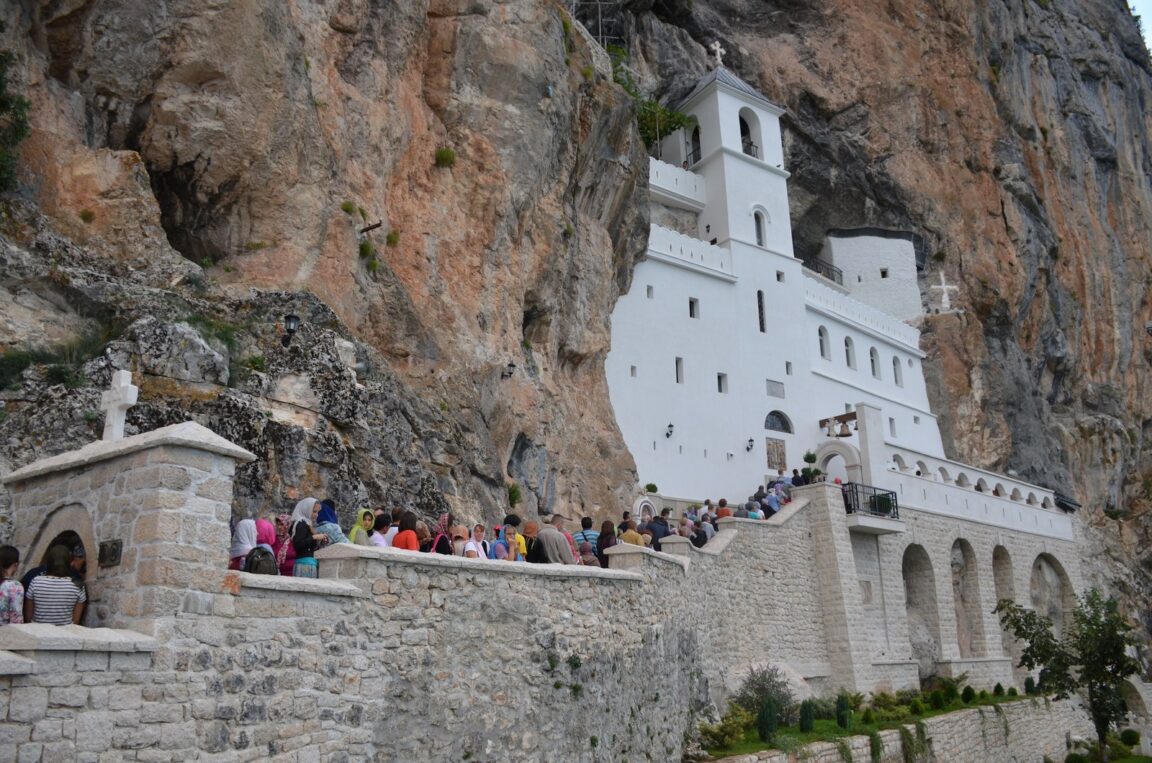
Ostrog is a Serbian Orthodox monastery built into a near vertical cliff roughly 900 metres above the Zeta valley floor, founded in the 17th century by Vasilije Jovanovic, Saint Basil of Ostrog, a bishop who came here looking for a place of prayer about as far from the world as Montenegro offers. The upper monastery was raised inside two large natural caves from 1665 onward, and its white facade does not sit on the rock so much as grow out of it. The present day appearance dates from a reconstruction in 1923 to 1926, after a fire destroyed much of the complex but spared the cave churches. Saint Basil died here in 1671, his relics rest in the Church of the Presentation, and the belief among the faithful that prayer at those relics heals and helps is what turned a hermitage into the most visited pilgrimage place in Montenegro. Published estimates put annual visitors at around a million or more, drawn from Orthodox, Catholic and Muslim communities alike, which is why this guide treats Ostrog as a working shrine you are permitted to visit, not a monument that happens to have monks in it.
What is the right order: lower monastery, then upper?
The complex has two halves, and the order matters. Start at the lower monastery, the group of buildings around the Church of the Holy Trinity, built in 1824, where the monks’ residences and the main parking sit. This is where you slow down: step into the Holy Trinity church, light a candle if you wish, and sort your clothing out here, not at the top, because the dress code is checked where it counts, at the upper monastery door. Many pilgrims then walk up. The pilgrim path climbs about 3 kilometres through forest from the lower monastery to the upper, passing the small Church of Saint Stanko the Martyr, which holds relics of a boy killed in the Ottoman period, and some pilgrims make the climb barefoot as an act of devotion. Driving the serpentine road up is the alternative, and there is parking near the upper monastery, but the road is narrow and in season the walk is honestly the calmer option.
At the top, the flow is set by the building itself. You join the line, which on feast days and summer weekends can stretch down the terrace, and move through the tiny Church of the Presentation, where Saint Basil spent his last 15 years and where his relics now rest. It is a cave room, low and dark, and the visit is brief by design: you venerate or simply stand a moment, receive a blessing if you wish, and move on. Above it, reached by steps cut into the cliff, is the second cave church, dedicated to the Holy Cross, its frescoes painted directly onto the cave rock at the end of the 17th century. Then take the terrace properly: the view over the Bjelopavlici plain is the monastery’s gift to people who came for the landscape rather than the shrine, and on the path you will pass the rock mosaic of Saint Isaija of Onogost beside the cave where tradition says he prayed. Work down the same way you came, and give the lower monastery a last few minutes rather than sprinting for the car.
When should you go, and how do the hours actually work?
Go in the morning, on a weekday if you can, and go early in the season or late in it rather than in the August peak. The monastery opens early, around 6am in the summer pattern, and the first hours are when the relic queue is shortest and the light on the white facade is at its best. Closing is the number to plan around: visitor guidance consistently puts it at 5pm from May to September and 4pm from October to April. Be honest with yourself about what that means for a November visit like the ones this guide is written for: the day is short, the cliff road is in shadow early, and a 2pm arrival leaves you rushing the one place in Montenegro that least rewards rushing. Aim to be at the lower monastery by 10am at the latest, earlier in summer. And avoid 12 May unless the feast itself is your reason for coming; it is the spiritual summit of the Ostrog year, and tens of thousands of pilgrims, many of whom have walked through the night and slept on mats in the courtyard, will be sharing the cliff with you.
What should you wear, and what are the rules inside?
Dress before you arrive. The rule is simple and enforced: shoulders and knees covered, for men and women both. For men that means long trousers and a shirt with sleeves. For women it means a skirt or trousers past the knee and covered shoulders, and a headscarf carried for inside the churches; many women wear one, and having it in your pocket removes the only awkward conversation of the day. Reports differ on whether wraps are available to borrow at the entrance, so do not build your visit on a loaner. Inside the cave churches: no photography, phones away, voices down, and follow the line’s pace rather than trying to linger. Outside, photography is unrestricted, and the classic shot of the facade set into the full height of the cliff is best taken from the lower monastery grounds or the approach road, where the whole improbable structure fits in one frame. Candles can be bought and lit at both levels, donations are welcomed but never demanded, and there is no shop pressure of any kind; the monastery shop by the upper church sells candles, icons and small religious items for those who want them.
How do you get to Ostrog, and what pairs with it?
By car, the sensible route runs through Danilovgrad on the Podgorica to Niksic road, then up the signed mountain road to the lower monastery; the older, narrower approach from the main highway is the one to leave to local drivers. Allow about an hour from Podgorica and about 40 minutes from Niksic, then add patience for the final climb. By train, Ostrog has its own small station on the Podgorica to Niksic line, roughly 45 minutes from the capital, but the station sits in the valley and the monastery is a steep hike of several kilometres above it, so rail suits walkers, not anyone on a tight clock. There is no bus to the monastery door.
The pairing the intent of most trips points to is Niksic, Montenegro’s second city, 15 kilometres away. Do Ostrog in the morning, then descend to Niksic for lunch and the afternoon: the town gives you the King’s Palace, the old town ramparts and a proper urban contrast to the cliff, and it sleeps visitors who would rather base outside the capital. Podgorica is the other workable base, an hour away, and travellers touring the whole country often slot Ostrog between the mountains and the coast; our Kotor travel guide covers the bay end of that route, and our Perast guide covers the quiet town to pair with it once you come down to the sea.
Frequently Asked Questions
Do you need tickets for Ostrog Monastery?
No. There are no tickets and no entrance fee; entry is free to all visitors. Donations are voluntary, and candles can be bought cheaply at the monastery if you wish to light one.
What are Ostrog Monastery’s opening hours?
The monastery is open every day. Visitor guidance puts closing at 5pm from May to September and 4pm from October to April, with early morning opening year round. The monastery publishes no official English timetable, so arrive in the morning and treat the last hour before closing as a buffer.
What is the dress code at Ostrog?
Shoulders and knees covered for everyone, and it is enforced at the upper monastery. Men should wear long trousers; women should wear a skirt or trousers below the knee and carry a headscarf for inside the churches. Dress before you arrive rather than relying on borrowing a wrap.
Can non-Orthodox visitors enter Ostrog?
Yes. Ostrog receives pilgrims and visitors of all faiths and none, and is a place of pilgrimage for Orthodox, Catholic and Muslim visitors alike. The only conditions are the dress code, quiet behaviour and no photography inside the cave churches.
How long does a visit to Ostrog take?
Allow 1.5 to 2 hours on site: 15 to 20 minutes at the lower monastery, the climb or drive up, the queue and visit at the upper monastery, and the return. In peak season or on feast days the relic queue can stretch the visit to 3 hours.
When is Ostrog at its busiest?
12 May, the feast of Saint Basil, is the busiest day of the year, followed by summer weekends. Weekday mornings, Tuesday to Friday, are the quietest times to come.
Featured image: The Upper Monastery of Ostrog set into the Ostroska Greda cliff, with pilgrims on the terrace. Photo: Ostrog Monastery, official monastery website, manastirostrog.com, used with credit.