 Maya Chen
The Milford Track is walked one way, over four days and three nights, in a fixed hut order, and in the Great Walks season there is no flexibility about any of it. For the 2026 to 2027 season, which runs from 1 November 2026 to 30 April 2027, you boat to Glade Wharf on Lake Te Anau, sleep at Clinton Hut, then Mintaro Hut, then Dumpling Hut, cross Omanui / McKinnon Pass on day three, and finish with a boat from Sandfly Point into Milford Sound / Piopiotahi. Bookings for the season opened on 13 May 2026, camping is not permitted at any point, and Fiordland weather, not the timetable, is the variable that decides how hard each day feels.
Quick Facts
- Distance and direction: 53.5 kilometres one way, from Glade Wharf to Sandfly Point, walked over 4 days and 3 nights in that direction only.
- 2026 to 2027 Great Walks season: 1 November 2026 to 30 April 2027, with the last permitted departure on 28 April 2027.
- Hut order: Clinton Hut on night one, Mintaro Hut on night two and Dumpling Hut on night three, each with 40 bunks, booked for consecutive nights.
- Hut fees in season: NZ$106 per night for a New Zealand adult and NZ$152 per night for an international adult.
- Booking release: Bookings opened at 9.30 am on Wednesday 13 May 2026 through the Department of Conservation booking system, with no waiting list.
- Camping: Not permitted on the Milford Track. There is no campsite alternative to the three huts.
- Highest point: Omanui / McKinnon Pass Shelter at 1,154 metres, crossed on day three.
Why the Milford Track is managed differently from every other Great Walk
Most Great Walks allow some choice. You can often walk in either direction, choose campsites instead of huts, or reshape the days to suit your fitness. The Milford Track allows none of that in season, and the reason is geography. The track threads two deep glacial valleys, the Clinton Valley on the Te Anau side and the Arthur Valley on the Milford side, joined by a single alpine pass. There is no road access to either end. Every independent walker arrives by boat at Glade Wharf and leaves by boat from Sandfly Point, and the Department of Conservation (DOC) controls numbers by controlling the bunks. The full official description is at DOC’s Milford Track description, and the track’s main page is doc.govt.nz/milfordtrack. Our broader explainer on how the Great Walks booking system works puts the Milford rules in the context of the other tracks.
That fixed structure is also the track’s protection. With a set number of walkers starting each day, all moving in the same direction and all sleeping in the same hut each night, the valleys never absorb more people than the huts, the track surface and the boat schedules can handle. It feels regimented on paper. On the ground it feels spacious, because you largely walk with the same small cohort, at walking pace, through country with no other access.
The booking release: the day the season is decided
Bookings for the 2026 to 2027 season opened at 9.30 am New Zealand time on Wednesday 13 May 2026. That single morning is when most of the season is claimed. DOC uses its online booking system, and for popular Great Walks the system operates a virtual lobby and queue at peak release times. There is no lottery and no waiting list. A place is either booked and paid for, or it is not held at all.
The booking task is more specific than booking three random hut nights. You must secure the same party, on consecutive nights, in the correct order: Clinton first, Mintaro second, Dumpling third, starting on a day when a boat can deliver you to Glade Wharf. A gap in the sequence is not a workable itinerary, because you cannot skip a hut, double back against the flow, or camp between huts. Before release morning, the preparation that matters is unglamorous: a working DOC booking account, traveller names and details ready, residency status clear because New Zealand and international walkers pay different fees, a payment card that will not fail at the final step, and a short list of alternative start dates ranked in advance. If your first date disappears while you are deciding, you need to already know your second choice.
Cancellations do return individual dates to the system through the season, and checking the booking site regularly is the only legitimate way to find them. DOC does not run a waiting list, and a booking without a valid confirmation for every night is not a partial ticket. Arriving in season without a valid booking can result in a penalty, or in being turned away if the hut is full.
What the huts cost in 2026 to 2027
In the Great Walks season a Milford Track hut night costs NZ$106 for a New Zealand adult and NZ$152 for an international adult. Across the three compulsory nights that is NZ$318 for a New Zealand adult and NZ$456 for an international adult, before boats, bus transfers, food and gear. Outside the Great Walks season the track sits in a different and much more serious category, discussed below, with a lower hut fee but far higher demands on experience and equipment. Children and youth rates are listed separately in the DOC booking system and should be checked for your exact party at the time of booking. DOC also notes that the track is not recommended for children under 10.
The four days, hut by hut
Day one: Glade Wharf to Clinton Hut, 5 kilometres
The walk starts with water. Boats run from Te Anau Downs to Glade Wharf at the head of Lake Te Anau, and the first day’s walking is deliberately short: 5 kilometres, in about 1 to 1.5 hours, on an easy track through beech forest beside the Clinton River to Clinton Hut. The short day is not wasted time. It absorbs boat schedules, weather delays and the simple logistics of getting a full cohort of walkers, packs and food into the valley. Use the afternoon to organise gear, dry anything that got wet in transit, and sleep early. The track gets longer from here.
Day two: Clinton Hut to Mintaro Hut, 17.5 kilometres
Day two is the long valley day: 17.5 kilometres, in about 6 hours, following the Clinton River gradually uphill to its source at Lake Mintaro, at the base of Omanui / McKinnon Pass. The valley narrows as you climb, the river stays close, and side waterfalls appear in number after rain, which in Fiordland means on many days of the year. This is the day that rewards a steady, unhurried pace and dry socks in reserve. Mintaro Hut sits positioned for the pass crossing, and the evening hut talk, usually led or informed by the DOC ranger in residence during the season, is where you get the most current picture of pass conditions for the morning.
Day three: Mintaro Hut to Dumpling Hut over the pass, 13 kilometres
The shortest distance is the biggest day. Day three covers 13 kilometres in about 6 to 7 hours, climbing more than 500 metres to Omanui / McKinnon Pass Shelter at 1,154 metres, the highest point of the track, then descending about 1,000 metres into the Arthur Valley to Dumpling Hut. The descent is long, stepped in places, and hard on knees, particularly when wet. The pass is exposed alpine country. In clear weather it delivers the defining views of the walk, across the Clinton Valley behind you and into the Arthur Valley ahead. In poor weather it is cold, windy and serious, and it is the section where layers, gloves, food and a conservative turnaround mindset matter most. An optional side trip to Sutherland Falls, among the tallest waterfalls in New Zealand, sits on the Dumpling Hut side of the pass for walkers with time, energy and daylight in hand.
Day four: Dumpling Hut to Sandfly Point, 18 kilometres
The final day is 18 kilometres, in about 5.5 to 6 hours, following the Arthur River and Lake Ada to Sandfly Point. The track passes historic rock cuttings built by hand and, on its last stretch, a wide, smooth section constructed by a prison labour gang between 1890 and 1892. The finish is timed by boats. A short boat ride from Sandfly Point carries walkers to Milford Sound / Piopiotahi, and missing the boat timing turns a well walked track into a long wait in famous sandfly country. The point’s name is honest. Insect repellent and a head net earn their pack space on this day above all others.
Fiordland weather reality: rain is not an interruption, it is the climate
New walkers often plan the Milford Track as if rain were a risk. In Fiordland, rain is the baseline. Milford Sound is one of the wettest inhabited places on earth, and the track valleys funnel weather systems directly across the route. DOC states plainly that the Milford Track is not an all weather track. Both the Clinton and Arthur Valleys can become impassable due to flooding during heavy rain, track closures are possible, and avalanche danger can persist into December in early season. Rivers rise fast, side creeks that were ankle deep in the morning can block a track by afternoon, and DOC and hut rangers manage holds and closures around those conditions. A delayed day is not a failed trip. It is the system working as designed.
Pack for that reality rather than for the brochure photograph. A genuinely waterproof jacket and overtrousers, not water resistant shells. A pack liner and separate dry bags for sleeping clothes and hut clothes, so something dry always survives. Footwear you have already worn in, chosen for grip and drainage rather than for keeping water out, because in sustained Fiordland rain your feet will get wet and the job becomes managing that comfortably. Warm layers for the pass in every month of the season. Hut shoes, a head torch, and enough food to cover a weather hold day. In season the huts provide bunks, mattresses, heating, toilets, basic cooking facilities, solar powered lighting and cold running water, with untreated tap water that DOC advises boiling before use. You carry all food, cooking gear beyond the basic facilities, a sleeping bag and all personal equipment. There are no shops, no resupply and no campsite fallback anywhere on the route.
Outside the season: a different track with the same name
From May to October the Milford Track leaves the Great Walks season, and DOC’s warnings change tone completely. Bridges across some major watercourses are removed to avoid avalanche damage, hazards such as flooding and avalanches are not managed in the same way, the pass route can be unmarked and covered in deep snow, and there is no monitoring of weather forecasts and river levels outside the season. DOC describes the track in that period as one that should only be attempted by fit, experienced and well equipped people. It is not a quiet season shortcut around the booking release, and it should never be sold or planned as one. International visitors combining the track with a wider New Zealand trip should also sort entry paperwork early, using our guide to New Zealand’s NZeTA and visitor levy.
Frequently asked questions
When did bookings open for the 2026 to 2027 Milford Track season?
Bookings opened at 9.30 am on Wednesday 13 May 2026 through the DOC online booking system. The Great Walks season itself runs from 1 November 2026 to 30 April 2027, with the last permitted departure on 28 April 2027.
Can I camp on the Milford Track instead of booking huts?
No. Camping is not permitted on the Milford Track. In the Great Walks season every walker must book Clinton, Mintaro and Dumpling Huts for three consecutive nights, in that order.
How much do Milford Track huts cost per night?
In the 2026 to 2027 Great Walks season, NZ$106 per night for a New Zealand adult and NZ$152 per night for an international adult. That totals NZ$318 or NZ$456 respectively across the three compulsory nights, before transport.
Can I walk the Milford Track in the opposite direction?
No. The track can only be walked in one direction, from Glade Wharf to Sandfly Point, over three nights and four days.
What happens if Fiordland weather closes the track mid walk?
DOC can hold or close sections when valleys flood or conditions become unsafe, and hut rangers manage walkers through those decisions in season. Carry spare food, follow ranger instructions, and treat a weather hold as part of the track’s normal operation.
How do I reach the start and finish of the track?
By boat at both ends. Walkers boat from Te Anau Downs to Glade Wharf to start, and from Sandfly Point to Milford Sound / Piopiotahi to finish. There is no private vehicle access to either point, so transport must be booked alongside the huts.
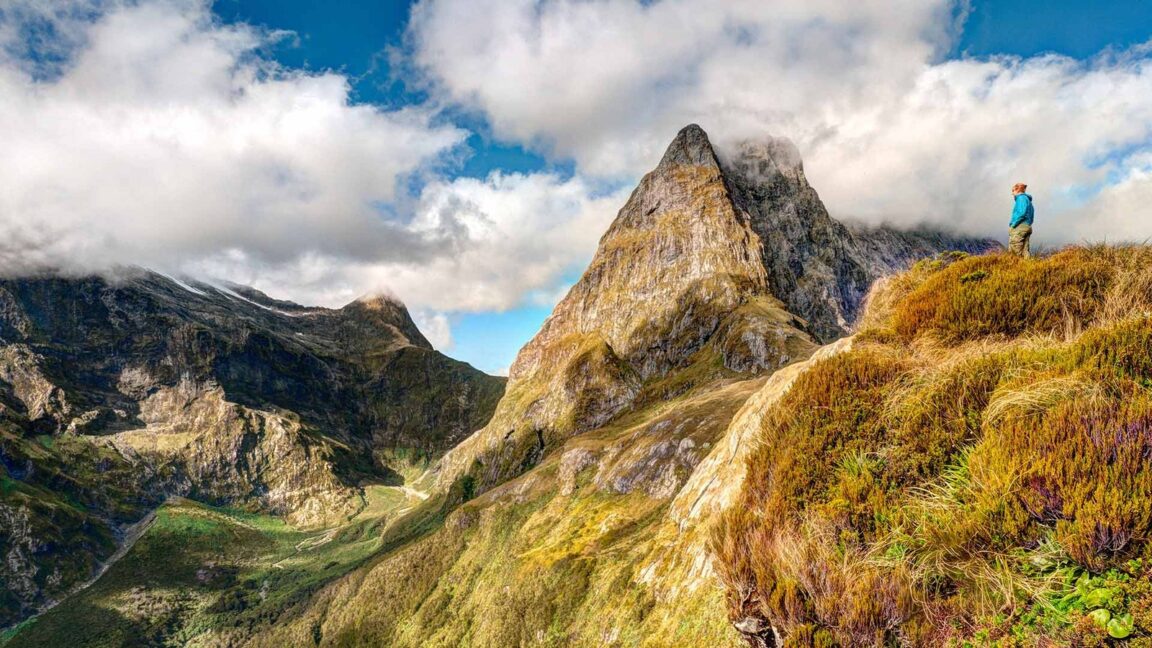
Photo credit: A walker above the Arthur Valley on the Milford Track, Fiordland National Park, New Zealand. Photo by John Strother, via the Department of Conservation (doc.govt.nz), Milford Track official page.