 Maya Chen
Freedom camping in New Zealand is still legal, but since 7 June 2026 it runs on one simple test: if you want to camp on council land in a vehicle, that vehicle must be certified self-contained under the new green warrant system, with a fixed toilet, and the warrant card must be on display. The old blue warrants no longer count, portable toilets no longer qualify, and the infringement fee for getting it wrong is NZ$400, with NZ$800 for damaging an area or dumping waste. Everything else in this guide, from dump stations to council bylaws, builds on that single rule.
Quick Facts
- Green warrant only: From 7 June 2026, only a green warrant counts as self-containment certification for freedom camping. Blue warrants are no longer recognised.
- Fixed toilet required: Certification now requires a toilet permanently fixed to the vehicle and usable inside it. A portable toilet does not qualify.
- Who runs certification: The Plumbers, Gasfitters and Drainlayers Board (PGDB) regulates the system, and certificates last up to four years.
- Certification levy: A government levy of NZ$120 including GST is paid to the certification authority, plus its separate inspection fee.
- Key fines: NZ$400 for camping in breach of a bylaw or in a vehicle that is not self-contained where required, NZ$200 for failing to display the warrant card, and NZ$800 for damaging an area or depositing waste.
- Where the rules come from: The Freedom Camping Act 2011 sets the national framework, and councils, the Department of Conservation (DOC) and Land Information New Zealand (LINZ) each manage their own land.
The law in plain English: permitted by default, restricted by bylaw
The starting point is the Freedom Camping Act 2011. Under the Act, freedom camping means camping on public land that is not a recognised campground or holiday park, within 200 metres of an area accessible by motor vehicle, within 200 metres of the mean low-water springs line, or on or within 200 metres of a formed road or a Great Walks Track. The New Zealand Government overview at govt.nz on freedom camping sets out that definition and the land-by-land rules that follow from it.
In practice, three different land managers matter on any road trip. Local councils control most roadside areas, reserves and car parks in and around towns. DOC controls public conservation land, which includes many of the most scenic stops in the country. LINZ manages Crown land in parts of the South Island. A spot that is legal under national law can still be prohibited or restricted by the council bylaw for that district, by a DOC notice for that piece of conservation land, or by signage on the ground. That is why two similar looking laybys an hour apart can have completely different rules, and why checking the specific place, not just the national rule, is the habit that keeps a trip fine free.
The certified self-contained badge: green is the only colour that counts
The biggest change in a generation of New Zealand campervan travel arrived with the Self-contained Motor Vehicles Legislation Act 2023. It replaced the old, loosely policed blue sticker system with a regulated green warrant system overseen by the PGDB. A transition period ran from December 2023, and for privately owned vehicles it ended on 7 June 2026. From that date, as the government freedom camping page confirms, blue stickers are no longer valid and a green warrant is the only proof of self-containment that counts for freedom camping.
So what does the green badge actually certify? A certified self-contained vehicle must be able to meet the toilet, fresh water, waste water and rubbish needs of its occupants without outside facilities. Under the current regulations the headline requirements include a toilet that is permanently fixed to the vehicle and usable within it, fresh water storage, a sealed waste water system with a trapped sink drain, ventilation, and a rubbish bin with a lid. The fixed toilet is the change that catches people out. Under the old standard a portable toilet tucked in a cupboard could pass. Under the green standard it cannot, and DOC guidance is explicit that a portable toilet does not qualify.
Certification is not a sticker you buy online. An approved Certification Authority inspects the vehicle, the government levy of NZ$120 including GST is paid, and the authority charges its own inspection fee on top. A certificate lasts up to four years unless the vehicle is materially modified or the certification is revoked. There is a national register of certified self-contained vehicles, so a buyer, a renter or an enforcement officer can check a registration plate against the record. When you freedom camp somewhere that requires a self-contained vehicle, the green warrant card must be displayed in the vehicle. Failing to display it is itself an offence, at NZ$200.
Renting: the questions to ask before you pay
For visitors, the practical risk sits at the rental desk. A van marketed as self-contained on an old listing may carry only an expired blue warrant, which stopped counting on 7 June 2026. Before paying, ask the company to confirm in writing that the specific vehicle you will collect holds a current green warrant, that its toilet is fixed rather than portable, and that the warrant card will be in the vehicle. Check the plate against the national register when you collect it. If a company cannot answer those questions clearly, the safe assumption is that the van is a campground only vehicle, and your itinerary should be built around DOC campsites and holiday parks instead of freedom camping sites. Travellers planning the wider trip paperwork as well should read our guide to New Zealand’s visitor levy and NZeTA, which covers what to arrange before flying.
Where you can and cannot freedom camp
On council land, the post 2023 position is the strictest. Freedom camping in a motor vehicle on local authority land is for certified self-contained vehicles only, unless the council bylaw has specifically set aside a site where vehicles that are not self-contained may stay. Councils can also prohibit freedom camping outright in named areas, or restrict it with conditions such as maximum stays, arrival and departure times, or a set number of vehicles. Urban streets, town centre car parks and popular beachfronts are the places most likely to be prohibited entirely, even for certified vehicles.
On DOC land the starting point is more permissive. Freedom camping is generally allowed on public conservation land where it has not been prohibited or restricted, but there are important exceptions, including areas around DOC campsites, scenic and recreation reserves where camping is not provided for, and any place covered by a DOC restriction notice. On LINZ land in the South Island, freedom camping is permitted in many places, again subject to local restrictions and signage. In all three cases the sign at the entrance is part of the rule, not a suggestion. Photograph it when you arrive, follow its stay limit, and leave before the stated time.
Tents sit in a different position from vehicles. The self-containment rules are about motor vehicles, but councils can and do prohibit tent camping in public places, and DOC rules for conservation land still apply. Never assume that a site open to certified campervans is open to tents, or the reverse.
Dump stations: the unglamorous system that makes it all work
A self-contained van is only self-contained if its tanks are emptied in the right place. Toilet waste and grey water must go into a designated dump station, never into a stormwater drain, a roadside ditch, a river or a standard public toilet unless that facility is explicitly designed for it. Dump stations are found at most holiday parks, at many service stations and at council facilities in towns across both islands, and the camping apps used widely in New Zealand map them along with freshwater taps and public toilets.
Build dump stops into the driving day rather than treating them as an emergency task. A sensible rhythm is to empty and refill every two to three days, sooner in hot weather or with a full van, and always before a stretch through remote country where the next facility may be hours away. Keep the hose and gloves accessible rather than buried under luggage, rinse the area after use, and leave the station cleaner than strict necessity requires. The NZ$800 infringement fee for depositing waste in or on an area while freedom camping, with a maximum court fine of NZ$2,400, reflects how seriously this is treated, and rental companies routinely pass fines and cleaning costs on to the hirer.
The fines, stated exactly
The penalty schedule sits in the Freedom Camping (Penalties for Infringement Offences) Regulations 2023, published at legislation.govt.nz, and summarised in the Ministry of Business, Innovation and Employment infringement table. The amounts most relevant to campervan travellers are these. Camping in breach of a prohibition or restriction in a council bylaw costs NZ$400, with a maximum court fine of NZ$1,200. Freedom camping in a vehicle that is not self-contained, where self-containment is required, is also NZ$400. Failing to display a warrant card where required is NZ$200, with a court maximum of NZ$600. Interfering with or damaging an area, its flora or fauna or any structure, or depositing waste while freedom camping, is NZ$800, with a court maximum of NZ$2,400. Failing or refusing to leave when an enforcement officer requires it is NZ$600. An infringement fee is the on the spot amount. The court maximum only applies if the matter goes to court, but neither figure is theoretical. Councils in high pressure districts patrol popular sites early in the morning, when overstays and uncertified vehicles are easiest to identify.
A nightly routine that keeps you legal
Experienced New Zealand van travellers treat each overnight stop as a small checklist rather than a guess. First, identify whose land it is and read the sign or the council or DOC listing for that exact site. Second, confirm your vehicle qualifies, which after June 2026 means a displayed green warrant for almost every vehicle based freedom camping site. Third, note the stay limit and departure time, and set an alarm if the limit is measured in hours. Fourth, park fully inside the marked or customary area, keep accessways clear, and keep noise and light low after dark. Fifth, take all rubbish with you if there is no bin, and never empty any tank anywhere except a dump station. Finally, if a site is full, ambiguous or feels contested by local residents, move on to a DOC campsite or holiday park. The paid night is always cheaper than a fine, and New Zealand has a deep network of low cost DOC campsites for exactly this situation. Walkers combining a van trip with a Great Walk should also see our explainer on how the Great Walks booking system works, because hut bookings and van nights need to be planned together.
Respecting the place: Tiaki and common sense
The legal rules are the floor, not the ceiling. New Zealand tourism promotes the Tiaki Promise, a commitment to care for land, water, wildlife and communities while travelling. In van terms that means staying on formed surfaces so grass and gravel areas are not churned up, keeping well clear of waterways when parking, never feeding wildlife, and supporting the small towns whose facilities make freedom camping possible by buying fuel, food and the occasional paid campsite night locally. It also means accepting that freedom camping is a privilege that councils can narrow if behaviour worsens. Every traveller who camps carefully is, in a small way, keeping the system open for the next one.
Frequently asked questions
Can I freedom camp in New Zealand with a blue self-contained sticker in late 2026?
No. The transition ended on 7 June 2026 and blue warrants are no longer recognised as self-containment certification. From that date only a green warrant counts, as confirmed on the New Zealand Government freedom camping page.
Does a portable toilet make my campervan self-contained?
No. Under the green warrant standard the toilet must be permanently fixed to the vehicle and usable inside it. A portable toilet does not qualify, so a van with only a portable toilet cannot be certified under the current rules.
How much is the fine for freedom camping in a vehicle that is not self-contained?
The infringement fee is NZ$400 where self-containment is required, with a maximum court fine of NZ$1,200. Failing to display the warrant card is NZ$200, and damaging an area or depositing waste is NZ$800.
Where do I empty a campervan toilet and grey water in New Zealand?
Only at a designated dump station. They are located at most holiday parks, many service stations and council facilities in towns, and camping apps map them nationwide. Never use a stormwater drain, waterway or roadside area.
Can a council ban freedom camping even for certified self-contained vehicles?
Yes. Councils can prohibit freedom camping in named areas or restrict it by bylaw, and DOC and LINZ can restrict or prohibit it on land they manage. Always check the rules and signage for the specific site, not just the national framework.
How long does self-containment certification last?
A green warrant certificate lasts up to four years, unless the vehicle is materially modified in a way that affects its self-containment systems or the certification is revoked earlier.
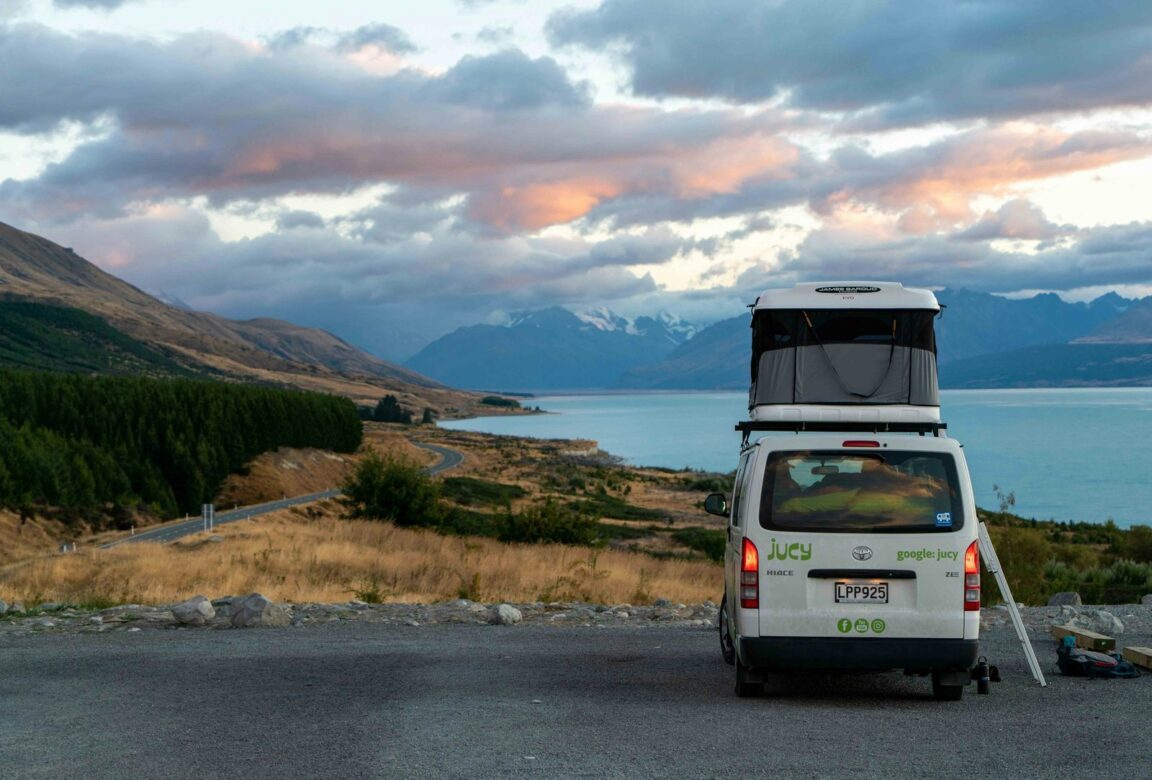
Photo credit: A Jucy rental campervan with a rooftop tent overlooking Lake Pukaki and Aoraki / Mount Cook, New Zealand. Photo by Sean Gatz on Unsplash, Unsplash License.