 Priya Nair
You reach car-free Zermatt in three moves: ride a mainline train to Visp or Brig, change onto the narrow-gauge Matterhorn Gotthard Bahn for the climb up the Matter valley, and, if you are driving, leave the car at Tasch and take the 12-minute shuttle train over the final five kilometres. No private car completes the journey, and that single rule explains every part of the system, from the 2,100-space terminal at Tasch to the electric taxis waiting outside Zermatt station.
Quick Facts
- Car rule: Zermatt is car-free. Private vehicles stop at Tasch, 5 kilometres down the valley
- Tasch shuttle: Every 20 minutes from 05:55 to 21:55, then less frequently late into the night; journey time 12 minutes, run by the Matterhorn Gotthard Bahn
- Parking: Matterhorn Terminal Tasch, a covered terminal of about 2,100 spaces beside Tasch station
- Valley line: Visp to Zermatt takes about an hour, with trains at half-hourly intervals through the day and connections from Brig
- Glacier Express: Zermatt to St. Moritz, about 8 hours and 291 kilometres, seat reservation compulsory on top of the ticket; it does not run during its autumn break, which covers November
- Last step in the village: Hotel electric shuttles, electric taxis from the station rank, or a short walk
- Official sources: Zermatt Tourism and the Glacier Express
Why does every Zermatt journey end with a train?
Zermatt has kept combustion-engine vehicles out of the village for generations, and the road up the Mattertal is closed to public traffic beyond Tasch. Driving it without authorisation brings a fine, and there is no drop-off exception for hotel guests, luggage or bad weather. The railway is therefore not one option among several. It is the arrival system, designed around the change: the terminal at Tasch puts the car park and the shuttle platforms under one roof, luggage trolleys roll from the parking decks straight onto the shuttle trains, and Zermatt station delivers you into the centre of the village, a short walk from most hotels.
Once you accept the rule, the planning gets simple. You are choosing between three rail approaches: the full mainline-and-valley-train journey from a Swiss city or airport, the drive to Tasch plus shuttle, or the Glacier Express as a scenic arrival in its own right. Each is covered below, with the luggage answer attached, because in Zermatt the bags are the part travellers get wrong. If you are building a wider Swiss rail trip around the arrival, our comparison in Swiss Travel Pass or Half Fare Card settles which pass covers these legs best.
Approach one: mainline train to Visp or Brig, then the valley line
From Zurich, Geneva, Bern or the Italian side via the Simplon route, ride the mainline to Visp or Brig and change onto the Matterhorn Gotthard Bahn. The valley trains run at half-hourly intervals through the day and take about an hour from Visp to Zermatt, climbing through Stalden, St. Niklaus and Randa before Tasch and the final run into Zermatt. The change itself is a same-station platform transfer, and Swiss connections are timed for it, but the honest advice is to protect the connection anyway: take an earlier mainline train if you are arriving on a flight, keep an hour of slack before any hotel check-in deadline, and check the live timetable on the day, because mountain weather occasionally interrupts the valley line and replacement buses take longer.
This approach carries your luggage best. You load once at your origin station, change once with a trolley or a wheeled case on flat platforms, and unload at Zermatt station. Travellers with very heavy bags can also use Swiss rail luggage services to send bags ahead to Zermatt, which turns the change at Visp into a walk between platforms with hand luggage only. For most visitors, this is the lowest-stress arrival and the one to default to.
Approach two: drive to Tasch and ride the shuttle
Drivers coming through the Rhone valley leave the main road at Tasch, five kilometres short of Zermatt. The Matterhorn Terminal Tasch is a covered parking terminal of about 2,100 spaces built directly at Tasch station, with luggage trolleys on the decks. Park, load the trolley beside the car, and roll it onto the shuttle. There are also smaller private car parks around Tasch, some of which bundle parking with a licensed taxi transfer up the closed road.
The shuttle itself is the simplest train in Switzerland. Matterhorn Gotthard Bahn shuttle trains run every 20 minutes from 05:55 to 21:55, then at wider intervals late into the night, with additional night services at weekends, and the ride takes 12 minutes. You do not need to reserve a shuttle seat. Buy the shuttle ticket at the terminal or hold a pass that covers it, board with the trolley, and ride to Zermatt station. The mistakes to avoid are arriving after the frequent service ends and assuming a late-night hourly gap will not matter with tired children and ski bags, and leaving anything you need for the first evening in the car. Whatever goes to Zermatt goes on that 12-minute train with you.
Approach three: the Glacier Express as the arrival itself
The Glacier Express is the famous way in: a panoramic train linking Zermatt with St. Moritz across 291 kilometres of Alpine railway, crossing 291 bridges and passing through 91 tunnels in a journey of about eight hours. It is run jointly by the Matterhorn Gotthard Bahn and the Rhaetian Railway, and it starts and ends at Zermatt station, so it can genuinely serve as your arrival or departure rather than a detour. Two separate purchases are required: a ticket for the route, or a rail pass that covers it, and a compulsory seat reservation, which costs CHF 54 per person in first and second class on top of the fare. Reservations open 93 days before travel, and window seats in peak weeks go early.
One timing fact catches people out every year, and it matters for late-autumn trips. The Glacier Express does not run year-round. It takes an autumn break between its summer and winter seasons, which means there is no Glacier Express service in November, including on the date this guide was checked, 18 November 2026. The winter season resumes in early December. The regular valley trains between Zermatt, Tasch, Visp and Brig run through the break, so Zermatt itself is fully reachable. Only the scenic through-train is paused. Always confirm your exact date on the official Glacier Express site before building an itinerary around it, and consider the ordinary trains over the same valley section if the Express is not running: the Zermatt to Brig leg shares the Mattertal scenery that makes the route famous.
Luggage logistics: station to hotel door in a village without cars
Zermatt station sits at the top of the Bahnhofstrasse, and the village is compact enough that many hotels are a genuine short walk. For everyone else, the system has three layers. First, many hotels send an electric shuttle or a porter with a trolley to meet arriving trains, so tell your hotel your arrival time and use it. Second, small electric taxis wait at the station rank and run to addresses across the village, which is the practical answer for chalets in the Winkelmatten and Steinmatte quarters with heavy bags. Third, inside the village you move on foot, by electric bus on its local routes, or by the same hotel shuttles for the return to the station.
Pack for the handoffs, not just the destination. One wheeled case you can pull for ten minutes beats two bags you have to carry, ski and boot bags should have wheels or a trolley plan at Tasch, and anything fragile should ride in the cabin with you rather than in a sent-ahead bag. In winter, add ten minutes to every transfer estimate. Snow makes the village prettier and every trolley slower. Travellers using Zermatt as a base for the wider Bernese Oberland will find the base-planning warnings in our Interlaken mistakes guide a useful companion, because the same change-at-the-junction discipline applies there.
Your first hour in Zermatt, in order
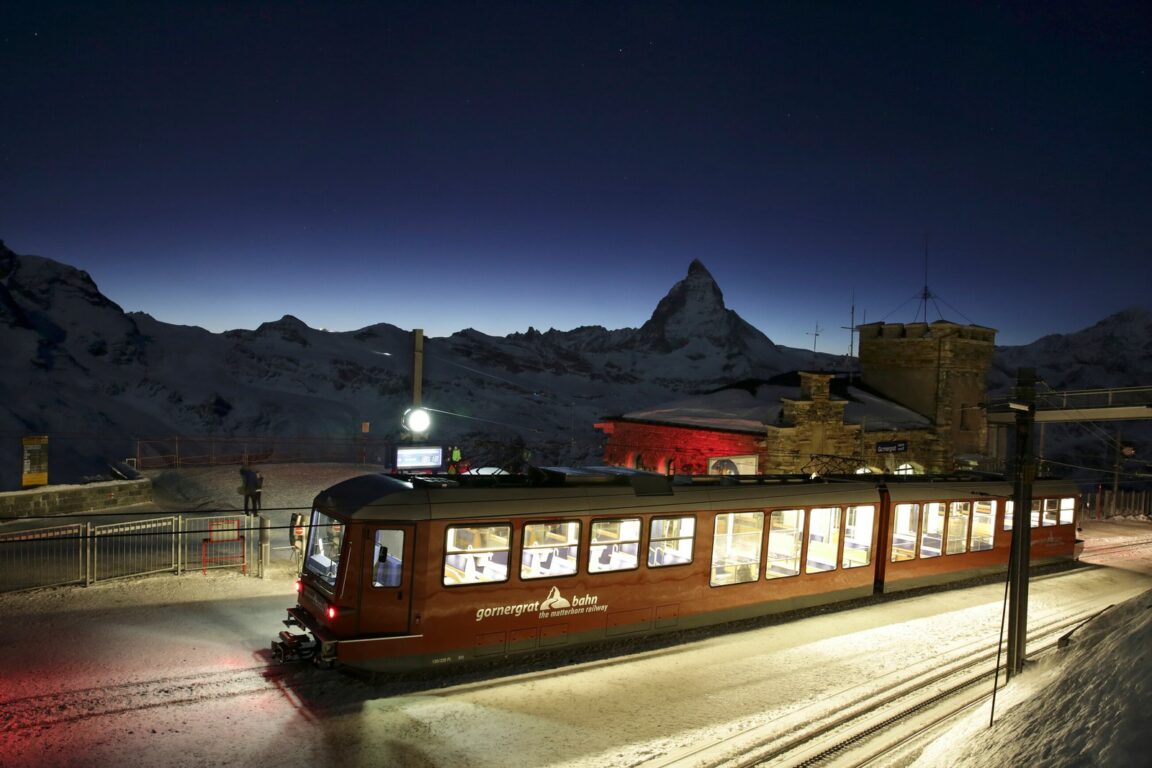
Arrive at the station and orient by the Matterhorn end of the valley before you move. Collect the hotel shuttle or an electric taxi at the rank if you have booked or need one. Check in, then walk the Bahnhofstrasse once without bags to learn the village layout, the Gornergrat station opposite the main station for mountain days, and the bus stops you will actually use. If you arrived via Tasch, keep the return shuttle times photographed on your phone. Departure day runs backwards through the same system, and the 12-minute shuttle plus the terminal walk sets the earliest sensible start for any drive away from the valley.
Frequently asked questions
Can you drive into Zermatt at all?
No. Zermatt is car-free and the road beyond Tasch is closed to public traffic. Drivers park at Tasch, five kilometres away, and ride the shuttle train. Only authorised vehicles, including licensed taxis, may use the final road section.
How often does the Tasch to Zermatt shuttle run?
Every 20 minutes from 05:55 to 21:55, then at wider intervals late into the night, with extra night services at weekends. The journey takes 12 minutes and no seat reservation is needed.
How long does the train from Visp to Zermatt take?
About an hour, with trains at half-hourly intervals through the day. Visp and Brig are the mainline change points for services from across Switzerland and from Italy via the Simplon route.
Does the Glacier Express run in November?
No. The Glacier Express pauses between its summer and winter seasons, and November falls inside that autumn break. In 2026 the winter season resumes in early December. Regular trains between Zermatt, Visp and Brig run all year.
What does the Glacier Express reservation cost?
The compulsory seat reservation is CHF 54 per person in first and second class, paid on top of a ticket or a covering rail pass. Reservations open 93 days before travel on the official Glacier Express site.
How do you get luggage from Zermatt station to your hotel?
Most hotels will meet your train with an electric shuttle or porter if you share your arrival time. Electric taxis wait at the station rank, and the village is small enough that many addresses are a short walk with a wheeled case.
Timetables, parking and reservation details checked 18 November 2026 against Zermatt Tourism, the Matterhorn Gotthard Bahn shuttle timetable and the official Glacier Express site. Mountain railways change with weather and season, so recheck your travel date before you set out.