 Aiko Tanaka
Singapore’s Jurong Region Line is not open yet, and it will not open all at once. The Land Transport Authority (LTA) plans a staged opening in the west of the island, with Stage 1 in 2028 linking Choa Chu Kang to Boon Lay and Tawas, Stage 2 also in 2028 running from Tengah to Pandan Reservoir through Jurong East, and Stage 3 in 2029 extending the line into Nanyang Technological University and on to Jurong Pier. For travellers, that sequence matters more than the headline date, because the trips the line transforms, to Tuas, to the Jurong industrial and innovation districts and to NTU, only become possible stage by stage.
Quick Facts
- Line: Jurong Region Line (JRL), Singapore’s seventh MRT line, fully elevated
- Length and stations: 24 kilometres and 25 stations, including one later in-fill station
- Stage 1, 2028: 10 stations, JS1 to JS8 excluding JS2A plus JW1 to JW2, Choa Chu Kang to Boon Lay and Tawas
- Stage 2, 2028: 7 stations, JE1 to JE7, Tengah to Pandan Reservoir via Jurong East
- Stage 3, 2029: 7 stations, JS9 to JS12 plus JW3 to JW5, to Jurong Pier and into NTU
- Interchanges: Choa Chu Kang, Boon Lay and Jurong East
- Trains: 62 fully automated, driverless three-car trains, expandable to four cars
- Source checked 18 November 2026: Land Transport Authority, Jurong Region Line project page
What Is the Jurong Region Line, in Plain Terms?
The JRL is a medium-capacity, fully elevated MRT line built for the west, an area that has long depended on the East-West Line and on buses for longer trips. The LTA’s Jurong Region Line project page describes it as Singapore’s seventh MRT line, serving existing and future development in the western part of Singapore and supporting Jurong as the largest commercial hub outside the Central Business District. Construction works are currently underway, according to the same page, and the expected project completion is 2029.
The geography explains the need. The line reaches north to Choa Chu Kang, south to Jurong Pier, west to Peng Kang Hill and east to Pandan Reservoir, with branches that reflect how the west actually works. One axis serves housing towns and the new town of Tengah. Another serves Jurong West and Boon Lay. The east branch cuts through Jurong East. The west branch in its final stage serves NTU. The LTA says the line will put more than 60,000 additional households in Jurong within a 10-minute walk of a train station, a figure that gives a sense of how many homes currently sit beyond easy rail access.
For a visitor, the west can feel distant in a way the map does not suggest. Jurong Lake, the Chinese and Japanese Gardens area, science and industrial visits, and NTU are all straightforward destinations, but reaching them has usually meant a long East-West Line ride to Jurong East or Boon Lay and then a bus. The JRL does not shorten Singapore. It rewires the last part of those trips, and that is where most of the time and uncertainty currently sit. Travellers planning a short stay can see how the existing network already handles the centre and east in 2 Days in Singapore: Hawkers, Gardens and Where to Stay on a Short Stop, which is a useful baseline for what the JRL will add later.
When Does Each Stage Open, Exactly?
The honest answer is in stages, and the LTA page checked for this article on 18 November 2026 lists them by year rather than by a single launch date. Stage 1 is listed for 2028, Stage 2 is also listed for 2028, and Stage 3 is listed for 2029. No month is given on that page for any stage, so no month should be assumed. A further in-fill station, JS2A, is listed for the mid-2030s, to serve future demand in Tengah when surrounding developments are ready.
Stage 1, 2028: Choa Chu Kang to Boon Lay and Tawas
Stage 1 covers 10 stations, JS1 to JS8 excluding JS2A, plus JW1 to JW2 on the west branch as far as Tawas. In practical terms, that first opening connects Choa Chu Kang in the north, through Tengah and Jurong West, to Boon Lay, with a short branch to Gek Poh and Tawas. The interchanges in this stage are Choa Chu Kang, with the North-South Line and the Bukit Panjang LRT, and Boon Lay, with the East-West Line. For travellers, Stage 1 already changes trips to Jurong West and towards Tuas, because Tawas is the JRL station closest to the Tuas industrial area, even though the final NTU and Jurong Pier sections are still to come.
Stage 2, 2028: Tengah to Pandan Reservoir via Jurong East
Stage 2 covers 7 stations, JE1 to JE7, on what the LTA calls the JRL (East). It runs from Tengah Plantation through Tengah Park, Bukit Batok West, Toh Guan and Jurong East to Jurong Town Hall and Pandan Reservoir. Its single interchange is Jurong East, with both the North-South Line and the East-West Line. This is the stage that matters most for network resilience, because it gives the west a second major interchange pattern instead of forcing almost every transfer through one station.
Stage 3, 2029: Into NTU and Towards Jurong Pier
Stage 3 covers 7 stations, JS9 to JS12 plus JW3 to JW5. It extends the main line from Boon Lay through Enterprise and Tukang to Jurong Hill and Jurong Pier, and it extends the west branch from Tawas through Nanyang Gateway and Nanyang Crescent to Peng Kang Hill, which is the section that brings NTU directly onto the MRT network. Only when Stage 3 opens does the full promise in the LTA description, direct rail access to NTU and to the Jurong Industrial Estate without a bus leg, become complete.
Why Does the Jurong East Interchange Matter So Much?
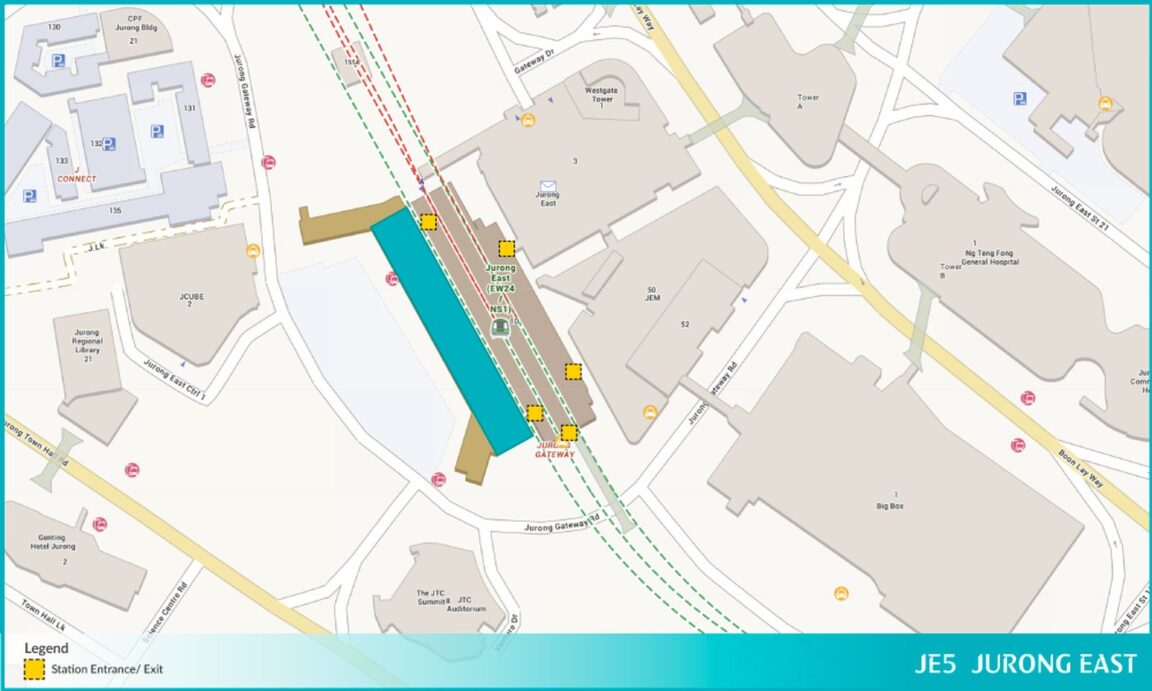
Jurong East is already one of the busiest interchanges in Singapore, where the North-South and East-West Lines meet. Adding the JRL as a third line at Jurong East, as JE5 in Stage 2, spreads load in two ways. First, passengers from Tengah, Bukit Batok West and Toh Guan gain a direct ride into Jurong East without a bus. Second, passengers travelling within the west no longer need to ride east to Jurong East and back west again for local trips that the JRL can handle directly. The LTA makes the same point in network terms, saying the new line will offer alternative travel options and help redistribute commuter load across the rail network, enhancing the resilience of the rail system.
For travellers, the practical effect is simpler. A stay near Jurong East, already useful for the science centre, Jurong Lake Gardens and west-side business parks, becomes a genuine three-line base from Stage 2. Trips that currently require careful bus timing become a walk to a station. Conversely, travellers who do not need the west should not over-plan around the JRL before it opens. Until Stage 2 is running, Jurong East remains a two-line interchange, and current journey planners remain the right tool.
What Changes for Tuas and NTU Trips?
Tuas and NTU are the two destinations most often cited for the JRL, and they arrive at different stages, which is easy to miss. Access towards Tuas improves first, in Stage 1, with the branch to Tawas. That does not mean a station at every Tuas workplace, and the LTA does not claim that. It means the railhead for the Tuas area moves much closer, shortening the bus or shuttle leg that follows. Travellers heading to Tuas for industry visits should still check the final leg from Tawas for their specific address, even after Stage 1 opens.
NTU arrives last, in Stage 3 in 2029, with Nanyang Gateway and Nanyang Crescent stations on the campus side and Peng Kang Hill as the terminus. The LTA lists NTU among the key activity nodes the line connects, alongside the Jurong Industrial Estate and the Jurong Innovation District, and notes that these are areas not currently served by an MRT line. For prospective students, conference visitors and families visiting campus, that final stage removes the long bus ride from Boon Lay that currently defines an NTU trip. Until 2029, that bus leg remains part of the journey, and any guide that suggests otherwise is getting ahead of the LTA timetable.
What Will the Trains and Stations Be Like?
The LTA says there will be 62 fully automated, driverless three-car trains, which can be expanded to four cars as commuter demand increases. The carriages are smaller and customised so trains can navigate tight curves and built-up areas along the JRL track, a design response to threading an elevated line through established housing and industrial estates. Carriages will have wider doors and spaces for wheelchair users and strollers, and improved condition monitoring and diagnostic systems that monitor train health and detect rail defects and faults.
The line will be operated, under an LTA award announced in November 2024, by a joint venture between SBS Transit Rail and RATP Dev Asia Pacific. The LTA’s operations award release says the first licensing period is nine years, with an option to extend for a further two years, and describes the JRL in that release as a fully elevated line spanning 24 kilometres. Travellers do not need to act on operator details, but the award is a useful sign of maturity. A line with an appointed operator, ordered trains and stations under construction is a project in delivery, not a proposal.
Engineering is part of the story, too. The LTA notes viaduct launching across the Pan Island Expressway and Ayer Rajah Expressway, viaduct construction over the existing North-South and East-West Lines during engineering hours, and construction in dense residential and industrial estates. That complexity is context for the staged dates. An elevated line woven through a living district cannot be switched on in one weekend, and staging lets completed sections carry passengers while the hardest southern and university sections finish.
How Should Travellers Plan Around a Line That Is Not Open Yet?
Plan for the Singapore that exists on the date of travel, and treat the JRL as a future improvement, not a current option. For trips before 2028, use Jurong East and Boon Lay on the East-West Line as the railheads for the west, and allow time for the bus leg to NTU, Tuas and Jurong Pier. For trips in 2028, check which stages the LTA confirms as open before relying on Tawas or on the Jurong East JRL platforms. For trips from 2029, the full pattern, Choa Chu Kang to Jurong Pier and Tengah to Pandan Reservoir with the NTU branch, should be checked again against the LTA page close to travel, because staged infrastructure dates can move.
There is also a wider regional point. Singapore rewards travellers who treat it as a base rather than a stopover, and the west is a large part of that case, from Jurong Lake to industrial heritage and university architecture. Travellers combining Singapore with Malaysia can pair this planning with 3 Days in Kuala Lumpur: Towers, Hawker Streets and a Batu Caves Morning for a two-city trip that uses rail well at both ends. The JRL will make the Singapore end of that pairing noticeably easier, once its stages are actually running.
Frequently Asked Questions
Is the Jurong Region Line open now?
No. Construction is underway and the LTA lists Stage 1 and Stage 2 for 2028 and Stage 3 for 2029. There is no JRL passenger service yet.
How many stations will the Jurong Region Line have?
The LTA lists 25 stations over 24 kilometres, including the JS2A in-fill station planned for the mid-2030s. The three main stages total 24 stations.
Which existing stations will become JRL interchanges?
Choa Chu Kang with the North-South Line and Bukit Panjang LRT, Boon Lay with the East-West Line, and Jurong East with the North-South and East-West Lines.
When will NTU get a station?
In Stage 3, listed for 2029, with Nanyang Gateway and Nanyang Crescent stations and a terminus at Peng Kang Hill.
Will the JRL help trips to Tuas?
Yes, from Stage 1 in 2028, when the branch to Tawas opens. Travellers will still need to check the final bus or shuttle leg from Tawas to a specific Tuas address.
Featured image: Jurong East JRL station design from the Land Transport Authority. Source: LTA, Jurong Region Line project media. Facts checked against LTA primary sources on 18 November 2026.