 Thandiwe Nkosi
Tharros rewards the visitor who reads it as a sequence, not a single ruin: a Nuragic village, a Phoenician settlement, a Punic city, a Roman town and an early Christian site stacked on one narrow promontory at Capo San Marco, with the sea on both sides. Done properly, the visit pairs the open air archaeological area with the Giovanni Marongiu Civic Museum in Cabras, where the finds make sense of the stones, and it starts early, because the site is fully exposed to sun and the Mistral wind. In winter the archaeological area keeps shorter hours, 9 am to 5 pm from November to March with last entry at 4.15 pm and Monday closing, so a late start quietly ruins the day.
Quick Facts
- Where: San Giovanni di Sinis, municipality of Cabras, Sinis peninsula, western Sardinia, on SP6
- Founded: Phoenician settlement from the 8th century BC on an earlier Nuragic site; abandoned in the 11th century AD
- Tharros ticket: Full price 10 euros (ages 18 to 64); reduced 7 euros; school and under 17 ticket 5 euros; Cabras residents free (official Sinis park rates, checked 17 November 2026)
- Combined tickets: Museum plus Tharros 15 euros full price; Tharros plus Spanish tower 11 euros; all three 17 euros
- Winter hours, Tharros: November to March, 9 am to 5 pm, last entry 4.15 pm, closed Mondays; June to August, 9 am to 8 pm, last entry 7.15 pm
- Museum: Giovanni Marongiu Civic Museum, Via Tharros, Cabras; full price 12 euros on the same official rate card; holds the Tharros finds and the Mont’e Prama material
- Time needed: 2 to 3 hours on site, plus 1 to 2 hours for the Cabras museum
- Exposure: No meaningful shade on the promontory; water, hat and closed shoes are essential kit
What are you actually looking at when you arrive?
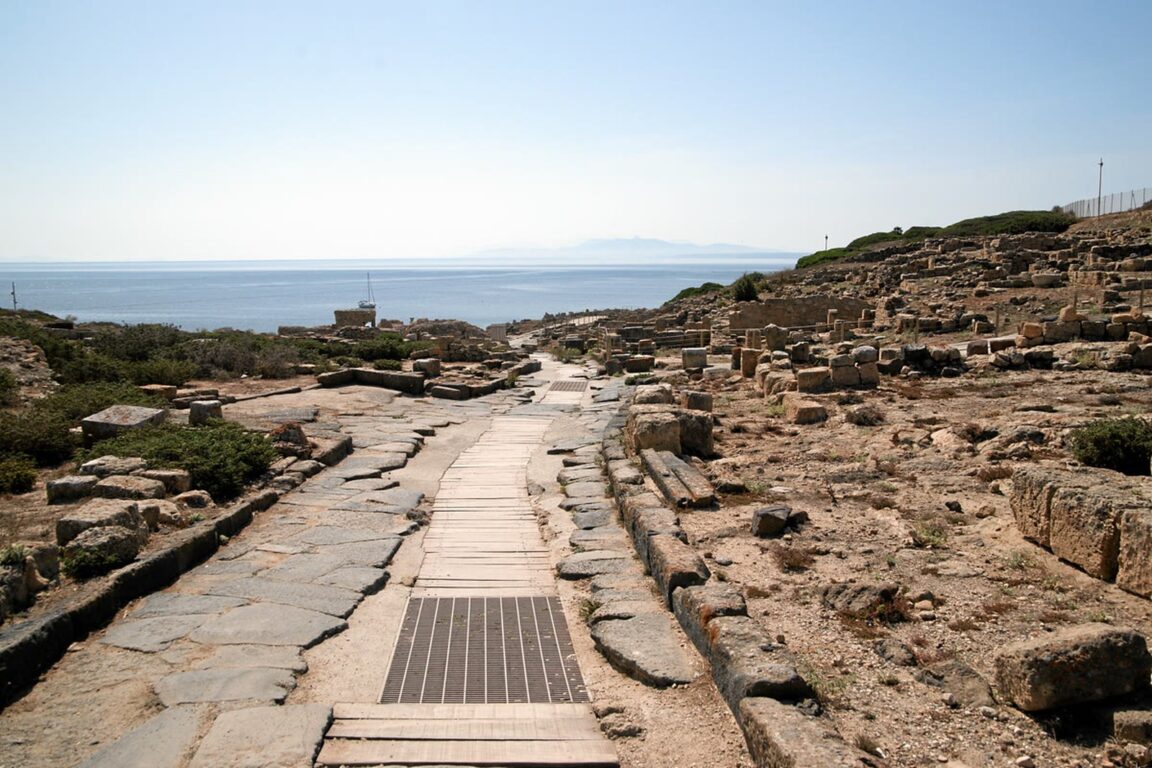
The city occupied the southern end of the Sinis peninsula for close to two thousand years, and the layering is the point. On the hill of Su Murru Mannu stood a Nuragic village, later covered by the tophet, the Phoenician and Punic sanctuary cemetery for infants that is among the most studied in the western Mediterranean. Below it, the Punic city built walls, cisterns and the rock cut temple with half columns whose base still reads clearly on the ground. Rome then replanned the centre with paved streets, drains, bath buildings and houses, and it is mostly the Roman street grid, including the paved road running down toward the sea in the featured photograph, that organises a modern walk.
The two re-erected Corinthian columns near the shore are the postcard, but they belong to just one phase of one building, and treating them as the site undersells everything around them. Walk the full circuit instead: the tophet and Nuragic remains on the hill, the Punic fortifications, the temple terraces, the Roman baths and housing quarters, the early Christian baptistery area, and the Spanish watchtower of San Giovanni above the site, which explains the coast’s later, defensive centuries. The little church of San Giovanni di Sinis nearby, one of Sardinia’s oldest, is free to enter on the same official programme and takes ten worthwhile minutes.
How do tickets and timing work in practice?
Buy at the site or through the official Sinis park channels, and decide about the combined ticket before you pay, because the combinations are where the value sits. On the official rate card checked for this guide, Tharros alone is 10 euros full price, the Spanish tower alone is 4 euros, and the three site combination of museum, Tharros and tower is 17 euros against 26 euros bought separately. Cabras residents enter free, as do children under 6 and several professional categories listed by the managing body.
Season changes everything about the clock. From June to August the archaeological area runs 9 am to 8 pm; in April, May and October it closes earlier; and from November to March it runs 9 am to 5 pm, closes on Mondays, and stops entry at 4.15 pm. The Cabras museum keeps its own pattern, 10 am to 6 pm in the November to December period on the same official page, also closed Mondays in winter. A winter plan that works: Tharros at 9 am in the best light and the calmest wind, lunch in San Giovanni di Sinis or Cabras, then the museum in the afternoon. A summer plan inverts nothing but adds a swim, because the beaches at San Giovanni di Sinis sit minutes from the gate.
For comparison with Sicily’s great Greek sites, see our Segesta archaeological park guide, and for a Roman villa day done with the same rigour, our Hadrian’s Villa, Tivoli guide.
Why does the Cabras museum change the visit?
Because Tharros was excavated, and frankly plundered, in the 19th century, a large share of its objects left the promontory. The Giovanni Marongiu museum in Cabras, a short drive north, is where the story reassembles: Punic and Roman material from the site, the necropolis finds, and the celebrated sculpture from Mont’e Prama, the Nuragic stone giants found near Cabras that rank among the oldest large scale statues in the Mediterranean. Reading the museum labels first, or visiting straight after the site while the street plan is fresh in your mind, turns anonymous blocks on the headland into a city with workshops, burials, trade goods and gods.
The Sinis around the site deserves the leftover hour. The lagoons behind Cabras, including the Stagno di Cabras, hold flamingos and traditional reed boat fishing culture, and the quartz sand beaches of the peninsula, such as Is Arutas, are unlike anything else in Sardinia. None of that needs booking; it needs only the discipline not to spend the whole day inside the fence line.
What should you wear, carry and watch out for?
The promontory is a wind funnel with no shade, so the kit list is short and non negotiable: closed shoes for uneven ancient paving, a hat, sunscreen, and at least a litre of water per person, bought before the gate because options inside are minimal. Photographers should come early or stay late, when low sun separates the street lines and wall courses that vanish at noon. In winter, check the forecast for Mistral days; the managing body notes that entry can be limited in adverse weather, and the exposed headland is the first place in the Sinis where a strong wind makes itself felt.
Frequently Asked Questions
How much does Tharros cost in 2026?
On the official Sinis rate card checked on 17 November 2026, a full price Tharros ticket is 10 euros, with reduced entry at 7 euros and a school and under 17 ticket at 5 euros. The combined museum, Tharros and tower ticket is 17 euros full price.
Is Tharros closed on Mondays?
In the November to March season, yes, the archaeological area and the Cabras museum both close on Mondays, with listed exceptions for specific holiday Mondays on the official programme. In high summer the site opens daily.
How long does a proper Tharros visit take?
Allow 2 to 3 hours for the archaeological area at a reading pace, and add 1 to 2 hours for the Giovanni Marongiu museum in Cabras. Rushing the promontory in 45 minutes misses the tophet, the fortifications and the point of the place.
Where do the finds from Tharros live now?
Mainly in the Giovanni Marongiu Civic Museum in Cabras, with further material in the Antiquarium Arborense in Oristano, the National Archaeological Museum in Cagliari and the British Museum in London, a legacy of 19th century excavation and collecting.
Can you swim after visiting Tharros?
Yes. The site sits above the shore at San Giovanni di Sinis, and the Sinis peninsula beaches, including the quartz sand at Is Arutas, are a short drive away. In summer, pairing a morning site visit with an afternoon swim is the natural shape of the day.
Featured image: The paved Roman street at Tharros running toward the Gulf of Oristano. Photo via tharros.sardegna.it, the site’s official website, CC BY-SA 4.0.