 Camille Baptiste
The W Trek works only if the bookings line up in the right order: secure every trail night first, across two different refugio operators, then buy the park entry ticket, then the catamaran, and only then lock in buses and nights in Puerto Natales. The walk itself covers roughly 70 to 80 kilometres in four to five days, linking the Base Torres viewpoint, the French Valley and Grey Glacier in the W shape that gives the route its name. Either direction works, but the choice changes the whole trip. Walking east to west puts the towers first, while legs are fresh, and ends with the catamaran out from Paine Grande to Pudeto. Walking west to east starts with that same catamaran and saves the towers for last, which is a gamble on one clear morning at the end of a long week. This guide spells out the booking order, the wind plan and the fitness the route actually demands, with prices and rules checked on 18 November 2026.
Quick Facts
- Route: The W Trek in Torres del Paine National Park, Chile, about 70 to 80 km over 4 to 5 days
- The three arms: Base Torres viewpoint, the French Valley (Valle del Frances) and Grey Glacier
- Booking order: Trail nights first, then the park ticket, then the catamaran, then buses and Puerto Natales lodging
- Refugio operators: Las Torres Patagonia runs Central, Chileno, Cuernos and Frances in the east and centre; Vertice Patagonia runs Paine Grande and Grey in the west
- Park entry: Online in advance only, through CONAF on pasesparques.cl, at least 24 hours before entry; foreign adult CLP 32,400 for one day or CLP 48,500 for the multi-day pass in the 2026 table
- Multi-day pass: Since 1 May 2026 the multi-day ticket covers one continuous stay of up to 10 days, which is the ticket W trekkers need
- Catamaran: Pudeto to Paine Grande across Lago Pehoe, about 30 minutes, paid separately from park entry and refugios
- Base town: Puerto Natales, about two hours by bus from the park entrances
- Main season: October to April, with December to February the busiest and hardest to book
- Last updated: Prices and rules checked 18 November 2026
Which direction should you walk the W?
There is no official direction, and rangers accept confirmed bookings either way, so the decision is about energy and risk. East to west is the lower risk plan. You enter at Laguna Amarga, climb to the Base Torres viewpoint early in the trip when your legs and your patience for a pre-dawn start are at their best, then walk west along Lago Nordenskjold below the Cuernos, turn up the French Valley, and finish at Grey Glacier before taking the catamaran from Paine Grande across Lago Pehoe to the road at Pudeto. If the weather closes in on the last day, what you lose is a glacier viewpoint walk, not the towers.
West to east reverses that logic. The catamaran delivers you to Paine Grande on day one, Grey and the French Valley come first, and the towers wait at the end as a finale. Plenty of walkers love finishing on the biggest sight. The honest cost is that the Base Torres climb, the steepest and most exposed part of the W, lands on day four or five, on tired legs, with no spare day left if wind or cloud shuts the viewpoint. If you walk west to east, protect that final morning: keep the last night at Chileno or Central so the climb starts close to the trail, and treat any earlier bad weather day as the buffer, not the tower day.
What is the correct refugio booking order?
Book the nights, not the trip. Every night on the W needs a confirmed refugio or campsite reservation, and there is no single website that sells the whole chain. Las Torres Patagonia sells the eastern and central nights (Central, Chileno, Cuernos and Frances) on its own site, and Vertice Patagonia sells the western nights (Paine Grande and Grey) on a separate site. Work out your night by night itinerary on paper first, with the operator named beside each night, then book both operators in one sitting so the chain of consecutive nights holds. A gap in the middle cannot be fixed on the trail, because wild camping is not permitted and rangers check bookings.
Only once every night is confirmed should you buy the park entry ticket. Since 1 May 2026, CONAF sells two tickets through its Pases Parques portal at pasesparques.cl: a one day ticket and a multi-day ticket covering a continuous stay of up to 10 days. In the 2026 tariff table a foreign adult pays CLP 32,400 for one day and CLP 48,500 for the multi-day pass, and the ticket must be bought online in advance, at least 24 hours before you enter, and shown as a code at the gate. Children under 12 enter free. Confirm the live price at checkout before you pay, because the peso figure, not any conversion, is the one that governs.
Third comes the catamaran across Lago Pehoe between Pudeto and Paine Grande, run separately from the park and the refugios and paid as its own ticket. It is the hinge of the whole route in both directions: west to east walkers start on it, east to west walkers finish on it. Crossings take about 30 minutes and the timetable changes with the season, so check the operator sailing times against your first or last trail day before you fix bus times. Buses from Puerto Natales, gear rental and town lodging come last, because all of them are easier to change than a sold out refugio night in the French Valley corridor. Our guide to what to pack for Patagonia covers the windproof carry-on system this route demands once the bookings are set.
How does the French Valley turnaround work?
The French Valley is the middle arm of the W and the day most likely to be cut by weather. From the Italiano ranger station the trail climbs into the valley to the Frances lookout, and stronger parties continue to the Britanico lookout at the head of the valley, beneath hanging glaciers and a ring of granite walls. It is an out and back, which means every step up the valley is a step you must also walk down before the onward trail to Paine Grande or Cuernos and, for westbound walkers, before the last catamaran sets the real deadline for the day.
Set the turnaround before you start, not at the lookout. A workable rule is to fix a clock time at Italiano, based on your onward distance and the last boat or last light, and to turn at that time wherever you have reached. The Frances lookout alone is a complete day for most walkers; Britanico is a bonus for fast parties in settled weather, not the baseline plan. CONAF and the rangers can close the valley in strong wind, and a closure is not a negotiation. If the valley is shut, walk the through route along the lakes instead and keep the itinerary intact, rather than burning a day waiting for a viewpoint that may not reopen.
What is the honest wind plan?
Wind is not a footnote in Torres del Paine; it is the condition the whole trek is planned around. Summer gusts above 100 km per hour are not unusual on the exposed sections, including the lakeshore walk below the Cuernos and the approach to Grey. Build the plan the Patagonian way: start early, when the wind is usually at its weakest; keep one decision point each day where turning back or taking the lower through route is still easy; and never let a boat time, a bus time and a hard trail section all depend on the same hour.
Pack for the wind you might get, not the forecast you liked. That means a hard shell jacket and overtrousers that stay on in horizontal rain, gloves and a warm hat in midsummer, sunglasses or goggles against blown grit, and trekking poles, which earn their weight purely as stabilisers on the exposed traverses. Keep the park ticket and every refugio confirmation saved offline on your phone, because signal on the road in and along the trail is patchy. If you are extending the trip north afterwards, the desert calm of the Atacama stargazing country is the natural counterpoint to a week of Patagonian weather.
How fit do you actually need to be?
The W is often sold as the moderate option next to the full O Circuit, and that word misleads people. Expect four to five consecutive days of roughly 15 to 20 km, with one genuinely steep climb on the moraine below the towers, rough and stony ground throughout, and weather that can turn an easy lakeshore day into a fight. You do not need technical skills, and refugio meals mean packs can stay light, but you do need recent experience of back to back full hill days and the honesty to say so before booking.
Turn back, or turn down a section, in these conditions: if the Base Torres moraine climb feels unsafe in wind or ice; if the French Valley is closed or the wind is knocking you off line on the traverses; if a knee or a blister is changing how you walk with two or more days still to go; or if you are racing the last catamaran rather than walking to it. None of those calls costs the trip. The towers, the valley and the glacier are three separate arms, and a W with one arm walked conservatively is still the full landscape. What ends trips here is not modesty; it is one ignored warning stacked on a fixed booking chain with no slack in it.
Frequently asked questions
Do I need to book the W Trek in advance?
Yes. Every night requires a confirmed refugio or campsite booking, split between Las Torres Patagonia in the east and centre and Vertice Patagonia in the west, and the park entry ticket must be bought online through CONAF on pasesparques.cl at least 24 hours before entry. Peak season nights, especially from December to February, sell out months ahead.
How much is Torres del Paine park entry in 2026?
In the 2026 CONAF tariff table, a foreign adult pays CLP 32,400 for a one day ticket or CLP 48,500 for the multi-day ticket, which since 1 May 2026 covers one continuous stay of up to 10 days. W trekkers need the multi-day ticket. Always confirm the current figure on pasesparques.cl at checkout.
Is east to west or west to east better on the W Trek?
East to west is the safer default: the Base Torres climb comes first on fresh legs and the trip ends with the catamaran from Paine Grande to Pudeto. West to east saves the towers for a finale but puts the hardest climb on tired legs with no spare day if the weather closes the viewpoint.
How long is the catamaran crossing on Lago Pehoe?
About 30 minutes between Pudeto, on the park road, and Paine Grande, the western trailhead of the W. The ticket is separate from park entry and refugio bookings, sailings are seasonal, and the last boat of the day should shape your French Valley turnaround time.
When is the best time to walk the W Trek?
The main season runs from October to April. November and March balance long daylight with better refugio availability, while December to February brings the longest days and the heaviest demand. Winter is a different undertaking: in June and July 2026 CONAF closed the W and suspended the Lago Pehoe boats entirely.
Can I walk the W Trek without a guide?
In the main season, yes, experienced walkers hike the W independently with confirmed bookings, and the trails are marked and ranger checked. Winter rules are stricter and change year to year, including guided only periods on the mountain trails, so anyone planning a May to September trek should confirm the current CONAF rules before booking anything.
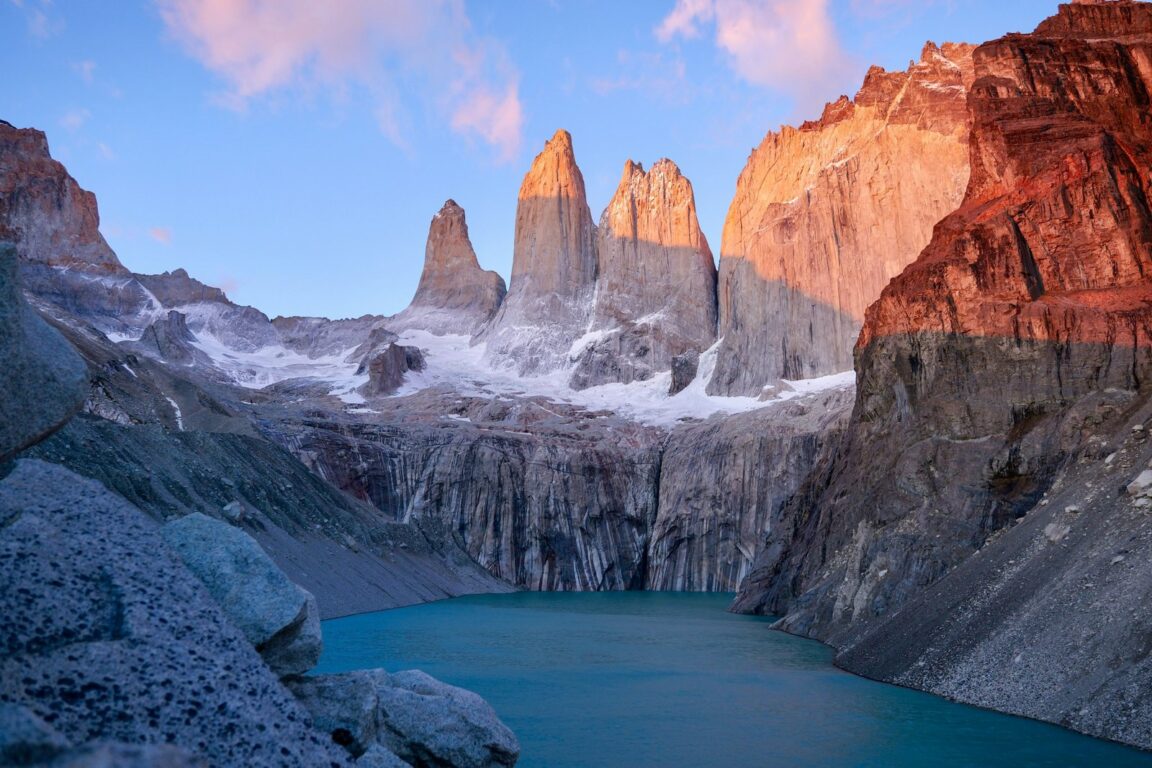
Featured image: The three granite towers of Torres del Paine above their glacial lake at sunrise, on the eastern arm of the W Trek. Photo via Unsplash (photo 1708394534994-4e66c2b09e1f), Unsplash License.