 Hana Kim
Eat in Hue in this order and the city makes sense: bun bo Hue first, at breakfast, when the lemongrass broth is freshest; the steamed imperial cakes, banh beo, banh nam and banh loc, as a shared afternoon set; and Dong Ba Market as the grazing ground that ties the two together, ideally in the morning before the heat builds. Hue was the Nguyen dynasty capital, and its food still runs on court logic, small, precise, highly seasoned dishes served in sets rather than single big plates. Plan your meals that way, book almost nothing except a food tour if you want one, carry small cash notes, and learn two phrases before you sit down: it cay for a little spicy, and khong cay for not spicy, because Hue is the spiciest kitchen in central Vietnam.
Quick Facts
- Signature dish: Bun bo Hue, thick round rice noodles in a beef and pork broth scented with lemongrass and fermented shrimp paste, finished with chilli oil
- The cake set: Banh beo, small steamed rice cakes in ceramic saucers topped with shrimp and crispy pork skin; banh nam, flat rice flour parcels with shrimp and pork steamed in banana leaf; banh loc, chewy translucent tapioca dumplings with shrimp and pork
- Anchor market: Dong Ba Market, on Tran Hung Dao Street on the north bank of the Perfume River near Truong Tien Bridge, busiest in the morning
- Breakfast rule: Locals eat bun bo Hue in the morning, roughly from 6.30 am, when the broth is freshest; many famous bowls sell through by mid morning
- Other essentials: Com hen, baby clam rice from Hen Island; banh khoai, the crisp turmeric crepe; nem lui, lemongrass skewers; and che, the sweet dessert soups Hue serves in many varieties
- Prices: Street and market dishes are inexpensive by any standard; treat any specific price quoted online as indicative, pay the posted or stated price at the stall, and carry small denomination cash
- Michelin note: The Michelin Guide does not cover Hue; its Vietnam selection covers Hanoi, Ho Chi Minh City and Da Nang, so judge Hue food by queues of locals, not stars
- Heat warning: Hue food is built on chilli. Order it cay or khong cay at the moment you order, not after the bowl lands
How should you order bun bo Hue like someone who knows the bowl?
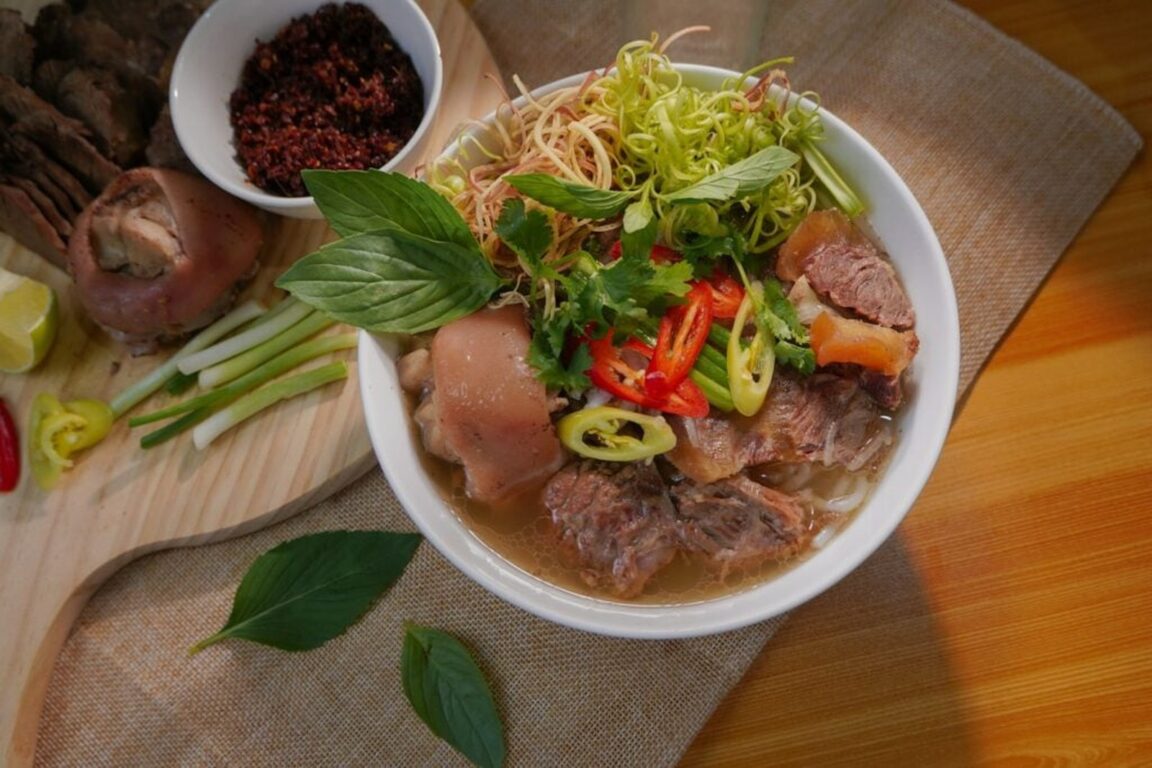
Understand what is in front of you first. Vietnam Tourism describes bun bo Hue as heartier than pho, and the difference is structural: a beef and pork bone broth built on lemongrass, seasoned with mam ruoc, the fermented shrimp paste that gives the bowl its deep, funky base, coloured and heated with chilli oil, and served over round noodles noticeably thicker than pho noodles. A full bowl carries sliced beef shank or brisket, pork knuckle or hock, Hue style pork or crab sausage, and, in traditional servings, cubes of congealed blood. The plate on the side is not decoration: shredded banana blossom, herbs and bean sprouts go in as you eat, with lime and fresh chilli to tune the heat.
Order with intent. If pork knuckle and blood cubes are a step too far at 7 am, say so when ordering; vendors adjust bowls every day for exactly this request. If you want the full traditional build, order the standard bowl and add the side herbs gradually, tasting the broth first, because the lemongrass and shrimp paste balance changes as the bowl cools. Eat it where the morning crowd is: the market area and the streets around the Citadel fill early, and the famous family shops trade on turnover, which is what keeps a broth this rich tasting clean.
Set Hue bowl against the northern style with our guide to what to eat in Hanoi, and sort your paperwork before you fly with our explainer on Vietnam 90 day e-visa, because a food trip this good deserves more than a rushed weekend.
What is the right way to eat the imperial cake set?
Order the trio together, as a set, in the afternoon. Banh beo arrive as a tray of tiny ceramic saucers, each holding a thin steamed rice cake topped with dried shrimp, crispy pork skin and scallion oil, eaten with a spoon and a pour of sweet salty fish sauce. Banh nam come as flat, soft rice flour sheets filled with minced shrimp and pork, steamed inside banana leaf, unwrapped at the table and dipped in fish sauce. Banh loc are the chewy ones, translucent tapioca dumplings with a whole small shrimp and a piece of pork visible through the wrapper. The three textures, soft saucer cake, flat leaf cake, chewy dumpling, are the point: this was court snack food, designed for variety in small amounts, and Hue cooks still serve it that way.
Two practical rules. First, the cakes are an afternoon and early evening food, roughly from mid afternoon, at specialist shops that do little else; they make a light dinner if you add nem lui, the grilled pork skewers moulded around lemongrass stalks, rolled in rice paper with herbs. Second, order a mixed set to share rather than three separate plates per person. The sets are priced as snack food, the dishes are rich, and sharing lets you keep appetite for che afterwards, the sweet soup desserts that Hue makes in more varieties than anywhere else in Vietnam, served hot or over ice in small glasses.
How should you work Dong Ba Market?
Dong Ba is Hue main market, on the north bank of the Perfume River by Truong Tien Bridge, and Vietnam tourism records trace a market on this story back to a predecessor rebuilt under King Dong Khanh in 1887 and moved to the present site under King Thanh Thai in 1899. Go in the morning, and go hungry. The food stalls inside and around the market serve the full Hue repertoire in one building: bun bo Hue for the main event, banh beo and banh nam for the set, com hen for the brave, and che to finish. It is the single best place in the city to taste four or five specialties without crossing town between meals.
Work it in a loop. Walk the produce and dry goods aisles first to see what the city cooks with, shrimp pastes, dried shrimp, sesame candies and the famous Hue chilli jam among the souvenirs, then eat, then shop for edible gifts on the way out, when you know which flavours you actually liked. Prices at Dong Ba run a little above the neighbourhood shops, which is the normal premium for the city central market, and haggling for food is not the custom; eat where the seats are full of locals and the trays are turning over.
Round the day out beyond the market. Cross to Hen Island for com hen, the baby clam rice that is Hue other signature, a room temperature bowl of rice, tiny clams, herbs, peanuts, sesame and chilli with a bowl of clam broth on the side. In the evening, the streets south of the river around the walking streets fill with snack stalls, and banh khoai, the crisp, turmeric tinted crepe folded around shrimp, pork and bean sprouts, is the order there, eaten hot from the pan with its peanut and liver dipping sauce.
What should you book ahead, and what should you leave loose?
Almost nothing in Hue food needs booking, and that is its charm. Market stalls and family cake shops are walk in, cash based and fast. The exceptions: a guided street food tour on your first evening, if you want the geography decoded and the ordering phrases modelled for you, which is worth doing in a city where the best rooms have no English menu; a table at one of the city few formal restaurants if your group is large; and your onward travel, because Hue pairs naturally with Da Nang and Hoi An down the coast, and the best morning bowls are an argument for sleeping in Hue rather than day tripping into it. In the rainy months, roughly October to December, Hue sees heavy rain and occasional flooding, and riverside stalls can close on storm days, so keep one flexible meal slot in the plan and ask your hotel what is open that morning.
Frequently asked questions
What is the difference between bun bo Hue and pho?
Bun bo Hue uses thick round rice noodles in a beef and pork broth flavoured with lemongrass, fermented shrimp paste and chilli oil, with toppings that include pork knuckle and Hue style sausage. Pho uses flat noodles in a clearer, spiced beef or chicken broth without the shrimp paste or the heat. Vietnam Tourism calls the Hue bowl the heartier of the two.
When is the best time to eat bun bo Hue?
At breakfast. Locals eat it in the morning, from around 6.30 am, when the broth is freshest, and well known shops can sell through their best cuts by mid morning.
What are banh beo, banh nam and banh loc?
Hue steamed cake trio, once court snacks. Banh beo are small rice cakes steamed in ceramic saucers with shrimp and pork skin; banh nam are flat rice flour parcels with shrimp and pork steamed in banana leaf; banh loc are chewy, translucent tapioca dumplings with shrimp and pork. They are usually ordered together as a set with fish sauce.
What should you eat at Dong Ba Market?
Start with bun bo Hue, add a banh beo and banh nam set, try com hen if you want the full local range, and finish with che. The market, on Tran Hung Dao Street on the north bank of the Perfume River, is busiest and best in the morning.
Is Hue food very spicy?
Yes, by Vietnamese standards Hue is the spicy capital. Say it cay for a little spicy or khong cay for not spicy when you order; the chilli is much harder to remove than to add.
Does Hue have Michelin starred restaurants?
No. The Michelin Guide Vietnam selection covers Hanoi, Ho Chi Minh City and Da Nang, not Hue. The city best food is in markets, family shops and street stalls, judged by local custom rather than inspectors.
Image: A bowl of bun bo Hue with pork knuckle, sliced beef, banana blossom, herbs and chilli. Photo: Vy Huynh, via Unsplash.