 Priya Nair
Petrified Forest works best as a route, not a stop: a single 28 mile park road runs one way in spirit from the Painted Desert at the north entrance on Interstate 40 to the Rainbow Forest at the south entrance on Highway 180, and driving it north to south in one pass, with no backtracking, is the smartest way to see the park. Enter at I-40 Exit 311 in the morning, walk the rim at the Painted Desert Inn, drop into the blue badlands on the Blue Mesa Trail at the halfway point, and finish among the big logs at Giant Logs and Crystal Forest before exiting toward Holbrook. The park is open 8 am to 5 pm, entry is $25 per vehicle for 7 days, and the whole logic of the day, where to stop, what to skip and how the clock governs everything, follows from that one straight line on the map.
Quick Facts
- Where: Northeastern Arizona, between Interstate 40 (north entrance, Exit 311) and Highway 180 (south entrance, near Holbrook)
- Park road: About 28 miles, paved, one continuous route through the park with overlooks and short trails off it
- Hours: Park open 8 am to 5 pm daily, year round except Thanksgiving and Christmas Day, on Mountain Standard Time all year (National Park Service). Gates lock at closing
- Entrance fee: $25 per private vehicle, $20 per motorcycle, $15 per person on foot or bicycle, each valid 7 days; park annual pass $45; America the Beautiful passes accepted; park is cashless, cards only (National Park Service, checked November 18, 2026)
- North visitor contact: Painted Desert Visitor Center at Exit 311 is closed for construction, expected to reopen June 2027; the Painted Desert Inn, about 2 miles inside, serves as the north visitor center in the meantime (National Park Service alerts)
- Do not miss: Painted Desert overlooks and Inn, Blue Mesa Trail loop, Crystal Forest, Giant Logs Trail behind the Rainbow Forest Museum
- Lodging and camping: None inside the park and no developed campground; nearest beds in Holbrook, about 30 minutes from either entrance; backcountry camping only, by free permit
- Hard rule: Removing petrified wood, or any natural or cultural object, is prohibited and punishable under federal law
Why does the north to south direction matter so much?
Because the park is really two parks spliced by one road, and the order changes what the light does to each half. The northern third is the Painted Desert, red, orange and lavender badlands of the Chinle Formation seen mostly from rim overlooks, and it photographs best in the low, warm light of morning and late afternoon. The southern two thirds hold the petrified wood itself, the log fields of Blue Mesa, Jasper Forest, Crystal Forest and the Rainbow Forest, where the color sits in the stones at your feet and reads well in brighter midday light. Driving north to south puts you on the rim early, walking Blue Mesa around the middle of the day and finishing with the log trails, then exits you at Holbrook in time for dinner, with Interstate 40 looping you back east or west. South to north works too, and locals run it both ways, but it saves the Painted Desert for last light, which gambles the best overlooks against the 5 pm gate closure. The one direction rule that is not negotiable is internal: the Blue Mesa spur road and most overlooks are short loops off the main road, so the route stays linear and nobody needs to double back more than a mile or two all day.
What happens at the north end, the Painted Desert and the Inn?
Exit 311 drops you at the north entrance station, and the first miles deliver the rim: Tiponi, Tawa and Kachina Points, a sequence of overlooks across the Painted Desert badlands, linked by the Painted Desert Rim Trail, an easy mile of walking between Tawa Point and Kachina Point that beats driving overlook to overlook. About 2 miles in stands the Painted Desert Inn, the stop that decides whether this park reads as scenery or as a place. The inn began in the 1920s as a stone and timber roadhouse built by Herbert Lore, was bought by the National Park Service in 1936 and rebuilt by Civilian Conservation Corps crews in 1937 to 1940 in Pueblo Revival style, then operated by the Fred Harvey Company, whose era left the inn its painted glass skylights and the murals by Hopi artist Fred Kabotie. Scheduled for demolition in the 1970s, it was saved by public campaign, listed on the National Register of Historic Places, and designated a National Historic Landmark in 1987. Today it is a museum, not a hotel, and while the Painted Desert Visitor Center is closed for construction the inn is also doing duty as the north visitor center, which makes it the right place to check trail conditions, pick up the park map and ask about the day road status. Walk out to Kachina Point behind the building before you leave; it is the trailhead view into the Painted Desert wilderness and the best single panorama of the northern park.
South of the inn the road crosses Interstate 40 and passes the park other famous line: a preserved stretch of historic Route 66, marked by a 1932 Studebaker on the old roadbed. Petrified Forest is the only national park that protects a section of Route 66 within its boundary, and the two minute stop earns its place on a road trip day. Puerco Pueblo and Newspaper Rock follow, a large ancestral Puebloan village occupied into the late 1300s and a dense petroglyph panel visible through spotting scopes from an overlook, the reminder that this desert was farmed and inhabited for centuries before it was scenery.
Is Blue Mesa really the deciding stop of the drive?
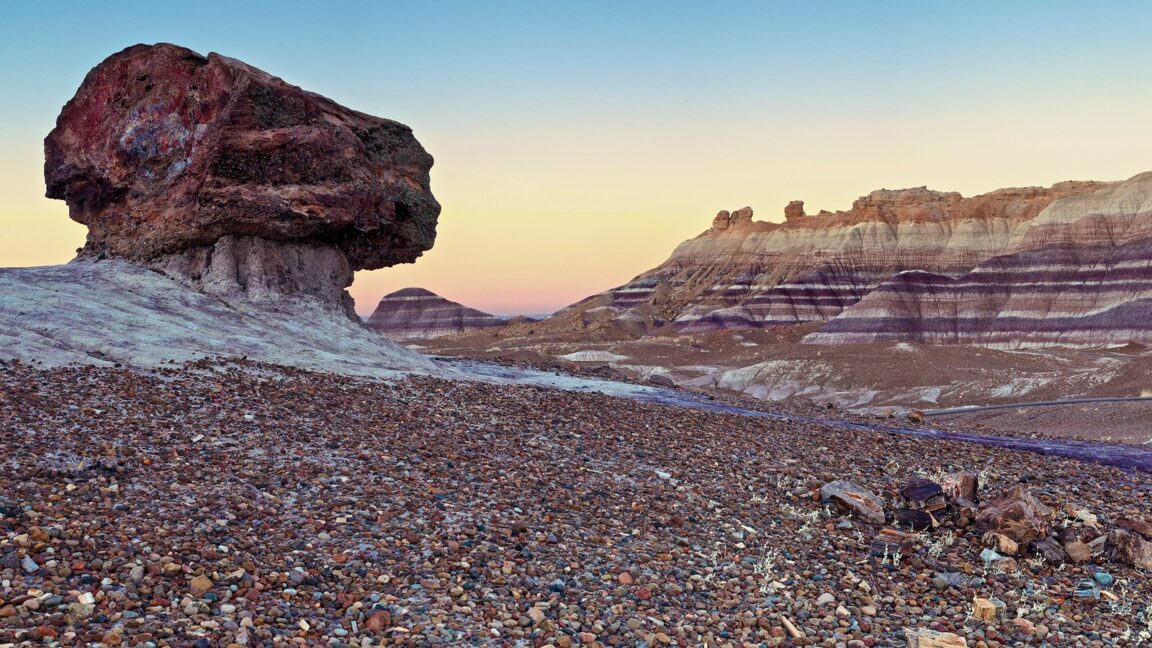
Yes, and plan the day so it gets your freshest hour. Blue Mesa sits roughly halfway through the park on a spur road of about 5 miles round trip that climbs onto the mesa top, loops past overlooks and reaches the trailhead at a sun shelter halfway around the loop. The National Park Service describes badlands banded in blue, purple, gray and peach, and that palette is the point: where the Painted Desert runs warm, Blue Mesa runs cold, bentonite hills striped in slate and lavender, with petrified logs weathering out of the slopes and pedestal logs balanced on clay pedestals, including the one in this article photograph, shot at twilight. The Blue Mesa Trail itself is a loop of about 1 mile that drops steeply off the mesa edge into the badlands and walks you at ground level among the banded hills and scattered logs. It is the one walk in the park that puts you inside the geology instead of above it, and on a route day it is worth more than any three overlooks. Allow 45 to 75 minutes for the loop, carry water even for this short distance, and expect the climb back up to feel longer than the descent. The Tepees, the striped cone hills right on the main road just north of Blue Mesa, need only a pullout and five minutes, but in angled light they are the most graphic geology on the drive.
What should you save time for in the southern half?
The log country, and it rewards selectivity. Jasper Forest overlook reads a whole valley of fallen logs from above. Agate Bridge is a single petrified log spanning a gully, supported by a concrete beam added in 1917, a famous and slightly melancholy monument to early park protection. Crystal Forest, a loop trail of about 0.75 mile, is the southern walk to choose if Blue Mesa took your hiking hour: logs here are studded with quartz and amethyst crystals, which is exactly why early visitors looted the site before protection, and why the trail exists to show both the beauty and the loss. Finish at the Rainbow Forest Museum, the south end visitor center with paleontology exhibits and the park film, and the Giant Logs Trail directly behind it, a short paved loop past some of the largest and most colorful logs in the park, including the fallen giant called Old Faithful. If you are deciding how this park fits the wider system this year, our explainer on which national parks still require reservations in 2026 is useful context: Petrified Forest needs no timed entry reservation at all, just the entrance pass and respect for the 5 pm close.
How do the hours and fees shape the day?
Petrified Forest is not a 24 hour park, and that single fact runs the itinerary. The National Park Service lists the park as open year round except Thanksgiving and Christmas Day, with park road hours of 8 am to 5 pm, and Arizona stays on Mountain Standard Time all year, so in summer the park clock matches California and runs an hour behind neighboring New Mexico and the Navajo Nation. Gates lock at closing, so the route has a hard finish: be rolling toward an exit by 4:30 pm at the latest, earlier in winter when the light goes sooner. Fees are simple and were rechecked on the Park Service site for this guide on November 18, 2026: $25 per private vehicle, $20 per motorcycle and $15 per person entering on foot or by bicycle, each pass good for 7 days, a park annual pass at $45, and America the Beautiful passes honored. The park does not accept cash, so bring a card. There is no lodging, no restaurant and no developed campground inside the boundary, fuel and food live in Holbrook, and the only in park overnight option is backcountry camping in the wilderness area under a free permit picked up in person. RVers are welcome on the park road, with length limits posted for a few tight overlooks, and summer visitors should treat water as the day limiting factor: there is almost no shade anywhere on this route, and every trail in this guide assumes you carry more water than the distance seems to ask for. For a desert basecamp at the opposite end of the budget spectrum, see our guide to Amangiri, Utah desert resort, a few hours northwest in the same Colorado Plateau country.
How much time do you actually need?
Four to six hours is the honest route day: an hour at the north rim and the inn, an hour at Blue Mesa, an hour spread across the mid park stops, an hour in the south, and the driving itself. Two hours buys a windshield version that will leave you with photographs of overlooks and no sense of the place. A full day, entering at 8 am sharp, adds the Rim Trail walk, a second southern loop and time to sit with the museum exhibits, and still ends at the same 5 pm gate. What this park does not need is two days, unless you are adding a permitted backcountry night in the Painted Desert wilderness, which is a different and rewarding trip that starts with a permit conversation at the visitor center.
Frequently Asked Questions
Can you drive through Petrified Forest in one direction?
Yes, and you should. The 28 mile park road connects the north entrance on Interstate 40 at Exit 311 with the south entrance on Highway 180 near Holbrook, so you enter one end, stop along the way and exit the other, then use I-40 and Holbrook to close the loop. There is no requirement to backtrack.
How much does Petrified Forest cost in 2026?
The National Park Service lists $25 per private vehicle, $20 per motorcycle and $15 per person on foot or bicycle, each valid for 7 days, with a $45 park annual pass and America the Beautiful passes accepted. The park is cashless, so pay by card.
What time does Petrified Forest close?
The park road hours are 8 am to 5 pm daily, and the park is closed on Thanksgiving and Christmas Day. Gates lock at closing time, so plan to be at an entrance well before 5 pm. Arizona does not observe daylight saving time, which matters if you are driving in from New Mexico.
Is the Painted Desert Visitor Center open?
No. Park alerts list the Painted Desert Visitor Center at the north entrance as closed for construction, with reopening expected in June 2027. The Painted Desert Inn, about 2 miles inside the park, serves as the north visitor center in the meantime.
What is the best hike in Petrified Forest?
The Blue Mesa Trail, a loop of about 1 mile that descends into blue and purple banded badlands among petrified logs, is the standout short hike. Pair it with the paved Giant Logs Trail behind the Rainbow Forest Museum for the easiest best of both halves day.
Can you take a piece of petrified wood as a souvenir?
No. Removing petrified wood or any natural or cultural object from the park is prohibited and punishable under federal law, a warning the Park Service prints on its own fees page. Buy polished pieces from shops outside the park in Holbrook instead, where they are sold legally from private land.
Image: A pedestal log balances in front of blue, purple and gray banded badlands at Blue Mesa, Petrified Forest National Park. Photo: Andrew V. Kearns, National Park Service, via nps.gov. Fees and hours checked on nps.gov on November 18, 2026.