 Thandiwe Nkosi
Twice a year, on or around 22 February and 22 October, the rising sun travels the full length of the Great Temple at Abu Simbel and lights the statues seated in its innermost sanctuary. That alignment is the reason to build a trip around those dates, and it is also the reason those two mornings are the busiest of the year at a site that is remote on every other day. Base yourself in Aswan, book the festival morning well ahead, expect a departure long before dawn, and give the temples a full day rather than squeezing them between other sights. On any other morning the same temples are quieter, easier to read, and no less monumental.
Quick Facts
- Where: Abu Simbel, on the western shore of Lake Nasser in southern Egypt, near the border with Sudan, reached as a day trip from Aswan
- The event: The Sun Festival, when sunrise light reaches the sanctuary of the Great Temple of Ramesses II, on or around 22 February and 22 October each year
- The temples: The Great Temple, fronted by four seated colossi of Ramesses II about 20 metres high, and the smaller Temple of Nefertari, dedicated to the goddess Hathor
- The rescue: Both temples were cut apart and rebuilt on higher ground between 1963 and 1968, as part of the UNESCO campaign to save the Nubian monuments from Lake Nasser
- Heritage status: Part of the World Heritage site listed as Nubian Monuments from Abu Simbel to Philae, inscribed in 1979
- Getting there: By road from Aswan on an organised day trip, by short flight, or as a stop on a Lake Nasser cruise
- Booking rule: Festival mornings sell through early and start earliest. Book transport and entry arrangements as soon as your dates are fixed, and confirm pickup times the day before
What actually happens on the two sun mornings?
The Great Temple was cut into the rock so that its central axis points toward the sunrise on two mornings a year. A visitor entering the temple walks through a sequence of halls, about 56 metres into the cliff, past eight statues of the king in the form of Osiris and walls carved with scenes from the Battle of Kadesh. At the far end sits the sanctuary, where four seated figures share the back wall: Amun-Ra, Ra-Horakhty, the deified Ramesses II, and Ptah. On the festival mornings, the first light enters the doorway, runs the length of those halls, and falls on the sanctuary figures. Accounts of the alignment consistently note that Ptah, a god associated with darkness, is the figure the light does not reach.
Two cautions belong in any plan. First, sources vary by a day when they name the dates, which is why this guide says on or around 22 February and 22 October rather than promising a single calendar square. The alignment is a sunrise event spread across a short seasonal window, and the festival crowds gather for the celebrated morning within it. Second, the temple you see is the rebuilt temple. The rescue teams preserved the alignment when they reassembled Abu Simbel on its new cliff, so the phenomenon still happens, but it happens in a temple that was moved, block by block, in the 1960s. Guides at the site tell that relocation story as part of the visit, and it deserves the telling.
Why were the temples moved, and what did the move change?
When the Aswan High Dam created Lake Nasser, the rising water threatened to submerge Abu Simbel permanently. Between 1963 and 1968 an international effort, funded by more than 50 countries, cut away the cliff above the temples, dismantled both of them, and rebuilt them about 60 metres above their original position, set into an artificial version of the original rock face. It was the centrepiece of the wider UNESCO campaign, running from 1960 to 1980, that rescued the temples of Nubia, and the group was inscribed on the World Heritage List in 1979 as the Nubian Monuments from Abu Simbel to Philae.
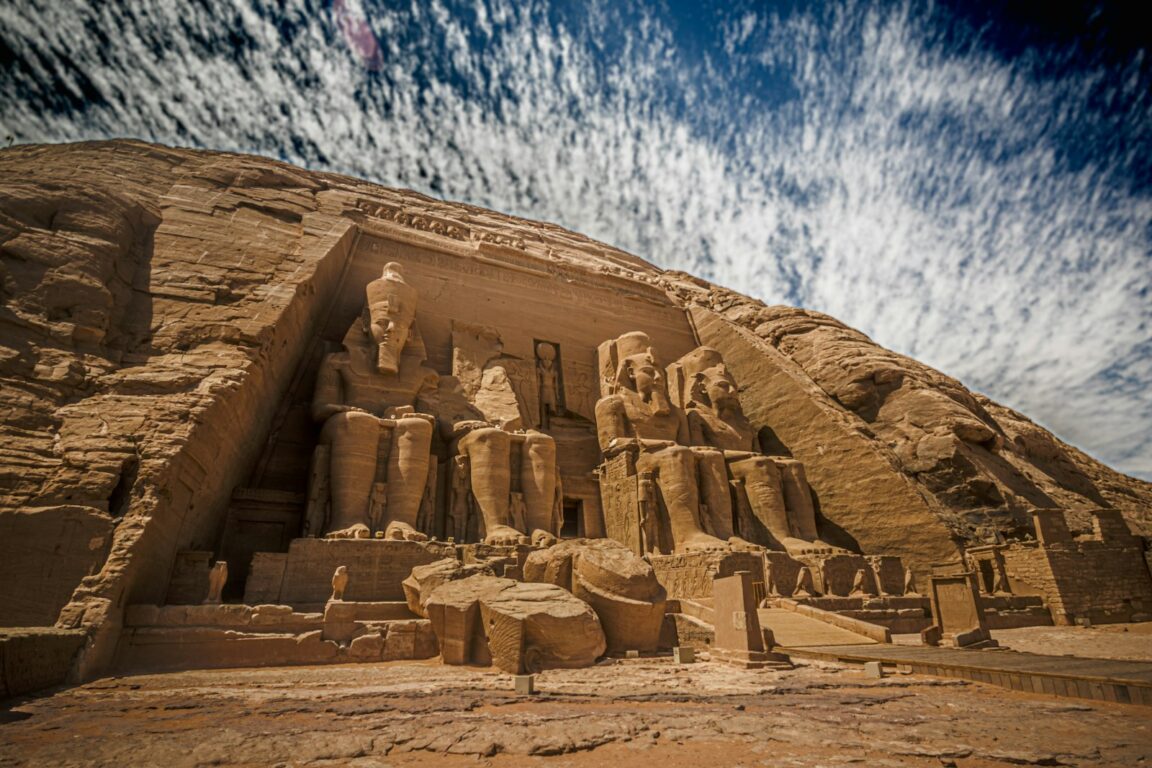
For a visitor, the move explains two things. The setting still works: the temples face the water across a forecourt with little shade, and the Great Temple still reads as a cliff that happens to have a king on it, rather than a building placed in front of one. And the scale still works. The four colossi on the facade are about 20 metres high, with smaller figures of Ramesses II’s queen Nefertari, his mother and his children standing at their feet. The Small Temple, just to the north, carries standing figures of the king and Nefertari about 10.5 metres high, an unusual honour that placed the queen at the same scale as her husband. If Egypt’s newest museum scale impressed you in Giza, Abu Simbel is the ancient version of the same impulse, as our guide to visiting the Grand Egyptian Museum sets out for the modern one.
Where should you base yourself, Aswan or Abu Simbel village?
Most visitors base in Aswan and treat Abu Simbel as a long day trip, and for a first Egypt itinerary that is usually the right call. Aswan has the hotels, the restaurants, and the other half of the story: Philae, the Nubian villages, and felucca time on the Nile all sit within easy reach, so the days either side of the temple trip fill themselves. The cost of that convenience is the drive. Road tours leave Aswan before dawn and return in the afternoon, and on a festival morning the departure is earlier still, because every operator in the city is aiming at the same sunrise.
Staying overnight in Abu Simbel village reverses the trade. You give up Aswan’s choice of beds and dinners, and you gain a morning start measured in minutes rather than hours, plus the chance to see the temples in the late afternoon of the day before, when the day trip coaches have gone. For the two festival dates, that trade tempts photographers and anyone who dislikes 3am lobby calls. For an ordinary date, the Aswan base is simpler and usually better value. Whichever base you choose, pack for a cold start and a hot site: desert mornings in February and October can be genuinely chilly in a moving vehicle, and the forecourt offers almost no shade by mid morning. Our seasonal guide to what to pack for Egypt in winter covers the layering logic that applies here.
How do you get there, by road, by air, or by lake?
By road is the default. Shared tours put you in a minibus or coach with fixed pickups and a fixed pace, and they are the cheapest way to see both temples. Private tours use a car and driver for your party alone, often with a guide who comes into the temples with you, and they let you agree the pickup time and how long you stay. On a festival morning, ask any operator three direct questions before paying: is temple entry included or paid on the day, does a guide enter the temples or only drive, and what is the cancellation position if you need to change the date. The answers vary more than the brochures suggest.
By air is the time saver. Short flights between Aswan and Abu Simbel cut the long desert drive in both directions, at a higher cost, and they make a same day visit feel civilised rather than heroic. Check the flight times against the visit you want: on a sun morning, a flight that lands after sunrise defeats the purpose of the date. By lake is the slow option, and for some travellers the best one. Lake Nasser cruises between Aswan and Abu Simbel approach the temples from the water, the way the site presents itself in the classic views, and they stop at other rescued temples along the lake, including Wadi es-Sebua and Amada. A cruise turns Abu Simbel from a day trip into the climax of a journey, and it removes the pre dawn road start entirely.
What does a festival morning actually cost in time and money?
Honest budgeting for Abu Simbel has two parts. The money part is a tour or flight fare plus temple entry, and because operators set those prices seasonally and festival dates command a premium, this guide does not print a fare that could be stale by the time you book. Get quotes from more than one Aswan operator for the same date, confirm whether entry is inside the quote, and treat a suspiciously cheap festival morning quote as a prompt to ask what is excluded. The time part is fixed and non negotiable: a road day trip from Aswan consumes most of a day, with the driving, the temple visit, and the return taking you from before dawn to mid afternoon. On a festival morning, add crowd time at the sanctuary, where everyone present has come for the same few minutes of light.
The practical response is to protect the rest of the itinerary. Leave the afternoon after a festival morning unscheduled, sleep early the night before, and carry water, a snack, and sun protection even though you are leaving the hotel in the dark. Photography rules inside the temples can change, so follow the guards on the day rather than advice printed anywhere, including here. If the festival dates do not fit your trip, go anyway on a quieter morning: the colossi, the Kadesh walls, and the rescue story are the substance of Abu Simbel, and the sun alignment is the flourish on top of them.
Frequently asked questions
When is the Abu Simbel Sun Festival?
On or around 22 February and 22 October each year, at sunrise, when light reaches the sanctuary at the back of the Great Temple. Sources differ by a day in how they name the dates, so confirm the festival morning with your operator when you book, and be in Aswan the night before either way.
Can you visit both temples on one day trip from Aswan?
Yes. The Great Temple and the Small Temple of Nefertari stand next to each other on the same site, and standard day trips by road, air, or lake include both. The Great Temple takes longer: its halls run about 56 metres into the rock, and the wall scenes reward a slow walk back toward the light.
Is a private tour worth it over a shared tour?
For a festival morning, often yes, because the value sits in the details: a guide who enters the temples with you, a pickup time you agree rather than inherit, and a pace that lets you stay for the sanctuary moment without watching a coach clock. A shared tour sees the same temples for less money, with fixed timings.
Why does one sanctuary statue stay dark?
The sanctuary holds Amun-Ra, Ra-Horakhty, the deified Ramesses II, and Ptah. Accounts of the alignment describe the sunlight reaching the first three figures while Ptah, associated with darkness and the underworld, remains unlit. It is the detail guides point out last, and the one visitors tend to remember.
What should you wear and carry for a festival morning?
A warm layer for the pre dawn drive, sun protection and water for the exposed forecourt, and comfortable shoes for uneven stone. February mornings in the desert can be cold enough to make the layer essential rather than cautious, and there is little shade at the site once the sun is up.
Featured image: The Great Temple of Ramesses II at Abu Simbel, Egypt. Photo by Michael Starkie on Unsplash, Unsplash License.