 LeVar Thomas
Three days in Tirana work best in this order: the centre on day one, the mountain edge on day two, and the lake and the long evening on day three. Day one stays inside a small walkable core, Skanderbeg Square, the Et’hem Bey Mosque, the Clock Tower and Bunk’Art 2, the bunker museum built for the Ministry of Internal Affairs. Day two pairs the two sights that share one bus ride east, Bunk’Art 1, the vast leadership bunker at the foot of Mount Dajti, and the Dajti Ekspres cable car that climbs from almost the same spot. Day three slows down: a morning around the Grand Park and its artificial lake, the Pyramid in the afternoon, and Blloku, the former elite quarter turned cafe district, after dark. One warning shapes the whole plan: the National History Museum on Skanderbeg Square is closed for restoration until 2028, so its famous mosaic facade is a photo stop, not a visit. Hours checked on November 20, 2026, against the museums’ and operator’s published schedules.
Quick Facts
- Base: Tirana, capital of Albania, in a basin at the foot of Mount Dajti, about 17 km south east of Tirana International Airport
- Bunk’Art 2: Central Tirana by Skanderbeg Square, open every day 9:30 a.m. to 6:30 p.m., allow 60 to 90 minutes
- Bunk’Art 1: Eastern edge of the city near the Dajti cable car, 5 floors and 106 rooms, open every day 9:30 a.m. to 4:30 p.m. on winter hours, allow about 2 hours
- Tickets: Neither Bunk’Art museum publishes its prices online; tickets are bought at the door, so carry Albanian lek in cash
- Dajti Ekspres: Cable car closed on Tuesdays, open 9:00 a.m. to 6:00 p.m. on weekdays and to 6:30 p.m. at weekends, prices given at the lower station
- Closed sight: National History Museum, closed for restoration until 2028; the mosaic facade on Skanderbeg Square remains visible
- Evening district: Blloku, the former restricted quarter for the communist elite, now the densest run of cafes and bars in the city
- Hours checked: November 20, 2026, against the Bunk’Art and Dajti Ekspres published schedules
How should day one in the centre be ordered?
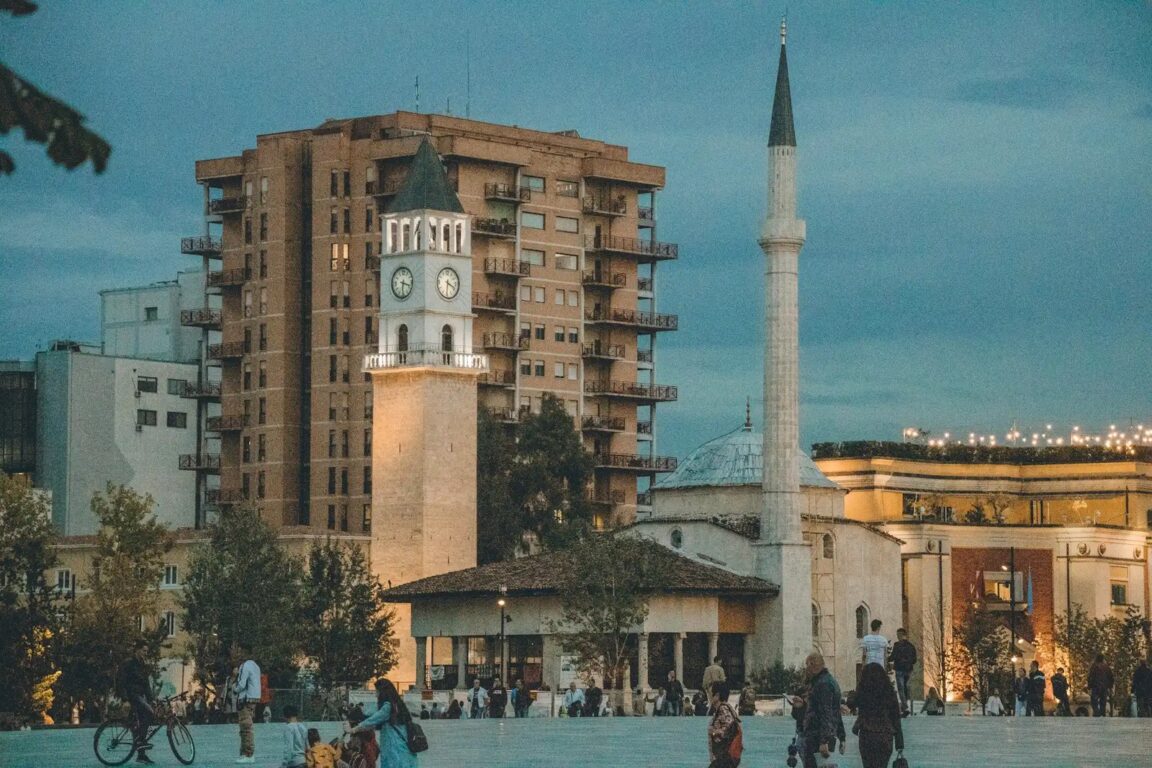
Start at Skanderbeg Square in the morning, when the light is on the mosaic facade of the National History Museum and the square itself is still a place locals cross rather than a place crowds gather. The museum has been closed for restoration since 2024, with reopening announced for 2028, so read the mosaic from the square and move on rather than queueing at a shut door. Beside the square stand the two small sights that repay an hour between them: the Et’hem Bey Mosque, one of the few religious buildings to survive the communist era’s destruction of places of worship, reopened in 1991, and the Clock Tower next to it, built in 1822 and still the square’s vertical marker. Both sit within a few steps of the Bunk’Art 2 entrance on Rruga Abdi Toptani, opposite the municipality building.
Bunk’Art 2 is the right bunker to do first. It occupies the bunker built in the early 1980s as a shelter for the Ministry of Internal Affairs, and its 24 rooms document the Sigurimi, the secret police, and the surveillance state that watched ordinary Albanians for decades. It is the more personal and the heavier of the two museums, and at 60 to 90 minutes it fits a first afternoon without consuming it. The museum opens every day at 9:30 a.m. and closes at 6:30 p.m., per the Bunk’Art visitor information drawn from the museum’s own site, which publishes hours but no ticket prices, so admission is paid at the door in lek. Finish the day at Pazari i Ri, the New Bazaar about 10 minutes east of the square, where the market hall and its surrounding streets are the easiest place in the centre to eat well without a reservation, then drift south into Blloku as the cafes fill.
Why do Bunk’Art 1 and the cable car belong on the same day?
Because they stand almost on top of each other, and going east twice wastes the trip’s scarcest resource, which is mornings. Bunk’Art 1 sits on the eastern edge of the city at the foot of Mount Dajti, a few minutes from the Dajti Ekspres lower station, and the same bus or taxi ride serves both. The bunker itself is on a different scale from its city centre sibling: built in secret in the 1970s as a nuclear shelter for Enver Hoxha and the political leadership, it runs to 5 underground floors and 106 rooms, entered through a tunnel cut into the hillside. Exhibitions mix the history of Albania’s communist period with contemporary art installations, and the sheer length of the corridors is the exhibit nobody forgets. Allow a full 2 hours, and go in the morning: on the winter schedule the museum keeps from late October, it opens at 9:30 a.m. and closes at 4:30 p.m., an hour earlier than in summer, which catches out visitors who leave it to the afternoon.
The cable car pairs with it in either order, but the stronger sequence is bunker first, mountain second, because the Dajti Ekspres runs later than the museum. The operator’s published week, set out in the Tirana sights schedule, has the cable car running 9:00 a.m. to 6:00 p.m. on weekdays and to 6:30 p.m. at weekends, and closed every Tuesday unless the Tuesday is a public holiday. That Tuesday closure is the single easiest way to wreck this day, so anyone whose three days include a Tuesday should swap day two and day three. The ride climbs to the upper station on Mount Dajti, where the operator lists a restaurant, a hotel, an adventure park and mini golf, and where walking trails continue into Dajti National Park. Like the museums, the cable car does not publish its fare online; it is given at the lower station. Readers continuing through the Balkans after Tirana can pair this trip with our Kotor guide, which uses the same one base, sights in order approach on the Montenegrin coast.
What belongs on day three, and what is the Pyramid now?
Day three starts south of the centre at the Grand Park, the large green space built around Tirana’s artificial lake, roughly 2 km from Skanderbeg Square. This is the city’s morning room: runners and walkers circle the lake, and the park is the natural counterweight to two days of bunkers and museums. Give it the whole morning at an easy pace, then walk back toward the centre for the Pyramid, which stands about 10 minutes south east of the square on the main boulevard. The Pyramid opened in 1988 as a museum to Enver Hoxha, spent decades as the city’s most argued over ruin, and was renovated and reopened in May 2023 as a youth technology and education centre, with its sloped concrete sides rebuilt as steps that visitors climb for one of the best free views in the centre. It is a working building, not a monument, and the climb is the visit.
The afternoon is for the loose ends the first two days deliberately left: the streets of Blloku in daylight, where the villa of the former leadership quarter now hold the city’s densest concentration of cafes, and a slow second pass through the New Bazaar if the first evening there raised appetites it did not settle. Travellers with a fourth day, or those who prefer their history in a smaller city, will find the same layered past handled at walking pace in our Mostar guide for Bosnia and Herzegovina.
How should the Blloku evening be ordered?
Blloku rewards arriving before dinner rather than after it. The quarter was closed to ordinary citizens for decades, reserved for the communist leadership, and its rebirth as the city’s nightlife district is itself the sight, so the first move is simply to walk it while there is still light to read the streets. Coffee comes first, because Tirana runs on it and Blloku’s cafes are where the evening assembles. Dinner follows in the quarter or a short walk away, and the bars fill late and stay late. Keep the order loose and the geography tight: everything on this evening sits within a short walk of everything else, and the only real mistake is booking a restaurant across town and spending the night in taxis. Visitors on a budget should know that Blloku prices are the city’s highest and still modest by the standards of other European capitals, and that the streets one block out in any direction return to local prices quickly.
What should be skipped, and what needs booking ahead?
Skip the National History Museum interior, because it does not exist as a visit until 2028. Skip the cable car on a Tuesday, because it does not run. Skip trying to do both Bunk’Art museums back to back in a single morning; the combined weight of the two is the point of splitting them across two days, and each deserves its own headspace. Almost nothing in this itinerary needs advance booking: both bunker museums sell tickets at the door, the cable car is walk up, and the Pyramid steps are open access. What does need thought ahead is cash, since the museums do not publish prices and card payment cannot be assumed, and timing, since Bunk’Art 1’s early winter closing makes it a morning sight from November onward. Tirana International Airport sits about 17 km north west of the centre, and the run in is a bus or taxi ride of roughly half an hour depending on traffic, so a morning flight out argues for the lake morning, not the mountain, on the final day.
Frequently Asked Questions
Should a visitor see Bunk’Art 1 or Bunk’Art 2 first?
Bunk’Art 2 first, on day one, because it is in the centre by Skanderbeg Square, takes 60 to 90 minutes, and explains the secret police system that Bunk’Art 1 then shows at leadership scale. Bunk’Art 1, with 5 floors and 106 rooms at the foot of Mount Dajti, needs about 2 hours and pairs with the cable car on day two.
How much do Bunk’Art tickets cost?
The museums do not publish ticket prices on their website, and neither does the Dajti Ekspres cable car, so exact fares cannot be confirmed online in advance. Tickets are bought at the door. Carry Albanian lek in cash, and treat any precise price quoted in older guides as out of date until the desk confirms it.
Is the Dajti Ekspres cable car open every day?
No. Tuesday is its regular day off, unless the Tuesday falls on a public holiday. On other days it runs from 9:00 a.m., closing at 6:00 p.m. on weekdays and 6:30 p.m. at weekends on the operator’s published schedule. Plan the Bunk’Art 1 and cable car day for any day except Tuesday.
Is the National History Museum in Tirana open?
No. The museum on Skanderbeg Square has been closed for restoration since 2024, and the announced closure runs to 2028. Its mosaic covered facade, the largest in Albania, can still be seen and photographed from the square, but there is no interior visit to plan around.
Can the Pyramid of Tirana be climbed?
Yes. The Pyramid was renovated and reopened in May 2023 as a youth technology centre, and its sloped sides were rebuilt as open steps. Climbing them is free and gives a wide view over the central boulevard and Blloku. It is a working building, so the visit is the exterior and the steps rather than a museum interior.
How many days does Tirana need?
Three days cover the city properly: one for the centre and Bunk’Art 2, one for Bunk’Art 1 and Mount Dajti, and one for the Grand Park lake, the Pyramid and Blloku. Two days can work by merging the third day’s sights into the first evening and final morning, but the cable car’s Tuesday closure then leaves no room for error.
Featured image: Skanderbeg Square at dusk, with the Clock Tower and the Et’hem Bey Mosque, Tirana. Photo by Mario Beqollari via Unsplash, Unsplash License, used with credit.