 Camille Baptiste
The Westfjords’ hot pots reward the traveller who paces the day around them rather than packing the day full: a geothermal pool hidden below a highway in Vatnsfjörður, a community pool at the very end of the Strandir coast road, and harbour-side tubs in a fishing village of under a hundred people. Visit Westfjords, the region’s official tourism authority, lists Hellulaug at 38°C and just 60 cm deep, tucked off the road near Flókalundur, and describes the Drangsnes pots as free with donations, used all year by locals and visitors alike. Krossneslaug, at Krossnes north of Norðurfjörður, is the seasonal prize: a shoreline pool built by local farmers in 1954, open only from about mid-May to the end of August, reached by the long gravel length of Route 643. This guide sequences the three, explains the honesty box and shower-first etiquette that keep these small places working, and is honest about the gravel road reality in between.
Quick Facts
- Hellulaug: geothermal pool in Vatnsfjörður near Flókalundur, 38°C, 60 cm deep, hidden from the road
- Krossneslaug: shoreline pool at Krossnes on the Strandir coast, built 1954, seasonal opening roughly mid-May to end of August, small entry fee
- Drangsnes hot pots: shoreline tubs in the village of Drangsnes, free with donations, open all year
- Access reality: Westfjords roads include long gravel stretches; Route 643 to Krossnes is unpaved and seasonal
- Etiquette: shower thoroughly before entering, pay the honesty box or fee, leave no trace
- Checked: pool details verified against Visit Westfjords listings, 20 November 2026
What is Hellulaug, and why do drivers miss it?
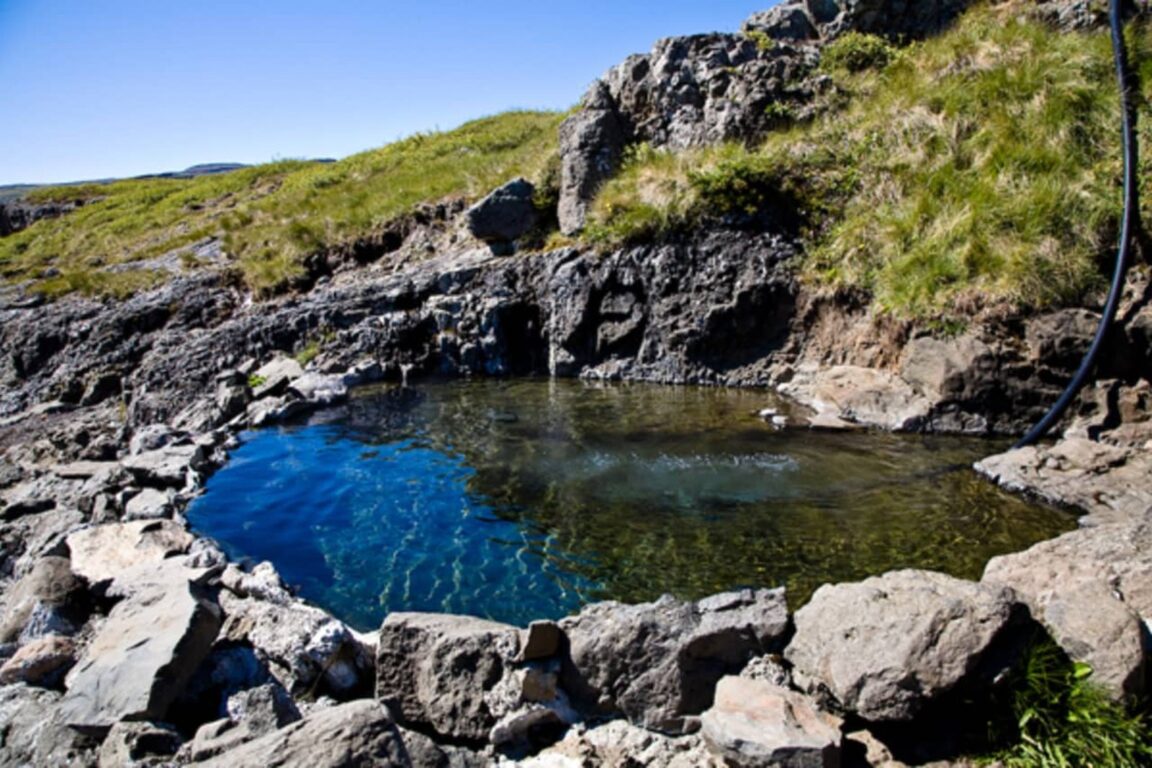
Hellulaug is a natural geothermal pool set into the shore at Vatnsfjörður, on the Westfjords’ south coast near the Flókalundur hotel and campsite. Visit Westfjords gives the essentials plainly: the water sits at 38°C, the pool is 60 cm deep, and it cannot be seen from the road. A small parking area stands by the path that leads down to it, and that invisibility is the point. Traffic passes on the highway above while the pool sits below the bank, looking out over the fjord, fitting a handful of bathers at a time.
The shallowness shapes the soak. At 60 cm, Hellulaug is a sit-and-linger pool rather than a swimming pool, warm rather than fierce, best treated as a long pause in a driving day rather than a destination that fills one. It pairs naturally with the south coast route between Brjánslækur, where the Baldur ferry crosses Breiðafjörður to Stykkishólmur, and the roads west toward Látrabjarg. Go early or late in the day in summer, keep voices low, and treat the small changing wall as the whole facility, because it is.
What makes Krossneslaug worth the Strandir road?
Krossneslaug is a proper little swimming pool and hot tub built right on the shoreline at Krossnes, a few kilometres past Norðurfjörður at the far end of the Strandir coast. Local farmers built it in 1954 where geothermal water runs toward the sea, and the low sea wall between the pool and the North Atlantic is so slight that the soak comes with open ocean views and, in rough weather, spray. A larger rectangular pool sits beside a smaller, hotter tub, with simple changing rooms and showers.
The commitment is the road. Route 643 north from Hólmavík runs about 100 km along the Strandir coast, much of it gravel, and the drive alone takes around two and a half to three hours in good conditions. The pool keeps a short season, roughly mid-May to the end of August, with a small entry fee of around 1,000 ISK for adults, because snow closes the road for much of the year. That combination, a long slow road and a short season, is precisely why the pool stays quiet. Stay overnight in Norðurfjörður rather than driving back the same day, and the whole equation relaxes. It is the opposite end of Icelandic bathing from the big serviced lagoons compared in Sky Lagoon versus the Blue Lagoon, and the better for travellers who prefer their hot water with weather in it.
Where do the Drangsnes pots fit the route?
Halfway up the Strandir approach, the village of Drangsnes keeps its hot pots on the shoreline in the middle of town, easily spotted from the road. Visit Westfjords lists admission as free with donations, notes the pots are used throughout the year, and calls them, with local understatement, the best place to meet people and talk about everything and nothing. Facilities sit across the street, where bathers shower and change before crossing to the tubs.
Drangsnes works as the pacing hinge of a Strandir day: the last easy stop before Route 643 commits to its long northern run, and the natural reward on the way back down. Because the pots sit in full view of the village, swimwear is non-negotiable and behaviour is on display. That visibility is part of the social contract of the place, and regulars enforce it with nothing more than presence.
What is the etiquette of remote soaking?
Why does the shower come first?
Icelandic pool culture runs on one rule that visitors break more than any other: wash thoroughly, without swimwear, in the showers before entering the water. These are small bodies of warm water with little or no chemical treatment and no lifeguard chemistry to rescue them. What goes in on skin and suits stays in. Krossneslaug has changing rooms and showers for exactly this purpose; at simpler pots with no facilities, arrive clean, keep soaps and shampoos far away from the water, and never wash in the pool itself. The same shower-first discipline governs Budapest’s thermal baths, at a rather grander scale.
How does the honesty box actually work?
Many rural pots are maintained by locals, a municipality or a landowner and funded by a donation box, a small posted fee or both. Hellulaug and the Drangsnes pots run on donations; Krossneslaug charges a modest set fee. The etiquette is to pay before you soak, in cash, without being asked, and to understand what the money does: it empties bins, repairs stones, cleans changing huts and keeps access open. Take every item of rubbish away, close gates, and leave the rocks, pipes and water flow exactly as found. A pot that is loved to death helps no one, and several Icelandic pools have restricted access after seasons of careless use.
How should the driving day be paced?
Slowly, and with fuel and food solved before the gravel starts. Westfjords distances deceive: the region’s peninsulas turn 60 km of map into two hours of fjord-edge road, and surfaces switch between paved and gravel without ceremony. Check road conditions on the Icelandic Road and Coastal Administration’s service before setting out, especially outside high summer, and treat any plan that strings Hellulaug, Drangsnes and Krossneslaug into one day as a mistake. The workable pattern is one pot per half day, a village overnight between them, and the soak placed at the end of the driving, not the start. Wet hair, warm muscles and a three-hour gravel road are a poor sequence; the reverse order is the entire pleasure of the region.
Frequently Asked Questions
When is Krossneslaug open?
Only in the summer season, roughly mid-May to the end of August, because Route 643 is snowbound or impassable for much of the rest of the year. Confirm locally before committing to the drive, since opening follows the road, not the calendar. Hellulaug and the Drangsnes pots, by contrast, are used all year.
Do the Westfjords hot pots cost anything?
Krossneslaug charges a small entry fee, around 1,000 ISK for adults in recent seasons. Hellulaug and Drangsnes are free with donation boxes, and the donation is a real part of the arrangement rather than a gesture: it funds the upkeep of facilities that have no other income. Carry cash in small notes.
Can I reach these pools without a car?
Realistically, no for Krossneslaug, which has no regular public transport along the Strandir coast. Hellulaug sits near Flókalundur on the south coast road and Drangsnes is a village stop, but Westfjords bus services are sparse and seasonal. A rental car, ideally with good clearance for gravel, is the practical key to the region.
What should I bring for a remote pot?
Swimwear, a towel, a dry bag for wet kit, cash for the box, drinking water and a warm layer for the walk back to the car. Changing space ranges from a small hut to a stone wall, so arrive ready to change modestly in the open. Take all rubbish home; bins, where they exist, are emptied by volunteers.
Are the pools suitable for children?
Hellulaug’s 60 cm depth and gentle 38°C suit supervised children well, and Krossneslaug is a community pool built for local families. The cautions are the usual ones, sharpened by remoteness: no lifeguards, slippery rock, hot spots where spring water enters, and long drives to any help. Supervision is total or the visit does not happen.