 Lucas Meyer
A weekend in Grand Marais works best when you treat the harbour as the centre of the trip and everything else as a spoke: walk the breakwater and the basalt shoreline of Artist’s Point in the morning, join the early queue at World’s Best Donuts before the favourites sell out, spend one half-day driving the Gunflint Trail into the inland lake country, and keep the second day for the town itself, its galleries, the folk school waterfront and a state park waterfall. Grand Marais is the Gunflint Trailhead town on Lake Superior’s North Shore, reached only by Highway 61, and its scale is the appeal: almost everything in this guide is walkable from the harbour, and the wilderness begins at the edge of town. Book lodging first, because the town is small and weekends fill, then build the days in the order set out below.
Quick Facts
- Base: Grand Marais, Minnesota, a harbour village on Lake Superior’s North Shore, between the lake and the Sawtooth Mountains, per Visit Cook County, the county’s official visitor authority.
- Getting there: Highway 61 is the only road in and out by car. The Gunflint Trail begins in town and runs inland through Superior National Forest toward the Boundary Waters.
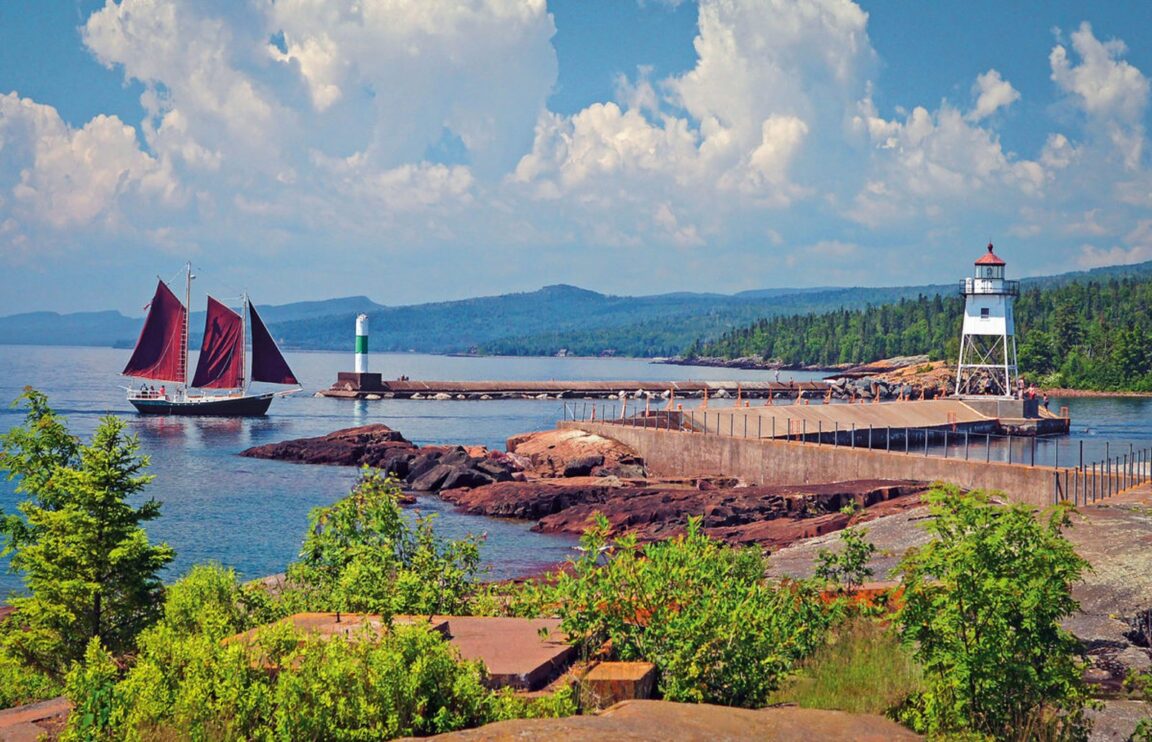
- Signature walk: Artist’s Point and the breakwater, dark basalt rock beside the working harbour, with the lighthouse at the end of the breakwater.
- Signature queue: World’s Best Donuts, 10 East Wisconsin Street, family owned and operated since 1969. Seasonal: it typically closes in October and reopens in late May, so check before a spring or autumn trip.
- Boundary Waters reality: A permit is always required to enter the Boundary Waters Canoe Area Wilderness. Non-motorized day use needs a free self-issued permit, filled in at the entry point, in every season.
- Booking order: Lodging first, then any folk school class or schooner sailing, then restaurant plans. Donuts and harbour walks need no booking, only an early start.
- Weather rule: Wind, waves and slippery rock can make Artist’s Point and the breakwater hazardous even when the town itself feels calm.
Why does the harbour walk come first in the weekend?
Because Artist’s Point is both the town’s best introduction and its most weather-dependent asset, and mornings give it to you at its quietest. The town’s official visitor guide describes the harbour opening onto Lake Superior at Artist’s Point, where paths lead out among trees and dark volcanic rock, with views back across the sheltered harbour from the same shoreline. It is a short walk from downtown, not a hike: you can be standing on basalt shelves within minutes of parking, watching the lake decide what kind of day it intends to be.
Pair the point with the breakwater, at the end of which sits the lighthouse, and with the working waterfront in between. North House Folk School’s timber-frame campus sits right on the harbour, and its 50-foot schooner Hjordis is part of the scenery when it is in port. The harbour circuit teaches you the town’s geography in one loop: where downtown’s galleries and cafes cluster, where the campground and recreation park begin, and where the Gunflint Trail leaves town to the north.
Respect the rock. The official guidance is blunt that wind, waves and ice can make both Artist’s Point and the breakwater hazardous, and that exposed rock is slippery when wet. On a calm morning it is an easy family walk. In a Superior blow it is a place to admire from the sheltered side. Checking the lake before you check your itinerary is the local habit worth copying.
How do you beat the donut shop queue?
World’s Best Donuts is a small red-and-white shop at 10 East Wisconsin Street that has been family owned and operated since 1969, and it makes nearly 30 donut recipes, with cake donuts as the staple its customers named the shop for. Its own site cheerfully admits the shop is very often slammed, with lines flowing out of the front door and from the walk-up window into the sidewalk, sometimes into the street. The queue is not a failure of planning on your part. It is the normal state of a beloved seasonal bakery in a small town at breakfast time.
The tactics are simple and they all point the same way: earlier beats cleverer. Go on the first morning, not the last, so a sell-out costs you nothing but a retry. Arrive near opening rather than mid-morning, when the line is longest and the trays are thinnest. Know the house specialities before you reach the window: the cake donuts, the Skizzle, a sweet yeast dough stretched out and deep fried, and the donut kabobs. The shop also offers call-ahead orders held for pickup, which its site lists as the way to guarantee favourites, and a coffee room for eating in rather than carrying a box back through town.
Build the season into your expectations. Explore Minnesota, the state tourism authority, notes the shop typically closes each October and reopens in late May, and local reporting puts the 2026 closing in mid-October. A summer or early autumn weekend can be planned around the queue. A November weekend, like the weekend this guide is published into, cannot: the donuts return with the spring, and winter visitors should put their early-morning ritual energy into the harbour walk and a cafe breakfast instead.
What does a Gunflint Trail half-day actually involve?
The Gunflint Trail is the paved road that leaves Grand Marais and climbs inland through Superior National Forest, past the maple ridge at Pincushion Mountain, toward the inland lakes, lodges and outfitters of the Boundary Waters gateway country. The town’s visitor guide frames it honestly: a drive all the way to the far end near Chik-Wauk and back takes much of the day, so a weekend trip should choose a turnaround point before setting out rather than discovering the distances by fuel gauge.
For a half-day version, the natural structure is Pincushion Mountain first, where the overlook a few miles from town gives the 180-degree view back over Lake Superior, then a lake stop further up the trail, with an outfitter visit if a paddle is on your mind. The official guidance makes a distinction first-timers often miss: the Gunflint Trail as a scenic drive is a different undertaking from entering the Boundary Waters itself. The drive needs nothing but fuel and time. The wilderness needs permits, planning and, in quota season, reservations made well ahead.
That distinction is worth an hour at an outfitter even if you never launch a canoe. Outfitters along the trail match paddles and routes to experience, explain the permit system in plain language, and will tell you honestly whether a day paddle suits the weather you have. Treat the half-day as reconnaissance for the longer canoe trip the town exists to launch, and the weekend gains a purpose beyond sightseeing.
What is the real position on Boundary Waters day permits?
Simple, and stricter than many visitors assume: a permit is always required to enter the Boundary Waters Canoe Area Wilderness, in every month of the year, for day trips as well as overnight trips. What changes with the calendar is the kind of permit. The Forest Service and Recreation.gov set it out in two seasons.
From 1 May to 30 September, overnight paddle, motor and hiking trips, and motorized day trips, require a quota permit reserved through Recreation.gov, with a per-person user fee, and only a limited number issued for each entry point each day. Non-motorized day use, which is what a weekend visitor paddling out from a Gunflint Trail entry point for a few hours is doing, uses a self-issued permit all year: free, no reservation, completed at the kiosk at the entry point or at a Forest Service office before you go in. From 1 October to 30 April, self-issued permits cover everyone, overnight visitors included.
The practical translation for a Grand Marais weekend is reassuring but not casual. A spontaneous day paddle is legal and free of fees, provided you stop at the entry point, fill in the self-issued permit properly, carry it with you, and observe the group limits of nine people and four watercraft per permit. What you cannot do is treat a summer overnight trip the same way: that needs the quota system, and popular entry points on summer weekends are claimed long in advance. Confusing the two is the classic Boundary Waters beginner error, and it is entirely avoidable.
How should the two days be put together?
Day one belongs to the town and the shore. Start with the donut queue while the trays are full, then walk it off on the harbour circuit: breakwater, lighthouse, Artist’s Point, and the folk school waterfront. Spend the middle of the day in the galleries and shops of downtown, where the Grand Marais Art Colony, founded in 1947 and described by the county visitor authority as the oldest art colony in Minnesota, anchors a genuine working arts scene rather than a souvenir strip. If North House Folk School is running a class or a Hjordis sailing that fits, this is the day it fits best, booked ahead. End with dinner in town and a second, evening look at the lake from the point if the weather is kind.
Day two is the spoke day, and you choose its length. The short version stays close: Pincushion Mountain’s overlook and trails in the morning, then a state park waterfall. Cascade River State Park, west of town on Highway 61, sends its river through a gorge in a compact, rewarding walk. The long version commits to the Gunflint Trail with a chosen turnaround, an outfitter stop and, permits filled in, a day paddle on an entry lake. Either version leaves the drive back down Highway 61 unhurried, which matters, because the North Shore road is part of the trip, not an errand after it.
For contrast, our guide to Prince Edward Island covers a very different harbour culture, and our Banff in winter guide is the cold-weather companion piece.
When is the best time to come, and what should you book first?
Grand Marais runs on a northern calendar. Late May through early October is the full-service season: the donut shop open, the schooner sailing, outfitters fully staffed, and the Boundary Waters in its quota season for overnight trips. Autumn brings colour and quieter streets but closing dates arrive business by business, so verify each must-do individually. Winter is a real season here rather than an off-season, built around snow, skiing at Pincushion and a harbour under ice, but it is a different trip from the one this guide describes, and several of its pleasures, donuts included, are simply not available.
Booking order matters because supply is thin. Lodging goes first: rooms and cabins are finite, and summer weekends sell out. Second, anything with a timetable: folk school classes, schooner sailings, and, for summer overnight canoe trips, the Recreation.gov quota permit release. Third, dinner reservations where taken. Everything else here runs on arrival time and weather rather than reservations.
Frequently asked questions
Do I need a permit for a day paddle in the Boundary Waters?
Yes. A permit is always required. Non-motorized day use takes a free self-issued permit, completed at the entry point kiosk or a Forest Service office, in every season. Only overnight trips and motorized day trips in the May to September quota season need a reserved Recreation.gov quota permit.
Is World’s Best Donuts open all year?
No. It is a seasonal shop that typically closes in October and reopens in late May, per Explore Minnesota. In season, go early or call ahead for an order to be held, because lines run out of the door and popular items sell out.
How far is the Gunflint Trail, and can I drive it in a day?
The trail runs from Grand Marais inland through Superior National Forest to the Boundary Waters gateway lakes. The town’s visitor guide warns that driving to the far end and back takes much of a day, so weekend visitors should pick a turnaround, such as Pincushion Mountain and a mid-trail lake, and keep the drive to a half-day.
What is there to do if the lake weather turns rough?
Stay off the exposed rock at Artist’s Point and the breakwater, which official guidance flags as hazardous in wind and waves, and move the day indoors and in town: galleries, the art colony, the folk school campus, cafes and shops are all within a few walkable blocks of the harbour.
How many days do I need in Grand Marais?
Two full days cover the harbour, the town and one Gunflint Trail or state park spoke comfortably. Add a third day if you want both a proper trail day with a day paddle and a waterfall park day without rushing either.
Featured image: Grand Marais harbour on Lake Superior, with the lighthouse, breakwater and the North House Folk School schooner Hjordis under sail. Photo by P. Sundberg for Visit Cook County (visitcookcounty.com), the official visitor authority for Cook County, Minnesota. Native 1200px wide, upscaled to exactly 1600px.