 Lucas Meyer
Lava Beds is a self guided caving park, and the order matters: collect the free caving permit at the visitor center, warm up in Mushpot Cave, the only cave with lighting and a paved path, then work the Cave Loop in rising difficulty from Valentine and Skull to Golden Dome, saving Merrill Ice Cave and the Captain Jack’s Stronghold trails for the surface hours. Entrance is $25 per vehicle for 7 days, every cave entry requires that free permit, and a helmet plus two real lights per person are the park’s non negotiable kit. Follow that sequence and two dozen lava tube caves become a structured day instead of a dark guessing game.
Quick Facts
- Park: Lava Beds National Monument, northeastern California, near Tulelake; more than 46,000 acres of volcanic landscape
- Entrance fee: $25 per vehicle for 7 days, $15 per person on foot or by bike for 7 days; the $55 annual pass also covers Crater Lake, Lassen Volcanic and Whiskeytown, per the National Park Service fees page checked on November 19, 2026
- Caving permit: Free, required before entering any cave, issued at the visitor center during opening hours
- Developed caves: 24 caves open to explore, ranked by the park as least, moderately and most challenging
- First cave: Mushpot Cave, 770 feet, paved and lit, a 524 foot walk from the visitor center
- Longest developed cave: Catacombs Cave, 6,903 feet, not recommended for inexperienced cavers
- Kit rule: A helmet and several real lights per person; the park names head bumps as its number one cave injury
- Closures: Caves close temporarily, seasonally or for wildlife protection; the park’s caving page listed Juniper, Hercules Leg, Sentinel, Lavabrook, Labyrinth and Sunshine caves as closed at the time of checking
- Prices checked: November 19, 2026, against National Park Service sources
Why does everything start at the visitor center?
Because the permit is the gate. The National Park Service caving page is blunt: a caving permit is required before entering any cave, it is free, and it is available only at the visitor center during operating hours. The permit does double duty. It lets rangers check that each party carries lights and helmets, and it is part of the defence against white nose syndrome, the fungal disease devastating bat colonies, since cavers who have worn gear in other caves can spread it between sites. Arrive outside visitor center hours and the caves are simply unavailable, however bright the day outside. The same stop settles the day’s other variables: the current closure list, which changes with bat protection and safety conditions, the cave map for the longer systems, and borrowed flashlights, which the park says it often has available at the visitor center. Fees are settled on the way in as well: $25 per vehicle for 7 days at the seasonal north end fee booth or the visitor center, per the park’s fees page, and there is no gas, food or lodging inside the monument, so the car should arrive fuelled and the day bag packed.
What order should the Cave Loop caves be done in?
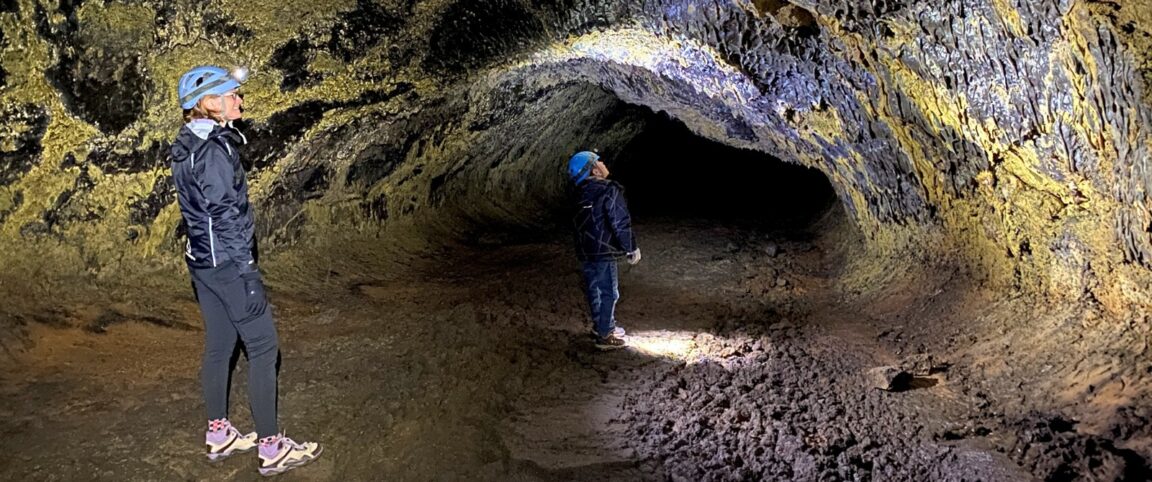
Start at Mushpot Cave, a short walk from the visitor center. At 770 feet with a paved path, lighting and interpretive signs, it is the park’s classroom: visitors learn what a lava tube looks like, how the ceiling lowers, and how dark true dark is, with the lights on. The park recommends it as everybody’s first cave, and it calibrates the party before anyone commits to carrying their own light. Second, drive the Cave Loop to Valentine Cave, 1,635 feet of smooth floored tube that the park calls probably the best second cave and, if time allows only one unlit cave, the one to choose, because its walls still show the primary volcanic features of the day the lava cooled. Third, Skull Cave, 580 feet but enormous in cross section, built by two stacked lava tubes, with a stairway down to a year round ice floor that earns its stop on any warm day. After those three, the moderately challenging set opens up: Golden Dome, 2,229 feet, named for the golden ceiling created by light reflecting off water droplets on a coating of bacteria, with stooping, a ladder entrance and a figure of eight back section where parties should track their turns. Catacombs, at 6,903 feet the longest developed cave, belongs at the end of the list and only with the downloadable cave map, because beyond its stairway the ceiling rarely rises above 3 feet and side passages multiply. Cavers comparing underground days across the park system will find the ranger led contrast in our Mammoth Cave family guide and the ticket release traps in our Great Basin Lehman Caves guide.
Where does Merrill Ice Cave fit, and what happened to its ice?
Merrill Cave, 650 feet long and a 2.8 mile drive from the visitor center, is the monument’s small history lesson. Its ice floor was once large enough that visitors ice skated on it by lantern light. The park’s account is honest about the ending: the great ice floor is gone, with changing air flow patterns the suspected cause, and small ice remnants can now be seen from a viewing platform at the bottom of the stairway. That makes Merrill a stop about change rather than spectacle, and it pairs naturally with Skull Cave, where the ice floor survives year round, and Heppe Cave, a short hike away, which holds a pond in summer and an ice floor in winter. Treat the three as one ice themed circuit on a hot afternoon, when the temperature drop at each stairway is its own reward. As with every cave here, the current closure list rules: ice caves and bat caves close seasonally, and a cave named in an itinerary is a plan, not a promise, until the visitor center board confirms it on the day.
What do the petroglyphs and the Modoc War sites add above ground?
Half of Lava Beds is a surface park, and skipping it wastes the entrance fee. Big Painted Cave and Symbol Bridge Cave, reached by a trail of about 0.7 miles, hold pictographs, rock art images painted by Modoc ancestors, some faded and some easy to spot, protected and to be viewed without touching. Petroglyph Point, at the monument’s northern edge, carries one of the region’s great concentrations of petroglyphs carved into a former island shore of Tule Lake. The history turns harder at Captain Jack’s Stronghold, where two self guiding interpretive loop trails, a shorter inner loop and a longer outer loop, wind through the natural lava fortress where a small band of Modoc people under Kintpuash, called Captain Jack, held off US Army forces for months during the Modoc War of 1872 to 1873. The rough terrain is the interpretation: broken lava ridges, natural parapets and hiding places that explain the siege better than any panel. Walk the Stronghold in the cooler hours, carry water, since the monument has no surface water to refill from, and give it a full hour rather than the photo stop it first appears to be.
What kit and rules keep a cave day safe?
The park’s safety list is short and absolute. Carry several real sources of light, a headlamp and a handheld flashlight for each person, and do not rely on a phone, whose battery and beam both fail the test of a 2,000 foot tube. Wear a helmet: the park identifies head bumps and cuts as its number one cave injury, all preventable, and basic helmets are sold at the visitor center bookstore. Add long trousers, sturdy footwear, gloves and kneepads for the moderately challenging caves, tell someone above ground which caves are planned and when the party expects to return, and keep children within reach where stairs, drop offs from collapsed tubes and uneven floors appear without warning. The companion rules protect the caves themselves: no pets, food, alcohol or flames inside any cave, no marking or defacing walls, no touching the golden bacterial coatings or any formation, and if bats are found sleeping, look quietly and move on; bats flying in daytime should be reported to rangers. Choose caves by the park’s own ranking, least challenging first, and the day scales from Mushpot’s pavement to Catacombs’ crawl with the difficulty always chosen, never stumbled into.
Frequently Asked Questions
Do I need a permit for every cave at Lava Beds?
One free caving permit, collected at the visitor center during opening hours, is required before entering any cave. It covers the visit and exists both to check safety readiness and to slow the spread of white nose syndrome between bat sites. No permit is available after hours, so arrival time matters.
How much does Lava Beds cost to enter?
A vehicle pass costs $25 and is valid for 7 days. Visitors on foot or by bike pay $15 per person for 7 days. The $55 annual pass covers Lava Beds plus Crater Lake, Lassen Volcanic and Whiskeytown, and America the Beautiful passes are accepted.
Which cave should a nervous first timer choose?
Mushpot Cave. It is 770 feet long, paved, lit, signed and a 524 foot walk from the visitor center, and the park recommends it as the first cave for everybody new to caving. Valentine Cave, smooth floored and walkable with a good light, is the park’s suggested second step.
Can visitors still skate on the ice in Merrill Cave?
No. Merrill Cave’s ice floor, once large enough for skating by lantern light, has melted, which the park attributes to changing air flow patterns. Small ice remnants remain visible from a viewing platform. For a living ice floor, Skull Cave keeps one year round.
Are any Lava Beds caves closed right now?
Closures change with bat protection and safety conditions. At the time of checking on November 19, 2026, the park’s caving page listed Juniper, Hercules Leg, Sentinel, Lavabrook, Labyrinth and Sunshine caves as closed. Always confirm the current list at the visitor center before finalising a route.
What is there to do at Lava Beds besides caves?
The Captain Jack’s Stronghold interpretive loops explain the Modoc War of 1872 to 1873 in the lava fortress where it happened, the Symbol Bridge trail leads to pictographs, and Petroglyph Point holds a major concentration of carved rock art. The monument also has a campground at Indian Well and miles of surface trails across the volcanic plain.
Featured image: Cavers with helmets and headlamps inside Valentine Cave, Lava Beds National Monument, showing the golden bacterial coating on the lava tube walls. Photo from the National Park Service official site (nps.gov), National Park Service, US Government work, used with credit.