 Aiko Tanaka
Paying for Nepal’s visa on arrival at Kathmandu’s Tribhuvan International Airport follows a fixed order, and getting the order right is the whole skill: first complete the tourist visa form, online before you fly or at an airport kiosk, then pay at the bank counter inside the arrivals hall, then take the payment receipt, your form receipt and your passport to the immigration desk, where the visa is actually issued. The fees are US$30 for 15 days, US$50 for 30 days and US$125 for 90 days, every visa is multiple entry, and travellers who walk straight to the immigration desk without paying first are simply sent back to the bank queue. This step-by-step guide follows the Department of Immigration’s own published sequence.
Quick Facts
- Fees: 15 days US$30, 30 days US$50, 90 days US$125, as published by Nepal’s Department of Immigration. All are multiple entry tourist visas.
- Step 1: Arrival card plus the online tourist visa form, completed before travel on the official portal or at a kiosk on arrival.
- Online receipt validity: 15 days. Complete the form earlier than that and it expires before you land.
- Step 2: Pay at the bank counter in the arrivals hall and keep the payment receipt.
- Step 3: Immigration desk with form receipt, payment receipt and passport. The officer issues the visa.
- Passport validity: At least six months.
- Gratis visas: Free for children under 10 except US citizens, SAARC citizens except Afghanistan on a first visit in a visa year for up to 30 days, Chinese nationals for 150 days, and Non-Resident Nepali card holders.
- No visa on arrival: Citizens of 12 listed countries, including Nigeria, Ghana, Iraq, Afghanistan and Syria, must obtain a visa from a Nepali diplomatic mission before travel.
Step 1: the form, and why the 15-day receipt catches people out
The Department of Immigration offers the same form in two places. You can complete the online tourist visa form on the official immigration portal before you fly, in which case you receive a submission receipt with a barcode that you should print and carry. Or you can complete it standing in the arrivals hall, at the self-service kiosk machines, which produce the same barcoded receipt on the spot. Alongside either version you fill in the paper arrival card, which airlines often hand out during the flight.
The detail that matters is printed in the Department’s own instructions: the online receipt works for fifteen days and becomes invalid after that. Travellers who enthusiastically complete the form a month before a trekking trip arrive with an expired barcode and join the kiosk queue anyway. The sweet spot is the final two weeks before departure, close enough that the receipt is safely valid, far enough ahead that you are not doing data entry on departure day. If your plans slip beyond the 15 days, there is no penalty beyond refilling the form, but you will be doing it at a kiosk with a queue behind you.
Do the form yourself on the official site. Nepal’s immigration authorities warn that payments and submissions made through third-party sites and agents are not their responsibility, and the official form is free to complete. The only money in this entire process changes hands at the bank counter, or through the official portal’s own payment options where offered.
Step 2: the bank counter, where the visa is paid for but not issued
With the barcoded receipt in hand, go to the bank counter inside the immigration hall before you join any immigration queue. This is the step the sequence exists to protect. The counter collects the fee for the duration you selected: US$30 for 15 days, US$50 for 30 days, US$125 for 90 days. You receive a payment receipt. Guard it; it is one of the three documents the immigration officer needs.
The Department advises travellers that while different modes of payment can be used at the visa fee collection counter, carrying some cash is the safe option. That advice deserves to be taken literally. Card terminals fail, networks drop, and the traveller with exact US dollar notes completes this step in two minutes while the traveller relying on a card waits for a machine to recover. Fees are quoted in US dollars, and carrying the exact amount for your chosen duration removes the exchange-rate conversation entirely.
Choose the duration honestly at this counter, because you are buying it now. Fifteen days suits a Kathmandu and Pokhara city trip. Thirty days is the standard trekking choice, covering the classic Everest and Annapurna itineraries with weather margin. Ninety days suits multi-region trips. Extensions exist, handled at the Department of Immigration in Kathmandu or the immigration office in Pokhara, at US$3 per day with a 15-day minimum charge of US$45, but buying the right length on arrival is cheaper and simpler than extending a short visa.
Step 3: the immigration desk, where the visa is actually issued
Only now do you approach immigration. The Department’s sequence is explicit: proceed to the immigration desk with your online form receipt, your payment receipts and your passport, and hand the documents to the immigration officer, who issues the visa. The desks are organised by category, including separate desks for gratis visas and for the different paid durations, so check the signage rather than joining the longest line by default.
The visa placed in your passport is a tourist visa with multiple re-entry facility, and it is the only entry visa Nepal issues on arrival. Travellers entering for purposes beyond tourism, including mountaineering, trekking, visiting family or media work, still enter on this same tourist visa and then change category at the Department of Immigration with the required documents if their purpose and length of stay demand it. Your total stay is counted from the day you enter.
Our comparison of Nepal’s online application and on-arrival routes separates the two ways of completing the same form, and our first-time Kathmandu itinerary covers what to do once the sticker is in the passport.
Who pays nothing: the gratis visa categories
Gratis visas are issued free of cost, but they are issued through the same hall, so gratis travellers still complete the form and still attend the correct desk; they simply skip the payment step. The Department lists the categories: children below 10 years of age, except citizens of the United States, who pay. Citizens of SAARC countries, except Afghanistan, receive up to 30 days gratis when visiting Nepal for the first time in a given visa year. Afghan citizens are eligible for a gratis visa on arrival only on the recommendation of the Department of Immigration, arranged through the institution inviting them. Non-Resident Nepali card holders qualify, and Chinese nationals receive gratis visas for 150 days.
Separately, officials of a listed set of countries, including Thailand, Russia, China, Brazil, Myanmar, Vietnam, Cambodia, Mongolia, Jordan, Israel, Georgia and Qatar, do not need an entry visa at all under reciprocal waiver agreements, with exemptions of 30 to 90 days depending on the country. Everyone else should assume the standard paid sequence applies to them, and check the Department’s page for their nationality before assuming either way.
Who cannot use visa on arrival at all?
The Department of Immigration lists the nationalities required to obtain a visa before arrival from a Nepali diplomatic mission: Nigeria, Ghana, Zimbabwe, Eswatini, Cameroon, Somalia, Liberia, Ethiopia, Iraq, Palestine, Afghanistan and Syria, plus refugees travelling on travel documents. For these travellers the Kathmandu sequence in this guide does not exist; the visa must be in the passport before boarding, and airlines will check for it.
One more timing rule applies to that mission route: a visa obtained from a Nepali diplomatic mission must be used to enter Nepal within six months of its issue date. Between that rule and the 15-day life of the online arrival receipt, Nepal runs two opposite clocks, and knowing which one governs your route is the difference between a smooth arrival and a refused boarding.
Frequently asked questions
Can I pay the visa fee by card at Kathmandu airport?
The Department says different payment modes can be used at the fee collection counter, but advises carrying cash to be safe. Card facilities can fail, so carry the exact fee in US dollars as your primary method and treat a working card terminal as a bonus.
I filled in the online form three weeks before my flight. Is it still valid?
No. The submission receipt is valid for fifteen days and then expires. Complete the form again within 15 days of arrival, or use the kiosk machines in the arrivals hall when you land.
Is the visa on arrival single or multiple entry?
Multiple entry. All tourist visas issued on arrival carry multiple re-entry facility, at all three durations, which is what makes side trips out of Nepal workable within a longer stay.
Can I extend the visa instead of buying 90 days?
Yes. Extensions are handled in Kathmandu and Pokhara at US$3 per day with a minimum 15-day extension costing US$45, and a late fine of US$5 per day applies for delays under 150 days. Buying the correct duration on arrival is still the cheaper, simpler option for most trips.
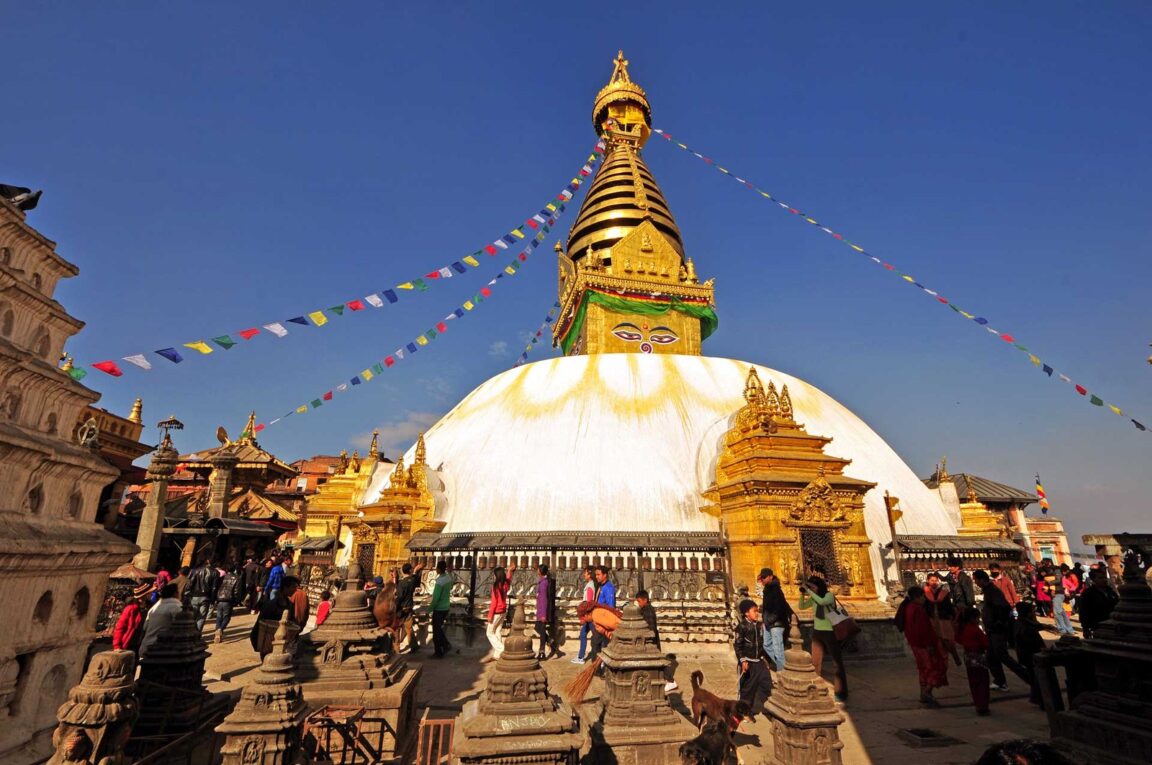
Featured image: Swayambhunath stupa in Kathmandu, Nepal, with prayer flags and visitors around the dome. Photo by Nepal Tourism Board (ntb.gov.np), Nepal’s official tourism authority.