 Jonas Lindqvist
For the Quebec Winter Carnival in 2027, the plan is to book the Old Quebec hotel first, buy the Effigy pass in the presale, and build ten winter days around three fixed points: Bonhomme’s Ice Palace lit up at night, the ice canoe race on the frozen St Lawrence, and one night parade watched from a spot claimed an hour early. The 73rd Carnival runs from Friday 5 February to Sunday 14 February 2027, dates confirmed on the official site, and everything else, the music nights, the sculptures, the snow baths and the toboggan runs, fills in around those anchors. Pack for minus twenty, base inside or beside the old town walls, and treat the cold as the festival’s medium rather than its obstacle: this is a carnival built out of winter itself.
Quick Facts
- Where: Quebec City, Quebec, Canada, centred on Old Quebec and the sites around the Parliament and the Plains of Abraham.
- When: The 73rd Quebec Winter Carnival runs from 5 to 14 February 2027, confirmed on the official Carnival site.
- The pass: The Effigy is the Carnival’s official pass, giving access to the paid sites and activities across the festival.
- The mascot: Bonhomme Carnaval, the seven foot snowman in the red toque and arrowed sash, ambassador of the Carnival since 1955 and lord of the Ice Palace.
- Signature events: The Ice Palace, the night parades, the St Lawrence ice canoe race, ice and snow sculpture, and the Music Nights programme.
- Book ahead: Old Quebec hotels for the two Carnival weekends, and the Effigy in its presale period. Parade positions and restaurant tables on parade nights also reward early planning.
- Facts checked: 19 November 2026, against the official Carnival site linked below.
What is the Quebec Winter Carnival, and why is it built from ice?
The Carnaval de Quebec is a pre Lenten winter festival in one of the coldest great cities of North America, and its founding idea, first staged in 1894 and relaunched in its modern form in 1955, was to give the hardest weeks of the Quebec winter a party equal to them. The official Carnival site carries the current edition: from 5 to 14 February 2027, with the Effigy as the pass to its activities, Music Nights from the opening evening, and the ice canoe race among its headline events, offered with a VIP viewing option for 2027. The programme’s materials are the season’s own: ice blocks for the palace, snow for the sculptures, the frozen river for the canoes, and the night itself, dark by late afternoon in February, as the stage lighting.
Bonhomme is the human shape of all this. The snowman mascot, short for bonhomme de neige, made his first public appearance in 1955, in a red toque, black buttons and the ceinture flechee, the woven arrowed sash of French Canadian and Metis tradition, and he has opened every Carnival since, receiving the keys of the city and presiding over his palace. Meeting him is a genuine event for Quebec families, and his appearances at the sites and on the final float of the parades are scheduled moments, not accidents. Plan one of them the way you would plan the canoe race. Our Quebec City in winter itinerary covers the city beyond the festival fences, for the days between Carnival events.
How do the Ice Palace, the parades and the canoe race fit together?
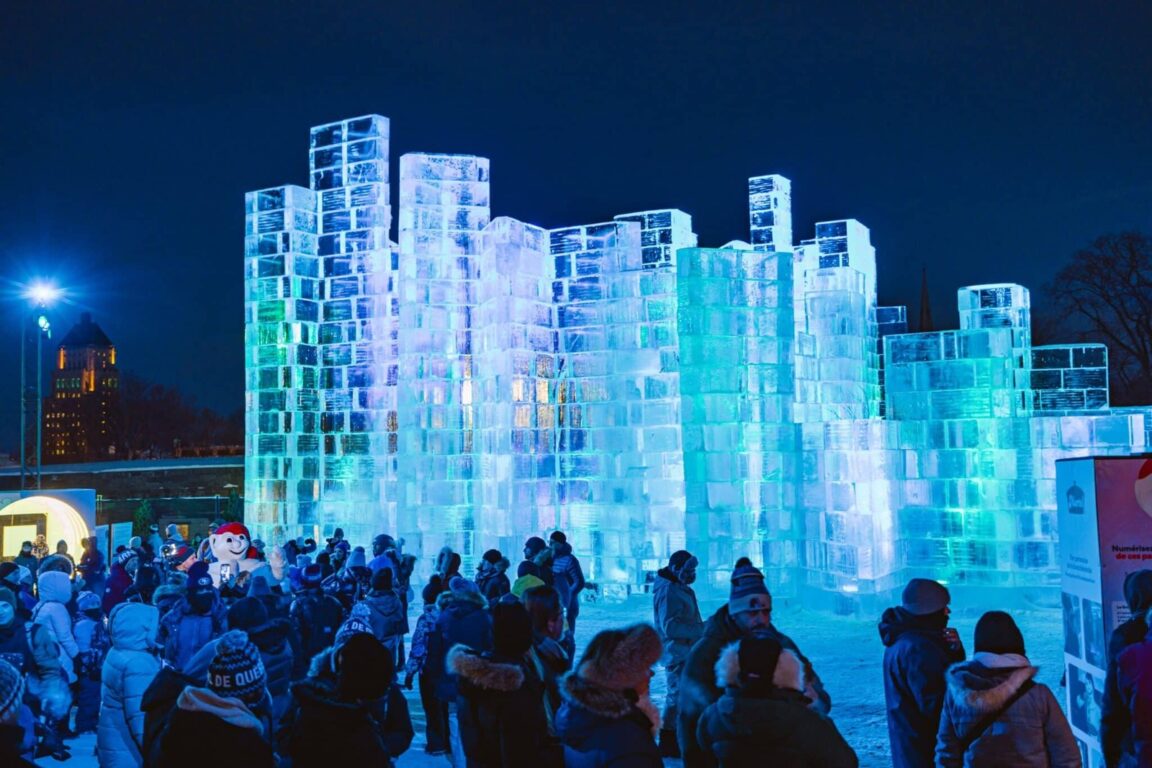
Start with the palace. Bonhomme’s Ice Palace is rebuilt from ice blocks every year on the Carnival site opposite the Parliament, a temporary residence with themed rooms that exists only for the festival and the weeks around it, and it repays two visits: once by day, when the block work and the carving read clearly, and once after dark, when the palace is lit from within and the site turns into an outdoor night party, with music and dancing beside the walls of ice. The palace is the Carnival’s fixed point. Everything else is scheduled around the sites it anchors.
The night parades are the moving counterpart. Carnival parades roll on the festival’s Saturday evenings through the upper town, floats, bands, performers and Bonhomme himself closing the procession, watched by crowds in full winter armour along the barriers. The method is the same as for any great street festival, with one Quebec addition: arrive an hour early for a barrier position, because the crowd is deep, and dress for standing still, which is a colder activity than walking and the moment underprepared visitors feel the temperature most. Hot drinks from the site vendors and the traditional carved cane filled with caribou, the Carnival’s fortified wine drink sold to adults, exist precisely for this hour.
The ice canoe race is the event with no equivalent anywhere else. Teams race long canoes across the St Lawrence between Quebec City and Levis, alternating between paddling the open leads of water and hauling, pushing and running the canoe over the ice floes, in a discipline that descends from the river’s winter transport history, when canoes were the freight link across the frozen strait. Watch it from the Old Port or the Levis shore with the official programme’s timings in hand, because heats and the final run to their own schedule, and dress for wind off the river, the coldest viewing position of the festival. Between these anchors, fill the days with the sculpture sites, the snow bath for the brave, the toboggan run on the Dufferin Terrace beside the Chateau Frontenac, and the Music Nights, which the official site programmes across the festival’s evenings.
Where should you base in Quebec City, and what does the Effigy cover?
Base in Old Quebec or on its immediate edge, around the Parliament and Grande Allee, and the whole festival becomes a walking trip. The Carnival sites, the palace grounds, the parade routes and the old town’s restaurants sit within a compact, steep, beautiful grid, and a hotel inside it means you can retreat, warm up, change a layer and return for the evening programme, which is the rhythm the festival rewards. Staying across the river or out by the airport turns every outing into an expedition and every cold hour into a negotiation. Book the base early: the two Carnival weekends are among the most demanded hotel dates of the Quebec winter, and the best located rooms go first.
The Effigy, named for the small Bonhomme effigy you wear on your coat, is the Carnival’s official pass. The official site describes it as the pass to countless winter activities, giving access to the paid Carnival sites and a range of discounts with local businesses, and it is sold in a presale period ahead of the festival at a lower price than during the event, with the current prices and the presale deadline published on the official site. Buy it before you travel if your dates are fixed, wear it visibly as the locals do, and check the official programme for which activities need it and which, like the parades and the canoe race viewed from public ground, are free to watch. Children and ticketing details change by edition, so the official site, checked in the weeks before you go, is the authority, not any guide, including this one.
How do you pack for minus twenty at a night parade?
Pack for the festival’s real condition, which is not the daytime temperature but the standing still temperature: an evening at a parade barrier or on the river shore in February can sit at minus twenty, colder with wind, and you will be stationary for an hour or more. The system that works is the northern one. A merino or synthetic base layer, never cotton, which chills when damp. A warm insulating mid layer. A windproof outer layer that reaches your knees if you have one. Two hat layers or a hat under a hood, a neck warmer you can pull over your nose, liner gloves under heavy mittens, because mittens beat gloves at this temperature, and winter boots rated for deep cold with room for thick socks and movement in the toes. Hand warmers in the mittens and boots are not a luxury here; they are the difference between watching the whole parade and leaving at the halfway float.
Dress in that full system for the evening events even if the walk out feels mild, and carry the day’s lighter version for the active hours, when skating, tobogganing and walking the sites generate their own heat and the risk flips to sweating into your layers. Our packing guide for Quebec City in December sets out the same layering logic piece by piece. The Carnival’s own traditions help: hot food and drink at the sites, heated spaces to rotate through, and a crowd that treats full winter dress as the festival costume. Dress like a local, which in February in Quebec means dress like an expedition, and the cold becomes what it is for everyone around you, the point of the party rather than the price of it.
Frequently Asked Questions
When is the Quebec Winter Carnival in 2027?
The 73rd Carnival runs from Friday 5 February to Sunday 14 February 2027, ten days spanning two weekends, as confirmed on the official Carnival site. The 72nd edition ran in February 2026, so the 2027 dates are the next edition to plan for.
What is the Effigy, and do you need one?
The Effigy is the Carnival’s official pass, worn on your coat, giving access to the paid Carnival sites and activities plus local business discounts. You need one for the gated sites such as the Ice Palace grounds. The parades and the ice canoe race can be watched free from public ground. Buy in the presale period for the lower price, and check current prices on the official site.
What should you not miss on a first visit?
The Ice Palace after dark, one night parade, and the St Lawrence ice canoe race. Those three are the Carnival’s irreplaceable events. Sculpture sites, the Dufferin Terrace toboggan run and the Music Nights fill the days and evenings around them.
Where is the best place to stay for the Carnival?
Inside Old Quebec or on its edge near the Parliament and Grande Allee, where the Carnival sites, parade routes and restaurants are all walkable. Book early for the two festival weekends, and plan to walk everywhere rather than drive, because the centre is steep, icy and busy.
How cold does it get, and what should you wear?
Plan for minus twenty, colder with wind off the river, especially standing still at evening events. Wear a non cotton base layer, an insulating mid layer, a long windproof outer layer, hat and neck warmer, liner gloves under mittens, deep cold boots with thick socks, and hand warmers for the parades.
Featured image: Bonhomme’s Ice Palace at the Quebec Winter Carnival, lit at night, with Bonhomme greeting the crowd in front of the ice walls. Photo from the Carnaval de Quebec official website, carnaval.qc.ca, the festival’s own official site, used with credit.