 Sofia Rossi
You can see the best of the Scottish Highlands without a car, and in several places the train is not a compromise but the finest way in: the West Highland Line crosses the Glenfinnan Viaduct and Rannoch Moor, the Kyle Line threads past lochs to the Skye bridge, and Highland buses and postbuses fill most of the remaining gaps. The method that works is simple to state and strict in practice. Choose one or two rail served bases, Fort William for the west and Inverness for the north and east, ride the great lines as journeys in their own right, and use local buses, ferries and the occasional taxi for the last miles. This guide sequences the whole system, with fares and timings checked on 20 November 2026.
Quick Facts: The Highlands Without a Car
- Best western base: Fort William, where the West Highland Line splits for Mallaig and where buses fan out to Glencoe and Glen Nevis
- Best northern base: Inverness, the Highland capital, for the Kyle Line, the Far North Line and buses to Loch Ness and the Black Isle
- Signature journey: Glasgow Queen Street to Mallaig on the West Highland Line, about five hours twenty minutes, crossing Glenfinnan Viaduct
- Steam option: The Jacobite steam train, Fort William to Mallaig, runs seasonally with West Coast Railways and books out far ahead
- Skye without a car: train to Kyle of Lochalsh, then bus over the Skye Bridge to Portree
- Money saver: ScotRail advance fares and the Highland Rover style rail passes reward booking the long legs early
- Reality check: rural buses can run only a few times a day and rarely on Sundays, so timetables, not maps, set the itinerary
- Checked: routes, services and headline fares verified 20 November 2026 against ScotRail, West Coast Railways and VisitScotland
Which base town should you choose, Fort William or Inverness?
Fort William and Inverness do different jobs, and most car free trips need both. Fort William sits at the head of Loch Linnhe under Ben Nevis and is the junction town for the west: trains to Mallaig, buses down the Great Glen and into Glencoe, and the ferry linked road to the Ardnamurchan and Skye corridors all pass through it. Its weakness is size; in peak summer its rooms fill and its one main street carries the whole town’s visitors. Inverness is a small city with the Highlands’ best transport web: the Kyle Line west, the Far North Line to Thurso and Wick, the main line south to Perth and Edinburgh, and bus routes in every direction, plus the widest choice of beds and places to eat. The classic car free pattern is three or four nights in each, joined by the bus and train corridor through the Great Glen, rather than a single base with exhausting day returns. Our car free guides to Lake Bled without a car and the Amalfi Coast without a car use the same base and spoke logic in very different landscapes.
How does the West Highland Line to Mallaig actually work?
The West Highland Line leaves Glasgow Queen Street, runs along the Clyde and Loch Lomond, then divides at Crianlarich: one branch west to Oban, the other north across Rannoch Moor, one of the last great wildernesses reachable by scheduled train anywhere in Britain. North of Fort William the Mallaig extension delivers the famous sequence: the curve over the Glenfinnan Viaduct above Loch Shiel, the white sands at Morar, and the fishing port of Mallaig itself, with ferries to Skye and the Small Isles. Ordinary ScotRail services cover the whole route for a standard fare, with advance tickets on the long Glasgow leg rewarding early booking. In summer the line is busy and the scenic side seats go first, so reserve where the service allows it and board early at Glasgow. Give the journey a full day rather than treating it as a transfer: Mallaig rewards a harbour lunch and, if the timetable allows, the short ferry hop to Armadale on Skye and back.
Should you ride The Jacobite steam train or the ordinary service?
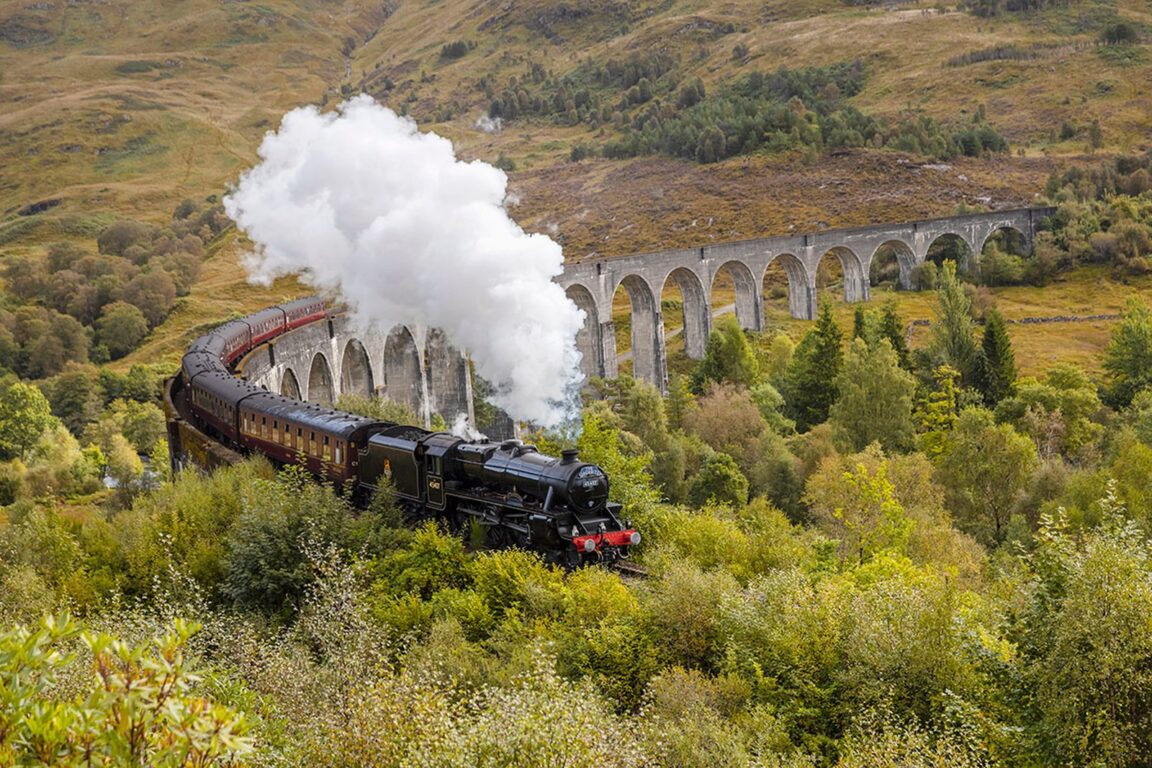
The Jacobite, West Coast Railways’ steam hauled service between Fort William and Mallaig, is the celebrity version of the same line, crossing Glenfinnan behind a heritage locomotive in vintage carriages. It runs seasonally, broadly spring to autumn, with a morning service and, in the main season, an afternoon one, and standard class day returns for the 2026 season were sold from around 76 pounds per adult. It is a superb day out and it sells out, so it belongs in the plan months ahead, not on arrival. What it does not give you is a better view of the viaduct itself: from on board, the curve is felt more than seen, and the classic photograph is taken from the hillside viewpoint near Glenfinnan station, reachable on the ordinary train. The honest answer is to ride the Jacobite for the steam experience if you can book it, and to ride the ScotRail service anyway for the viewpoint walk, the flexibility, and a fare that leaves money for everything else.
How do you work the Kyle Line and reach Skye without driving?
The Kyle Line from Inverness to Kyle of Lochalsh is the quieter masterpiece: two and a half hours or so past the Beauly Firth, through Strathcarron and along Loch Carron to Plockton’s palm fringed harbour shore and the line’s end opposite Skye. From Kyle, buses cross the Skye Bridge to Broadford and Portree, turning a rail journey into a full Skye stay without a car. On Skye itself, Stagecoach buses link Portree with Dunvegan, Uig and the Trotternish circuit, but frequencies are thin and Sunday services thinner, so a Portree base and one or two carefully chosen bus days beat any attempt at a grand tour. Plockton, ten minutes before the terminus, makes a gentle overnight in its own right, with the train as its high street’s quiet engine. Check the day’s times before committing to connections, because on this line a missed bus can mean a long, if beautiful, wait.
What fills the gaps: buses, postbuses and ferries?
Beyond the rails, the Highlands run on a sparse but workable web. Citylink coaches tie Glasgow, Fort William, Inverness and the Skye corridor together along the Great Glen. Local operators cover the peninsulas, and Royal Mail postbuses survive on a handful of the most remote routes, carrying passengers on the mail run from places such as Tongue and Lairg; where they run, they are as much an experience as a service, but they must be checked individually because routes change. CalMac ferries open the islands: Mallaig to the Small Isles and Armadale, Oban to Mull and the Hebrides, Ullapool to Stornoway. The working rule is to build each day around the single scarcest service, usually the last bus or the ferry, and let everything else arrange itself in front of it. Traveline Scotland and the operators’ own timetables, checked the week you travel, are the sources that count; printed guides, including this one, can only describe the pattern.
What does a car free Highland week cost, and where does the money go?
The long rail legs dominate. Glasgow to Mallaig and Inverness to Kyle are each priced like intercity journeys when bought on the day, and like bargains when bought as advance singles weeks ahead. Rail rover tickets covering the Highlands for a block of days suit travellers riding most days and remove the advance booking choreography, at the price of paying for days you might spend walking. The Jacobite is a deliberate splurge line. Buses and ferries are comparatively cheap, and the real cost of car free travel is occasionally a taxi: the last five miles to a remote hotel or a station connection that the bus misses by twenty minutes. Budget a modest taxi allowance per base and the system stops feeling fragile. Against that, set the avoided costs of hire cars in peak Highland season, fuel at rural prices and car park charges at honeypot sites, and the train based trip regularly wins outright.
Frequently asked questions about the Highlands without a car
Can you really visit the Scottish Highlands without a car?
Yes, provided you build the trip around the rail served towns. Fort William and Inverness as bases, the West Highland and Kyle lines as the spines, and buses and ferries for the spokes will cover Glenfinnan, Glencoe, Loch Ness, Plockton, Skye and the Great Glen without a single driven mile.
How do I see the Glenfinnan Viaduct without a car?
Take the ScotRail train from Fort William to Glenfinnan station, then follow the signed path to the viewpoint above the viaduct. Time the walk to a Jacobite crossing for the steam photograph, and confirm the day’s crossing times locally, because the heritage timetable varies across the season.
Is The Jacobite worth it compared with the normal train?
For steam, ceremony and a reserved seat on a famous train, yes, and it should be booked well ahead for the summer season. For scenery, flexibility and value, the ordinary ScotRail service runs the same track for a much lower fare, and it is the better tool for the viewpoint walk at Glenfinnan.
What is the biggest mistake car free travellers make in the Highlands?
Planning by distance instead of by timetable. Twenty miles can mean one bus a day, and Sunday services in rural areas may not run at all. Check the scarcest leg of each day first, book beds near stations and bus stops, and keep one flexible day in each base for weather and missed connections.
When is the best time to do this trip?
Late spring to early autumn gives the full Jacobite season, the longest days and the most complete bus network. May, June and September balance that against quieter trains and easier rooms than the peak weeks of July and August, when every part of this system should be booked ahead.
Services and headline fares checked on 20 November 2026 against ScotRail, West Coast Railways and VisitScotland. Rural timetables change seasonally, so confirm every leg in the week you travel.