 Jonas Lindqvist
The stress-free way to Hallstatt is the train and ferry, in that order: ride the main line to Attnang-Puchheim, change onto the Salzkammergut Railway to Hallstatt station, walk two minutes down to the pier, and let the ferry carry you across the lake straight into the village centre. Hallstatt station is not in Hallstatt at all. It stands on the opposite shore, which is why the ferry is not a scenic extra but the final leg of the railway journey, timed to meet the trains. Sleep in Obertraun, one stop further along the line, and you get the same lake, the cable car on your doorstep and a village that is calm after the day groups leave.
Quick Facts
- The route: Main-line train to Attnang-Puchheim, then the Salzkammergut Railway (REX) toward Stainach-Irdning, getting off at Hallstatt station, per the Hallstatt tourism authority.
- The ferry: Hallstatter Seeschifffahrt boats meet train arrivals and departures. The pier is a two minute walk below the station. Sources differ on the crossing time, listing about 7 to 15 minutes, so treat it as a short crossing and confirm the fare on the day. Carry cash.
- From Vienna and Salzburg: Both cities connect through Attnang-Puchheim, which sits on the main line between them.
- The bus alternative: Postbus lines 542 and 543 serve the Hallstatt Lahn bus terminal on the village side, avoiding the ferry.
- The base call: Obertraun, the next station south, for Dachstein Krippenstein access, quieter evenings and an easy bus or train hop to the village.
- Facts checked: 21 November 2026, against hallstatt.net, the village’s official tourism site, and OBB.
What are the exact steps from the main line to the village?
Step one is Attnang-Puchheim. Almost every rail route to Hallstatt passes through this junction, because the Salzkammergut Railway branches from the Vienna to Salzburg main line there. From Vienna, ride a Railjet or InterCity west to Attnang-Puchheim. From Salzburg, ride east to the same station. Step two is the change onto the Salzkammergut Railway, the single-track line that runs south through Gmunden, Ebensee and Bad Ischl toward Stainach-Irdning. The Hallstatt tourism authority calls it one of the most beautiful railway lines in Austria, and the claim holds: the line threads a chain of lakes with the water often directly beside the track.
Step three is knowing where to get off. The order of stations matters, because the names mislead. Steeg-Gosau comes first, then Obersee, then Hallstatt station, then Obertraun Dachsteinhohlen. Hallstatt station is a small building on the eastern shore of the lake, with the village visible across the water and no road connection into it. Step four is the ferry. The pier sits below the station, about a two minute walk, an easy route even with luggage, according to the tourism authority. Boats are timed to train arrivals and departures and run almost hourly, and the crossing lands you at the pier in the centre of the village, arriving the way the village was reached for most of its history.
Why does the ferry beat the car and the tour bus?
Because Hallstatt has almost nowhere to put cars. The historic centre is closed to visitor traffic by barriers during the day, and even hotel guests cannot drive through it. Day visitors are directed to the paid car parks at the edge of the village, which cannot be reserved and fill early in season. Coaches must book arrival and departure slots in advance and set down at the terminal by the tunnel. The train and ferry route skips all of that. You step off a boat in the middle of the village with your bag, while drivers are still circling the guidance signs looking for a space.
The ferry also fixes your timing discipline in a useful way. Your day is built around trains, which run to a published timetable on oebb.at, rather than around parking luck. The one rule to respect is the last connection: build your return around the last train from Hallstatt station, and take the ferry that meets it, rather than assuming a later boat exists. Check for engineering works before you travel, because OBB is modernising the Salzkammergut Railway over several years and replacement buses run during closures.
What about the bus, and the Steeg option?
The bus is the right tool for some bases. Lines 542 and 543, run under the regional OOVV network, stop at Hallstatt Lahn, the bus terminal on the village side of the lake, which avoids the ferry entirely and suits travellers already staying around Bad Ischl or Gosau. From Salzburg, the established bus pattern runs via Bad Ischl with changes onward to Hallstatt Lahn. Buses are also how you move between Hallstatt and Obertraun on the village side, a short hop that pairs with the train when you split your days.
Steeg-Gosau, the station before Hallstatt, is the other name to know. It is the closest station for Gosau and the Gosausee, and lakeside routes from the Steeg side serve travellers touring the wider Dachstein Salzkammergut by bike or on foot. For a straightforward village visit, however, Hallstatt station plus the ferry remains the cleanest arrival, and it is the one the tourism authority documents step by step. Do not get off at Steeg expecting a shorter walk into Hallstatt. There is not one.
Why sleep in Obertraun instead of in the village?
Obertraun sits across and down the lake, on the same railway line, one stop beyond Hallstatt station, and it solves three problems at once. First, space: it is a real lakeside village with room to breathe, parking that is not a daily contest and evenings that belong to residents and a handful of overnight guests once the day groups have gone. Second, the mountain: the Dachstein Krippenstein cable car valley station is in Obertraun, with the bus stop, Obertraun Dachsteinseilbahn, directly in front of it, so the Five Fingers viewing platform and the ice caves become a walk-up morning rather than a cross-lake expedition. Third, flexibility: from Obertraun you can reach Hallstatt village by train to Hallstatt station and ferry, or by the 542 and 543 buses to Hallstatt Lahn, and choose per day depending on weather and timing.
The trade-off is honest. Obertraun has fewer restaurants and less of the postcard density that draws people to Hallstatt, and the last connections back at night need checking rather than assuming. But for a two or three night stay, most travellers gain more than they lose: one early morning in Hallstatt before the groups arrive, one Dachstein day, one lake day, and quiet nights. The background reading is in Hallstatt itself, the lake village managing its own fame, and the mountain day is planned in Dachstein Five Fingers, done properly with cable car timing and tickets.
How should a day tripper time the whole thing?
Take an early train, not the one that feels civilised. Arriving on a morning ferry gives you the village in its best state, lanes walkable, the market square calm and the lakefront viewpoints unqueued. Do the salt mine or the Skywalk in the middle of the day, when the village centre is at its busiest and being above or below it is an advantage, and save a final lakeside walk for the hour before your ferry back to the station. Keep a buffer of one full connection: if a ferry or train is missed, the next pairing should still get you back to Attnang-Puchheim for the main line. And carry cash in small notes, because the ferry has historically been cash only and card assumptions are how travellers end up watching a boat leave without them.
One last piece of sequencing advice: put Hallstatt at the start of a Salzkammergut stay, not the end. Travellers who arrive fresh, by train, on a morning ferry tend to forgive the village its midday crowds, because they have already seen it quiet. Travellers who arrive tired, by car, at noon tend to judge it by that hour alone. The transport choice quietly decides which Hallstatt you meet, which is why this guide treats a railway timetable and a two minute walk to a pier as the most important sights on the trip.
Frequently Asked Questions
Is Hallstatt station in Hallstatt village?
No. Hallstatt station is on the opposite shore of the lake, according to the Hallstatt tourism authority. A ferry of the Hallstatter Seeschifffahrt carries you from the pier below the station to the village centre, and boats are timed to the trains.
Where do you change trains for Hallstatt?
At Attnang-Puchheim, for both Vienna and Salzburg departures. Change there onto the Salzkammergut Railway toward Stainach-Irdning and get off at Hallstatt station.
How do you get from Hallstatt to Obertraun and the Dachstein cable car?
By bus lines 542 or 543 to the Obertraun Dachsteinseilbahn stop, directly in front of the cable car valley station, or by train between Obertraun Dachsteinhohlen station and Hallstatt station plus the ferry.
Can you drive into central Hallstatt?
No. The centre is closed to visitor cars by barriers during the day, and day visitors use the paid public car parks at the village edge, which cannot be reserved. The train and ferry route avoids the issue entirely.
What should you check before travelling?
Train times on oebb.at, the ferry connection for your chosen train, and any Salzkammergut Railway engineering works or replacement buses, which OBB publishes during its multi-year modernisation of the line.
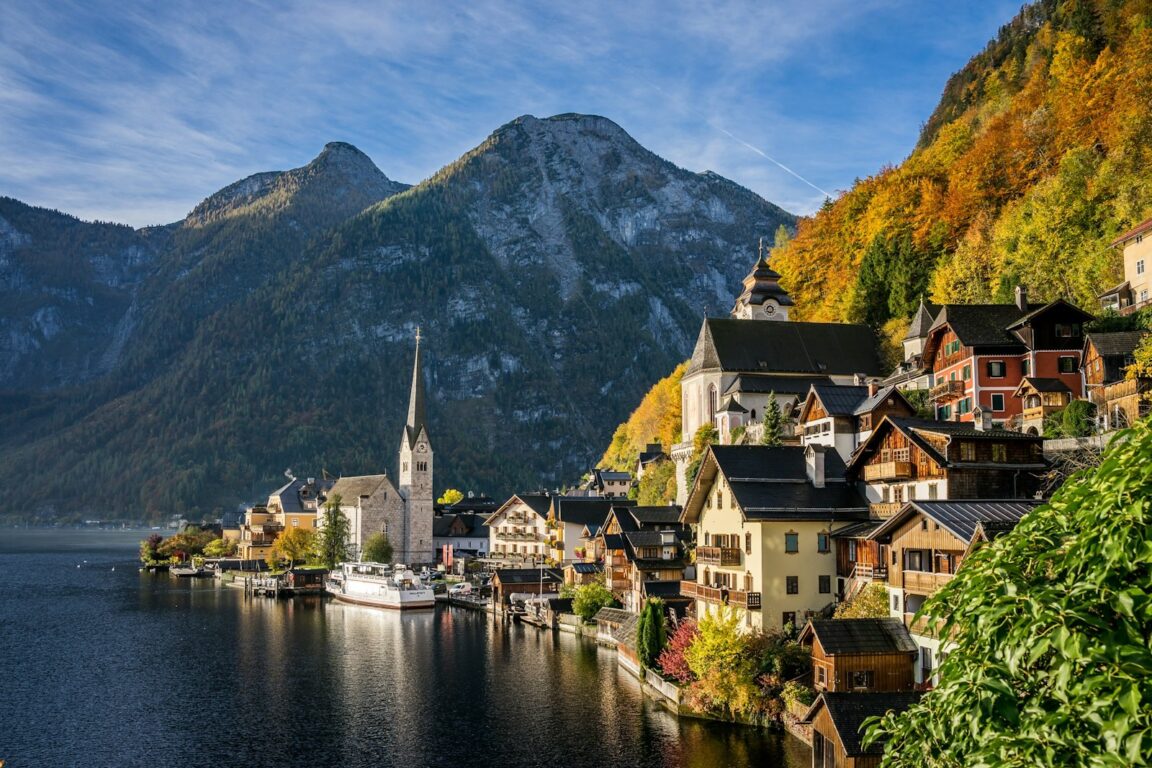
Featured image: Hallstatt village on Lake Hallstatt, Austria, with its churches and the Dachstein mountains. Photo by Leonhard Niederwimmer on Unsplash, Unsplash License, via the captioned hosted copy at Honge. Facts checked 21 November 2026.