 Aiko Tanaka
Ho Chi Minh City is about to become a two airport city, and the change will catch out anyone who books on autopilot. Long Thanh International Airport, built on a greenfield site in Dong Nai province about 40 kilometres east of the city, held its technical inauguration on 19 December 2025, and the Airports Corporation of Vietnam (ACV) has notified authorities that commercial operations are planned to begin at midnight on 24 December 2026, taking over part of the traffic that now squeezes through Tan Son Nhat. The two airports will operate side by side, flights will move in phases rather than all at once, and the airport code on your booking, SGN for Tan Son Nhat or LTH for Long Thanh, becomes the single most important detail of a southern Vietnam trip.
Quick Facts
- Where: Long Thanh, Dong Nai province, roughly 40 kilometres east of central Ho Chi Minh City.
- Codes: Long Thanh is LTH (VVLT). Tan Son Nhat remains SGN, and both airports operate in tandem after opening.
- Opening: Technical inauguration on 19 December 2025, after a first technical flight by a Boeing 787 on 15 December 2025. ACV’s operating notice sets commercial operations from 00:00 on 24 December 2026.
- Phase 1 scale: One passenger terminal and a 4,000 metre runway built to ICAO 4F standard, designed for 25 million passengers and 1.2 million tonnes of cargo a year.
- Full build: A designed capacity of 100 million passengers and 5 million tonnes of cargo a year across later phases.
- First months: Operations start in the terminal’s west wing and central area at roughly 20 to 30 flights a day, growing in three phases through 2027.
- Ground transport: Road only at opening, via the Ho Chi Minh City to Long Thanh to Dau Giay expressway and National Highway 51. No rail link is expected before the 2030s.
Why does Ho Chi Minh City need a second airport?
Tan Son Nhat is a city-centre airport that the city grew around. It handled 40.7 million passengers in 2023 against a design capacity of around 30 million, and it cannot expand because dense urban districts surround it on every side. Long Thanh is the release valve: a 5,000 hectare site where Vietnam can build the hub it actually wants, with a lotus-inspired passenger terminal of about 376,000 square metres, a roof peak above 45 metres and room for the operation to grow toward 100 million passengers a year. The terminal’s design takes the lotus blossom as its organising image, worked into the roof, the main facade and a central skylight that drops light and a waterfall feature through the check-in hall.
What is the real opening timeline?
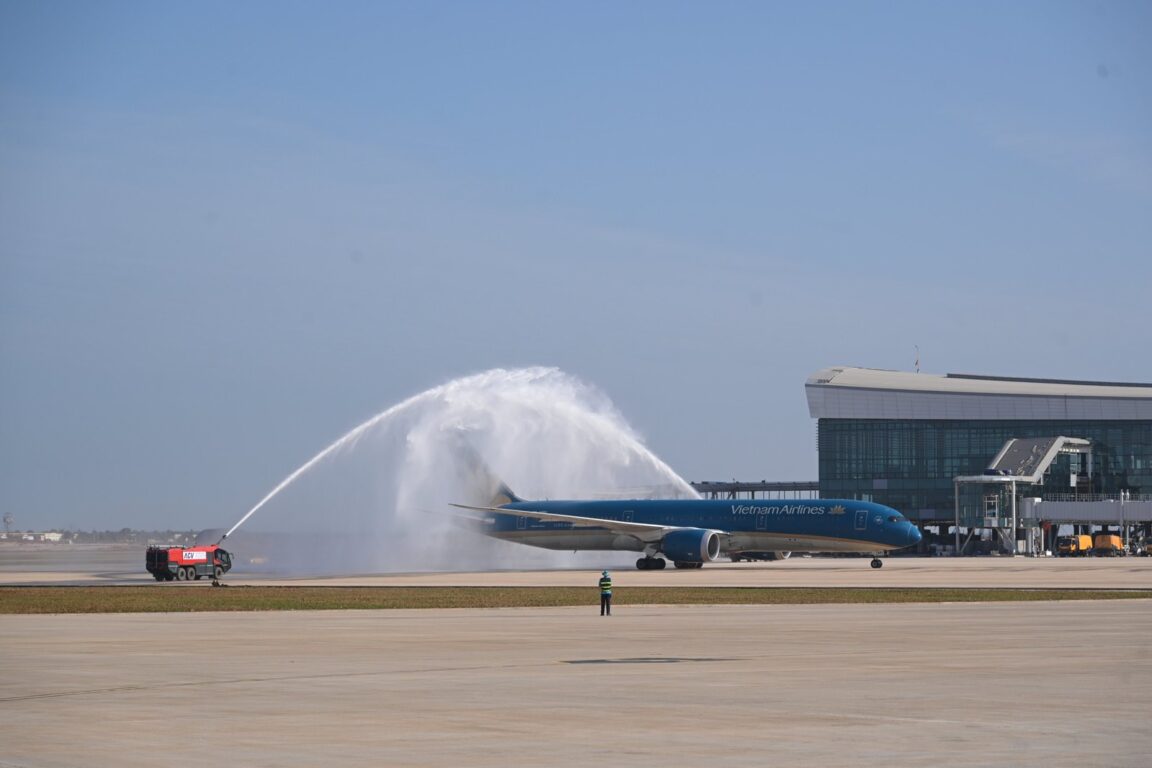
Two dates confuse almost every report on this airport, so it is worth separating them. The technical inauguration on 19 December 2025 was a ceremony and a systems milestone: runways, taxiways and aprons were complete enough to host a first technical flight by a wide-body Boeing 787 on 15 December 2025, and ACV formally inaugurated the key facilities. No passenger could buy a ticket for any of it.
Commercial opening is the date that matters, and it has moved. An earlier target of 1 December 2026 was widely reported, but ACV’s formal notice to the Dong Nai People’s Committee set the start of commercial operations at 00:00 on 24 December 2026, with Vietnam Airlines and Vietjet expected to lead the first services. Even that date depends on construction acceptance and operating certification being completed package by package, and ACV’s own plan accepts that some works, including the terminal’s east wing, continue into 2027 while the airport operates. Treat 24 December as the plan, not a promise, and confirm your departure airport with your airline close to travel.
Which flights move to Long Thanh, and which stay at Tan Son Nhat?
ACV plans the ramp-up in three operating phases. From 24 December 2026 to the end of March 2027, only the west wing and central area of Terminal 1 open, handling about 20 to 30 flights a day, with a registered ceiling of up to 366 flights a week, a mix ACV outlines as 322 domestic and 44 international services. The second phase runs from April to October 2027 as more of the terminal is accepted, and the third begins with the winter schedule in October 2027. Across the industry, the expectation is that long-haul international services progressively shift to Long Thanh while domestic routes and short regional flights, including services from Bangkok, Phnom Penh and Vientiane, remain concentrated at Tan Son Nhat during the transition.
The risk in a phased move is the split booking: a long-haul arrival at Long Thanh connecting to a domestic departure from Tan Son Nhat, or the reverse, with 40 kilometres of road between the two and no airside transfer. Check every segment of an itinerary separately, and be especially careful with codeshares and self-transfer tickets bought as two separate bookings. If a flight is moved from Tan Son Nhat to Long Thanh after you bought it, ACV has confirmed passengers will not pay additional passenger service charges for the change.
What will it cost, and how do you reach the city?
Vietnam’s Ministry of Construction has set Long Thanh’s passenger service charges for tickets issued from 1 October 2026 at VND 90,909, about US$3.52, for domestic departures and US$25 for international departures, both before tax. The domestic charge matches Tan Son Nhat and Hanoi’s Noi Bai; the international charge matches Noi Bai and sits five dollars above Tan Son Nhat’s.
On the ground, everything is road. The Ho Chi Minh City to Long Thanh to Dau Giay expressway is the main artery, backed by National Highway 51, and ACV is developing bus and shuttle arrangements for the opening period. No official transfer timetable or fare table had been published at the time of writing, and a rail or metro link is a 2030s project, not an opening-day option. For a first arrival, a hotel-booked private transfer is the most predictable choice; for departures, leave substantially earlier than you would for Tan Son Nhat, because the honest transfer time is however long the expressway takes that day. Travellers heading onward into the country should also read our stall-by-stall guide to eating in the capital, Hanoi’s breakfast order, and anyone combining Vietnam with a Pacific island hop can compare arrival systems in our explainer on the Cook Islands’ 31-day visitor permit.
What will the terminal itself be like?
ACV is building Long Thanh as a biometric-first airport. Its published digital journey has passengers registering through the national VNeID system, the iACV app or airline apps, then using 96 biometric check-in kiosks and 64 self bag drop units, with a smart operations centre monitoring the terminal’s systems in real time and smart parking using camera-based guidance and cashless payment. First months in any new terminal bring teething problems, slower processing and staff learning a new building, so early users should arrive with extra time and patience built in, and should not schedule tight onward commitments on an opening-week itinerary.
Frequently Asked Questions
When does Long Thanh Airport open to passengers?
ACV’s operating notice sets the start of commercial operations at 00:00 on 24 December 2026, following the technical inauguration on 19 December 2025. The date depends on final acceptance and certification, so confirm with your airline before travel.
What is Long Thanh’s airport code?
Long Thanh is LTH. Tan Son Nhat is SGN. During the transition both airports serve Ho Chi Minh City, so the code on each segment of your booking tells you which airport that flight uses.
Will my flight to Ho Chi Minh City use Long Thanh or Tan Son Nhat?
It depends on the route and the phase of the transfer. Operations begin with a limited schedule of about 20 to 30 flights a day and grow through 2027, while domestic and short regional services are expected to stay concentrated at Tan Son Nhat during the transition. Check your itinerary and ask the airline.
How far is Long Thanh from central Ho Chi Minh City?
About 40 kilometres east, in Dong Nai province. All transfers at opening are by road via the expressway and National Highway 51, and journey times vary widely with traffic. No rail link is expected before the 2030s.
Can I connect between Tan Son Nhat and Long Thanh on the same day?
It is possible by road but risky. The airports are about 40 kilometres apart with no airside connection, so a same-day self-transfer needs a large buffer and a backup plan.
How big will Long Thanh be when finished?
Phase 1 is designed for 25 million passengers a year. The full development is designed for 100 million passengers and 5 million tonnes of cargo a year, which would make it Vietnam’s largest airport.
Facts checked against Airports Corporation of Vietnam statements carried by ACI Asia-Pacific and Middle East, Vietnam’s official tourism portal and ACV’s operating notices on 21 November 2026. Opening dates and flight allocations remain subject to certification and airline scheduling. Featured image: a Vietnam Airlines Boeing 787 receiving a water salute beside the Long Thanh terminal at the airport’s first flight ceremony, photo by the Airports Corporation of Vietnam via ACI Asia-Pacific and Middle East, used with credit.