 Elena Vasquez
Ainsa is a medieval stone town on a ridge where the Ara and Cinca rivers meet in the Sobrarbe comarca of the Aragonese Pyrenees, and it deserves far more than a fuel stop on the way to Ordesa. The old town, declared a Historic Artistic Site in 1965, holds one of the finest medieval squares in Spain, an arcaded Plaza Mayor built in the town’s twelfth and thirteenth century heyday, a castle whose keep now houses a Pyrenean fauna eco museum, and the Romanesque church of Santa Maria at the square’s far end. Below the ridge, the newer town carries the hotels, shops and services that make Ainsa the most practical base in the district. From here, the valleys of Ordesa, Anisclo and Pineta are all under an hour away, which is exactly why the smart move is to give Ainsa an evening and a morning of its own before driving up into the national park.
Quick Facts
- Where: Ainsa-Sobrarbe, Huesca province, Aragon, Spain, at the confluence of the Ara and Cinca rivers, south of the central Pyrenees.
- Altitude and size: the old town sits at about 589 metres above sea level, and the municipality counts roughly 2,000 residents spread across 22 villages, per the town council.
- The square: the Plaza Mayor dates from the twelfth and thirteenth centuries, with a trapezoidal plan, stone arcades of semicircular arches and most of its original buildings intact.
- The castle: begun in the eleventh century around its keep and much expanded in the seventeenth century; the keep holds the Eco Museum visitor centre for Pyrenean fauna.
- The church: Santa Maria, a Romanesque parish church of the late eleventh and early twelfth centuries, among the most notable in the Sobrarbe.
- Status: the historic quarter was declared a Site of Historical and Artistic Interest in 1965, and Ainsa was named one of UN Tourism’s Best Tourism Villages in 2024.
- The park gateway: Ordesa y Monte Perdido National Park, the Sierra y Canones de Guara Natural Park and the Posets-Maladeta Natural Park all sit within easy driving reach.
Why does Ainsa reward staying overnight instead of passing through?
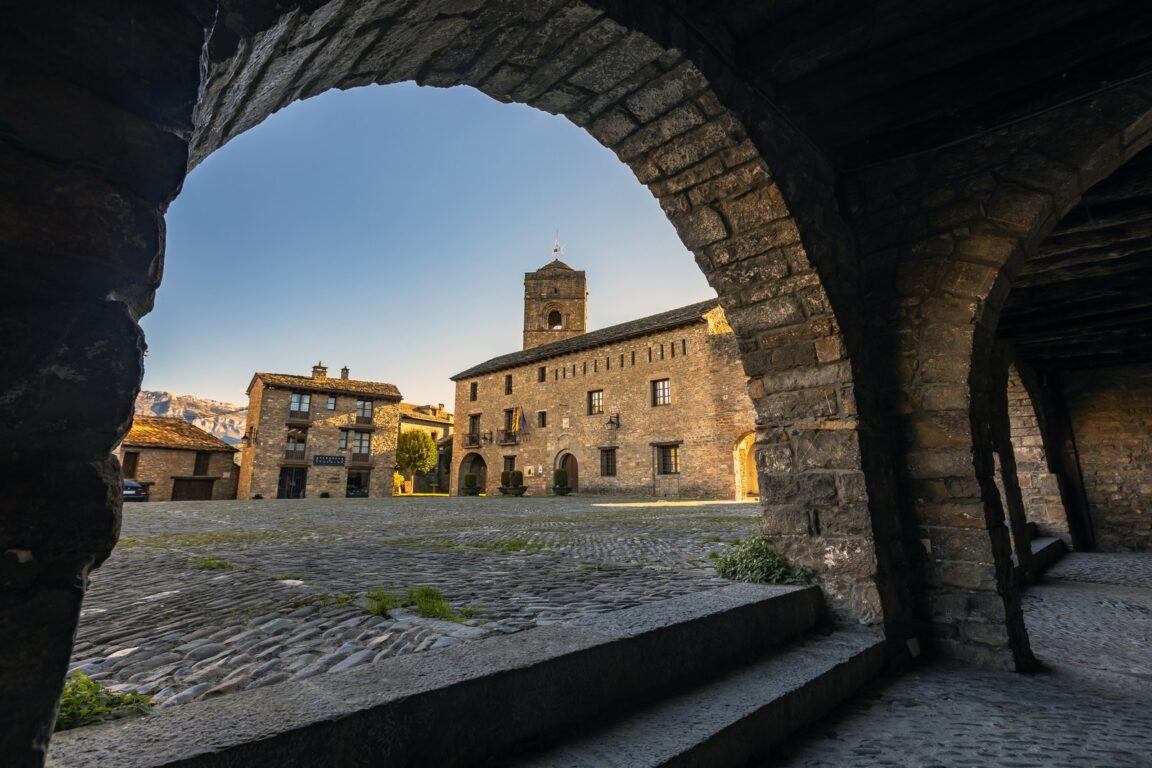
Because the town changes character once the day traffic leaves. Most visitors bound for Ordesa treat Ainsa as a crossroads, and by late afternoon the old town empties back to its residents, its two dinner options and the swallows working the square. The Plaza Mayor at dusk, seen from under its own arcades, is the version of Ainsa that justifies the trip on its own: golden stone, a cobbled trapezoid sloping gently toward the church, and the ridge of Pena Montanesa turning colour behind the rooftops. Staying also fixes the logistics of an Ordesa day, since you start rested, fed and already on the right side of the valley junctions, rather than adding a long morning drive from Huesca or Barbastro.
The Plaza Mayor: a medieval square that kept its buildings
The square is the town’s masterpiece, and the town council’s own account explains why it looks so complete: it kept most of its original buildings, a claim few medieval squares in Spain can match. The porticoes run along its sides in a rhythm of semicircular arches, no two quite alike, sheltering what were once market stalls and workshops. Under the arcades, two communal wine presses survive as a reminder that this was a working agricultural square, not a stage set. The houses that frame it are built in the local stone, with the small windows and heavy roofs the Pyrenean climate demands. Walk it slowly, once in the morning light and once at dusk, and read the square as the town’s original engine room: fairs, markets and announcements all happened here, and the covered cross and town hall still anchor its civic life.
What should you look for on the two old town streets?
Behind the square, the old town narrows to two nearly parallel streets, Calle Mayor and Calle de Santa Cruz, lined with stone houses that include the sixteenth century Casa Arnal and the Casa Bielsa. The defensive walls still wrap the quarter, and five of the original seven gates survive, so a full circuit of the old town is a short, satisfying walk that keeps delivering river views. The Sobrarbe-Pirineos Geopark has even built a geo route through the old quarter, starting at the Geopark Space in the castle’s south east tower, which explains the town through the rivers and rock that made its position inevitable.
The castle above the two rivers: what is actually there?
The castle stands at the northern end of the old town, where the ridge falls away toward the meeting of the Ara and the Cinca. Its oldest element, the keep, rose in the eleventh century on the site of an earlier fortress, and most of what stands today dates from a seventeenth century expansion so large that dozens of houses were demolished to make room for the parade ground. That parade ground is now the castle’s great pleasure: a huge open esplanade inside the walls where children can run and every visitor ends up at the parapet, reading the two river valleys below. The keep houses the Eco Museum, the visitor centre for Pyrenean fauna run with the Bearded Vulture Foundation, which makes it the right primer before a park day, especially for families who want to know what the big birds circling the cliffs actually are. In July the castle bailey hosts a music festival, and in September the Sobrarbe fair fills the same ground.
Santa Maria and the covered cross: the town’s two quiet landmarks
At the end of the Plaza Mayor stands the parish church of Santa Maria, built in the late eleventh and early twelfth centuries in a bare, austere Romanesque that suits the Sobrarbe. Its tower is the vertical accent in every photograph of the square, and the interior rewards a quiet ten minutes: this was the church of a frontier county town, built to last rather than to dazzle. Outside the walls, the Cruz Cubierta, a small circular temple built in 1655, shelters the cross in the oak that tradition ties to the legendary eighth century battle for Ainsa, the Sobrarbe cross that still appears in the first quarter of the coat of arms of Aragon. Whether or not the legend survives scrutiny, the temple tells you how this town understands itself: as the place where Aragon began.
How does Ainsa work as the Ordesa base?
Practically, and better than any rival. The town sits at the junction of the roads into the Sobrarbe’s great valleys, so the Anisclo canyon, the Pineta valley and the Ordesa valley itself are all under an hour away, and the Sierra de Guara canyoning country lies to the south. That geometry means one base, no repacking, and a different valley each day, with dinner back in a town that has real services: supermarkets, fuel, outdoor shops and a tourist office on the Avenida de Ordesa. Ainsa is also the hub of Zona Zero, a mountain bike network of more than 1,000 kilometres of signed trails reopened from the old paths between the Sobrarbe’s villages, which has turned the town into a riding base in its own right and keeps it lively outside the hiking season. Travellers who enjoy this pattern of a small historic town unlocking a big landscape may also like our guide to Ronda, Spain, and the path down into its Puente Nuevo gorge, another Andalusian ridge town that rewards those who stay past the day trip.
Where should you eat and sleep in Ainsa?
The old town’s dining is famously a two restaurant decision at the top of the hill, and both sides of that decision sit around the Plaza Mayor, where the square itself is the entertainment. The newer town below carries the wider choice, including the hotel restaurants along the main road. Sleep in the old town if you can, in one of the small stone hotels on or near the square, because the walk home under the arcades is part of the stay; sleep below if you need parking at the door and an early start. Either way, book ahead in summer and during the September fair, when the Sobrarbe fills. For a second old town built around a single dramatic site, pair this trip in your reading with Ait Benhaddou in Morocco, read beyond its film sets, a fortified village that, like Ainsa, makes most sense after the day buses have gone.
Frequently asked questions about Ainsa
How long do you need in Ainsa itself?
Half a day covers the square, castle, church and a full circuit of the walls at a relaxed pace. Add a night and the town becomes the base for two or three valley days in Ordesa, Anisclo and Pineta without changing hotels.
When is the best time to visit Ainsa?
Late spring and early autumn balance warm weather, open services and thinner crowds. July brings the castle music festival and September the Sobrarbe fair, both lively and both worth booking around rather than stumbling into.
Can you visit Ainsa without a car?
It is possible by regional bus from Huesca or Barbastro, but the valleys that make Ainsa a base really need wheels. Drivers should leave the car in the newer town or the castle car park and walk the old town, which is compact and largely traffic free.
Is Ainsa suitable for children?
Yes. The castle parade ground is enormous and enclosed, the Eco Museum introduces the park’s wildlife at child height, and the old town’s scale means nothing is a long walk. The Geopark route through the old quarter adds a treasure hunt quality for older children.