 Jordan Ellis
A friends trip to the Catskills succeeds or fails on group mechanics, not scenery. The mountains will deliver. What needs solving in advance is the money split on a big rental house, a fair way to handle food and cars, an honest reading of the reservoir rules that govern some of the region’s prettiest water, and a hiking order that keeps six people of mixed fitness together and happy. Solve those four things before you leave the city and the weekend runs itself: one person books, everyone pays a fixed share into a single pot on a set date, reservoir land is treated with the respect a drinking water supply deserves, and the hikes escalate through the weekend instead of peaking on day one.
Quick Facts
Group size assumed: Six friends, one large rental house, two cars.
The money rule: Split the house, house supplies and shared food equally per person, per night. Personal extras stay personal.
Booking rule: One named organiser books everything. Nobody books a rival house, activity or dinner on the side.
Reservoir access: Many New York City watershed lands and reservoirs are open for hiking, fishing and boating under New York City Department of Environmental Protection rules. Some areas need a free DEP Access Permit, others are signed Public Access Areas open without one.
Boating season: Recreational boating on the four Catskills reservoirs that offer it runs from 1 May to 31 October under the current DEP rules.
State land hiking: New York State Department of Environmental Conservation Forest Preserve rules apply on state trails: camping below 3,500 feet and at least 150 feet from water, roads and trails, with group size limits on trails.
Hiking order for six: An easy waterfall or rail trail walk on arrival day, a moderate summit on the main day, and a short scenic walk before the drive home.
How do you split the cost of a big house fairly?
Equal shares, calculated per person per night, is the only split that survives a friendship. Divide the total rental cost, including cleaning fee, taxes and any damage deposit handling, by the number of people and the number of nights, and publish the number in the group chat before anyone commits. Couples pay two shares, because they occupy the house, eat the food and use the water exactly as two people do. The one legitimate adjustment is a room differential, agreed in advance: if the house has one clearly superior primary suite and several clearly smaller rooms, the group can price the suite at a modest premium and discount the smallest room by the same total, so the sum is unchanged and nobody subsidises anyone else’s upgrade silently.
Run the money through one pot and one organiser. Every guest pays their share to the organiser by a fixed date before the booking deadline, and the organiser books in their own name and holds the house relationship. Shared costs during the trip, groceries, firewood, ice, a group dinner, petrol for shared driving, go on one card or one shared expenses app and are settled from the same equal split at the end. Personal costs, individual bar drinks beyond a group round, personal shopping, a massage, stay personal and are never argued about, because the boundary was drawn before the trip. Groups that improvise the split at the checkout of a grocery store on day two are the groups that come home with a grievance. Groups that publish the maths in advance almost never discuss money again.
What are the reservoir rules a Catskills group actually needs?
The Catskills hold New York City’s water, and that fact shapes recreation across a huge area of the region. The New York City Department of Environmental Protection manages more than 137,000 acres of water supply land open to recreation, across 19 reservoirs, three lakes and the watershed lands around them, with activities including fishing, boating, hiking and hunting governed by a formal rule set. The practical translation for a visiting group is a two category landscape. Some watershed lands are signed Public Access Areas, open to everyone without a permit. Others require the free DEP Access Permit, which covers the permit holder for fishing, hiking and related access on designated lands, and which each adult should obtain online before the trip if the group plans to walk watershed land rather than state or private trails.
Boating is the most regulated pleasure in the system, and the rule most likely to catch a group out. Recreational boating is a seasonal, managed program, running from 1 May to 31 October under the current rules, offered on four Catskills reservoirs, with boats subject to DEP requirements including steam cleaning to protect the water supply from invasive species. You cannot simply arrive with a friend’s canoe and launch it. Fishing similarly runs on licences and boat tags with their own terms. None of this is a reason to avoid the reservoirs: the Ashokan and its neighbours are among the most beautiful flat water and shoreline walking in the eastern Catskills. It is a reason to plan a reservoir day as a shoreline walk, a permitted fishing plan or a properly arranged boating booking, rather than an improvised swim and launch party. Swimming, it should be said plainly, is not a permitted reservoir activity. Keep the group’s water play for the region’s swimming holes, hotel pools and creeks where it is allowed, and check current signage and the DEP rules again on the week of the trip, because access areas and seasons are managed actively.
State land has its own rulebook, administered by the Department of Environmental Conservation, and the two systems sit side by side on the same map, which is why checking the specific trailhead matters. On Forest Preserve land, backcountry camping is allowed at designated sites or below 3,500 feet and at least 150 feet from water, roads and trails, camping above 3,500 feet is restricted to the winter window and emergencies, and larger groups need permits for extended stays. A house based group will rarely camp, but the same ethic applies to day use: stay on trail in mud season rather than widening it, carry out everything, and follow the Leave No Trace principles the DEC publishes for the Catskills. If the group wants a second water and woods day beyond the reservoirs, the gorge trails of the neighbouring Finger Lakes, covered in our Finger Lakes gorge trails guide, make a natural extension trip.
What hiking order works for six people of mixed fitness?
Sequence by confidence, not by ambition. Day one’s walk should be short, beautiful and finishable by the least fit member with energy to spare: a waterfall trail, a rail trail section or a reservoir shoreline path, walked in the afternoon after the drive up and the house shop. Its job is calibration. The organiser watches who is fast, who is slow, whose knees complain on descents, and sets day two accordingly. Groups that open with the biggest summit discover their spread on a mountainside, which is the worst classroom in the Catskills.
Day two carries the main hike, chosen as a moderate summit or loop with a bail out point, walked as one group with a simple discipline: the fastest walkers set a pace the middle can hold, the group regroups at every junction and viewpoint, and nobody walks alone in either direction. Carry the shared kit properly for six: more water than a couple would take, a real first aid kit, layers for the summit even in summer, and headtorches against a late finish. Day three gets a short scenic walk before checkout and the drive home, ideally somewhere like a fire tower viewpoint or an easy lake loop, finished by lunch. For wider context on building a New York State trip around the city, our Dia Beacon Hudson Valley day trip guide covers the valley floor pairing that many Catskills groups add on the drive home.
How do food, cars and downtime work for a group house?
Feed the house on a rota, not on enthusiasm. Assign each night to a cooking pair, publish the menu in advance, and shop once, properly, on arrival, from a list built off those menus plus a fixed breakfast and lunch kit. Two shared dinners cooked in, one dinner out booked ahead for the full six, because Catskills restaurants fill on weekends and a group of six without a reservation is a group eating late and badly. Dietary requirements are collected by the organiser before the shop, not discovered at the stove.
Cars run on the same clarity. Two cars for six people, with drivers named for each leg and the return drive protected: whoever drives home on the last day is off cooking and cleanup duty that morning, and petrol for shared legs goes into the common split. Downtime, finally, is scheduled rather than apologised for. A big house earns its money in the unscheduled hours, the porch, the fire pit where fires are allowed under local rules, the board games, the second coffee. Build one completely unplanned half day into the weekend and defend it. The groups that remember Catskills trips fondly are never the ones that completed the most activities. They are the ones whose mechanics were invisible, whose money was settled before it was spent, and who had time to sit still together in a beautiful place.
Frequently Asked Questions
What is the fairest way to split a rental house between friends?
Equal shares per person per night, including fees and taxes, with any room quality differential agreed and priced in advance so the total is unchanged. Couples pay two shares.
Do we need a permit to hike near the Catskills reservoirs?
Sometimes. Signed Public Access Areas are open without a permit, while other New York City watershed lands require the free DEP Access Permit for each adult. Check the specific area before you go.
Can we swim or launch our own boat in a reservoir?
No to swimming, and boating is a managed seasonal program from 1 May to 31 October on four reservoirs with DEP boat requirements including steam cleaning. Do not improvise either activity.
What is the best hike order for a mixed fitness group?
An easy scenic walk on arrival day to calibrate the group, the moderate main summit on day two with regrouping discipline, and a short viewpoint or lake walk on departure day.
How many cars does a group of six need?
Two, with named drivers per leg, shared petrol in the common split, and the final day driver excused morning chores so the drive home is safe and unhurried.
Who should book and hold the money?
One named organiser. Everyone pays their published share by a fixed date, the organiser books in their name, and shared trip costs are settled by equal split at the end.
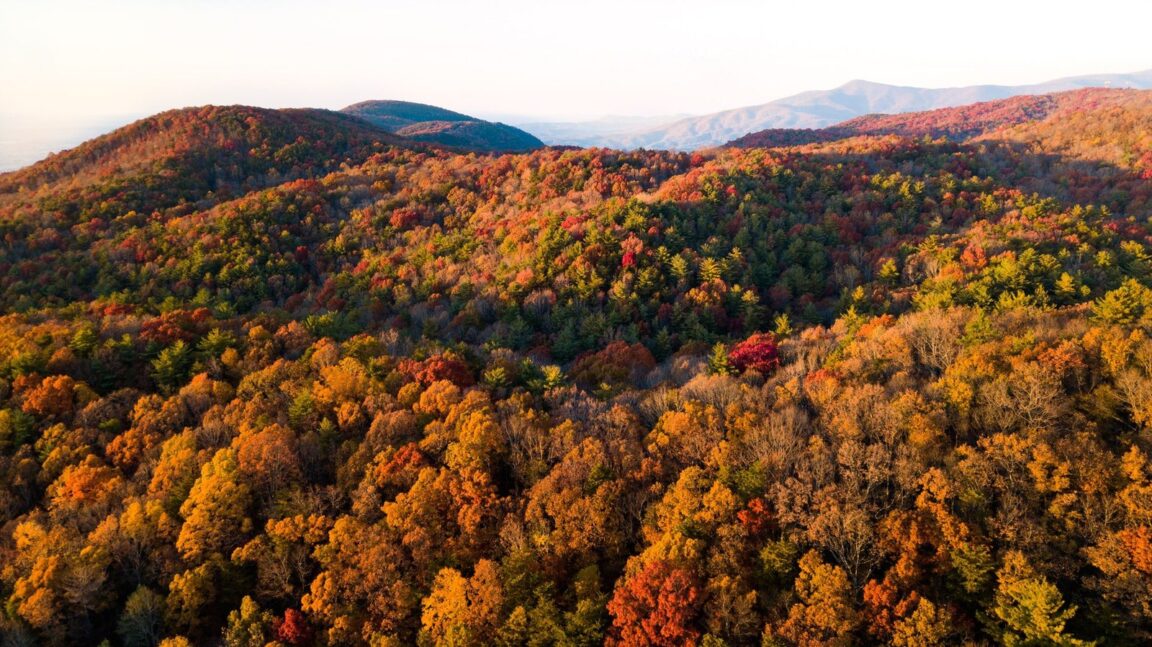
Photo: Autumn forest rolling across the Catskill Mountains of New York, the group’s hiking country in full fall colour. Credit: Ruvim Miksanskiy, via Unsplash (Unsplash License).