 Hana Kim
Inti Raymi, the Inca Festival of the Sun, is staged in Cusco every 24 June in three acts across three historic settings: an opening ceremony on the esplanade of Qorikancha, the Temple of the Sun, at about 9 in the morning, a civic encounter in the Plaza de Armas at about half past 10, and the main ceremony on the Chukipampa esplanade at Sacsayhuaman from about half past 1 in the afternoon. The Plaza de Armas act is free to watch from the square. The Qorikancha and Sacsayhuaman ceremonies have ticketed grandstands sold through EMUFEC, the Cusco municipal festival company, with free viewing from surrounding public ground and hillsides for those who arrive early enough to claim it. The whole performance is delivered in Quechua by a cast of hundreds, and it is a modern reconstruction, first staged in 1944, of a ceremony the Spanish authorities suppressed in 1572.
Quick Facts
- Date: 24 June every year, the centrepiece of Cusco’s jubilee month and now also the Day of Cusco.
- Act one: Qorikancha esplanade, from about 9:00. The Inca greets the rising sun at the former Temple of the Sun.
- Act two: Plaza de Armas, the Inca Haukaypata, from about 10:30. Free to watch, and the most crowded free ground of the day.
- Act three: Sacsayhuaman esplanade, from about 13:30. The main ceremony, with ticketed tribunes and free hillsides.
- Tickets: grandstand seats for Qorikancha and Sacsayhuaman are sold officially through EMUFEC channels. Buy only from the official seller and book months ahead.
- History: the Inca ceremony was banned in 1572. The modern reenactment dates to 1944, scripted by Faustino Espinoza Navarro from colonial chronicles including Garcilaso de la Vega.
- Status: declared part of Peru’s National Cultural Heritage by Law 27431 in 2001.
- Altitude: Cusco stands at about 3,400 metres, and Sacsayhuaman higher still. Arrive in Cusco at least two days before the festival.
What actually happens at each of the three stages?
The day is built as a procession, and watching it well means understanding that you are following a court on the move, not attending three separate shows. At Qorikancha, once the richest temple in the Inca world, its walls once covered in gold sheet, the actor playing the Inca emerges with his queen, the Coya, and his court to greet the sun and make the first offerings. The setting does half the work: the perfectly fitted Inca stonework of the temple survives beneath and beside the colonial Santo Domingo convent built on top of it, so the ceremony opens at the exact point where Cusco’s two histories are stacked on one another.
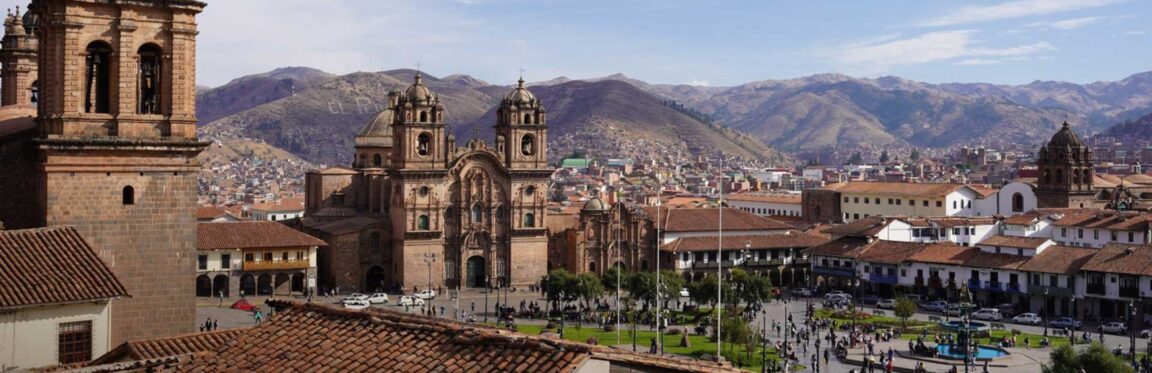
The court then processes to the Plaza de Armas, the square the Incas knew as Haukaypata, for the encounter between the Inca and the modern city authorities, the meeting of two eras that gives the act its name in the programme. This is the free heart of the day, ringed by the cathedral and the colonial arcades, and it is where the crowd is densest and the view most dependent on arriving early and holding a position. From the plaza the procession climbs out of the historic centre to Sacsayhuaman, the great zigzag walled complex above the city, where the full ceremony unfolds on the open esplanade: reports from the four suyos, the four quarters of the empire, offerings of chicha, and the staged sacrifice of a llama, performed with a prop animal. No animal is killed. The rite is theatre built on chronicle accounts, and knowing that in advance lets you watch it as the city intends, as an act of cultural memory rather than a survival.
Should you buy a grandstand ticket or watch for free?
That depends on which act matters most to you. For the Plaza de Armas, there is no decision to make: arrive early, pick a side of the square, and accept the crowd. For Qorikancha, a grandstand seat buys you an elevated, held position over a compact esplanade where free sightlines are limited and fill very early. For Sacsayhuaman, the choice is real. The ticketed tribunes face the ceremonial ground with an assigned seat, shade is limited, and the performance runs for around two hours in high altitude sun. The free hillsides around the esplanade hold thousands of Cusquenos and visitors in a festival atmosphere, with a wider, more distant view. Neither is the wrong answer, but they are different days: the tribune is for following the ritual sequence, the hillside is for sharing the city’s own picnic scale celebration.
Buy grandstand tickets only through EMUFEC’s official sales channels, and buy them months in advance, because the seated capacity is a few thousand against a crowd that fills a city. Treat any resale offer at a large markup with suspicion, and confirm exactly which venue and which tribune a ticket covers before paying, since Qorikancha and Sacsayhuaman are sold as separate venues. Festival crowds reward the same discipline as any great European feast day: our guide to Las Fallas in Valencia makes the same point about arriving before the daily set piece, and our look at Venice Carnival through its mask makers shows how much more you see when you plan around the makers and the timetable rather than drifting with the crowd.
How much of the ancient ceremony is this, really?
Honesty improves Inti Raymi rather than diminishing it. The original festival was one of the great ceremonies of the Inca state, held at the winter solstice, when the sun was at its weakest and furthest, to honour the sun god Inti and plead for his return. Colonial authorities banned it in 1572, and for nearly four centuries it survived, if at all, in fragments folded into other feasts. The ceremony you watch today was reconstructed in 1944 by the Cusco scholar and actor Faustino Espinoza Navarro, working principally from the Royal Commentaries of Inca Garcilaso de la Vega, and Espinoza himself played the Inca in the first modern performance at Sacsayhuaman. The script has been revised since, the cast has grown to hundreds of performers, many of them Cusco residents who rehearse for weeks, and the speeches are delivered in Quechua, with translation available to spectators through the event’s official channels.
So treat it the way Cusco treats it: not as a window left open onto 1500, but as a deliberate, skilled act of revival that the city has performed every year for eight decades, and which the Peruvian state recognised in 2001 as part of the national cultural heritage. That framing also explains the festival’s emotional register. For many Cusquenos this is the proudest day of the year, the centrepiece of a June filled with parades, dance competitions and Corpus Christi celebrations, and visitors who watch with that understanding are received accordingly.
How should you plan the day itself?
Acclimatise first. Cusco sits at about 3,400 metres and Sacsayhuaman above it, and a festival day means hours standing outdoors, much of it in intense high altitude sun after a cold start. Arrive in the city at least two days early, and ideally build June in Cusco as a week, because hotel capacity tightens across the whole festival month. On the day, dress in layers you can shed by midday, wear a hat and sunscreen without negotiation, carry water and snacks, and expect street closures around the procession route to make taxis slower than walking for much of the morning. If you hold a Sacsayhuaman ticket, confirm your tribune and entry point the day before, and leave the plaza with generous time in hand for the climb or the official transport arrangements. If you are watching from the hillside, claim your ground late in the morning and settle in. Either way, keep the following morning loose. Inti Raymi ends in the late afternoon, but Cusco celebrates into the night.
Frequently Asked Questions
When is Inti Raymi and how long does it last?
It is held on 24 June every year. The staged ceremony runs across a single day in three acts, from about 9:00 at Qorikancha to mid afternoon at Sacsayhuaman, inside a full month of June festivities in Cusco that includes parades, dances and Corpus Christi.
Do I need a ticket for Inti Raymi?
Only for the grandstands. The Plaza de Armas act is free to watch from the square, and the Sacsayhuaman ceremony can be watched free from the surrounding hillsides. Reserved seats at Qorikancha and Sacsayhuaman require tickets bought through EMUFEC’s official channels, well in advance.
Is a real llama sacrificed at Inti Raymi?
No. The sacrifice is simulated as part of the theatrical reconstruction, using a prop. The modern ceremony, staged since 1944, is a reenactment based on colonial chronicles, not a continuation of the pre Hispanic rite.
What language is Inti Raymi performed in?
Quechua, the language of the Incas, which is still widely spoken in the Cusco region. Spectators can follow the sequence through the official programme and translation provision announced by the organisers each year.
How high is Sacsayhuaman and does altitude matter?
Sacsayhuaman stands above Cusco, which is already at about 3,400 metres, so the esplanade is higher still. Altitude, strong sun and long periods standing are the day’s real challenges. Arrive in Cusco at least two days beforehand, take the first day gently, and carry water, a hat and sunscreen.
Where is the best free place to watch?
The Plaza de Armas for the midday encounter, if you arrive early enough to hold a good position, and the hillsides above the Sacsayhuaman esplanade for the main ceremony, where the atmosphere is festive and the view is panoramic rather than close.
Image: Cusco’s Plaza de Armas, the second stage of Inti Raymi, from PROMPERU (peru.travel), Peru’s official tourism website, used with credit.