 Hana Kim
A doubles is two small fried flatbreads called bara, overlapped on a sheet of wax paper, loaded with curried chickpeas called channa, and finished with chutneys and pepper sauce at the heat level you name when you order. The pepper scale is the whole ordering language: no pepper, slight pepper, medium pepper or plenty pepper. Say the words clearly, because the vendor works at speed, the queue behind you is ordering breakfast on the way to work, and the finished doubles should be eaten within minutes, while the bara is still soft and warm and before the wet curry soaks through it. That is the doctrine in Port of Spain, Trinidad, and everything else, the dawn queues, the famous junctions, the arguments about who fries the best bara, follows from those few facts.
Quick Facts
- The build: two bara, a ladle of curried channa, then chutneys and pepper sauce to order, folded in wax paper and eaten by hand, standing up.
- The bara: palm sized discs of flour dough with baking powder, salt and turmeric for colour, deep fried for seconds until soft and puffy, never crisp.
- The channa: chickpeas boiled tender and cooked in a wet curry of onion, garlic, curry powder or turmeric and cumin.
- The pepper scale: no pepper, slight pepper, medium pepper, plenty pepper. Slight is the sensible first order for a visitor.
- The toppings: tamarind, mango, cucumber, coconut and culantro chutneys, plus kuchela, a spicy grated green mango relish.
- The origin: created in Princes Town in 1936 by Emamool Deen and his wife Raheeman, after customers asked him to double the bara.
- The price guide: Visit Trinidad, the official tourism site, puts a pair at around TTD 20 from street vendors. Check the board at the stall before you order.
- The timing: a breakfast food first. Morning vendors are busiest and freshest, with a second wave in the evening in St James.
What exactly is a doubles, and why are there two breads?
The name is the recipe. In 1936 in Princes Town, in south Trinidad, Emamool Deen, known as Mamoodeen, was selling curried chickpeas served over a single fried flatbread with chutneys, a street adaptation of the north Indian pairing of chole and bhature that Indo-Trinidadian families had carried across two generations since indenture. Customers kept asking him to double the bread. He did, the extra bara turned a snack into a small meal that could be held in one hand, and the word doubles stuck to the dish and then to the whole trade. His son Badru Deen later set the family account down in the memoir Out of the Doubles Kitchen, which is why the 1936 date and the Princes Town origin are more than folklore.
The two bara matter structurally, not just historically. One bara alone collapses under a ladle of wet channa. Two overlapped discs give you a scoop, a fold and a spare layer to tear and mop with. Skilled eaters work from the top bara down, using it as the utensil, and finish with the soaked bottom bara, which by then has absorbed the curry, the tamarind and the pepper into one soft, saturated bite. Ordering a single, one bara only, or a triple, three, is possible at many stalls, but the double is the standard unit, and prices, queues and appetites are all calibrated to it.
How do you order without holding up the queue?
Watch one full round before you step forward. The vendor lays out bara in a row, spoons channa over each, then moves down the line adding chutneys, and the only decision you are really being asked for is pepper. The local formula is some version of give me a doubles, slight pepper, and regulars add their chutney preferences in the same breath. Slight pepper means a measured flick of pepper sauce, enough heat to register against the sweet tamarind without overwhelming the channa. Medium is a confident local order. Plenty pepper is exactly what it promises, and first time visitors who order it to be brave usually spend the rest of the morning recovering.
Pay attention to what else is on the counter. Kuchela, the grated green mango relish, brings sour heat. Cucumber chutney cools. Coconut chutney rounds everything out. If you want everything, say so, but know that the classic doubles is a balance, not a pile up: the channa should stay in charge, with the chutneys as seasoning. Eat where you stand. Doubles does not travel, does not reheat and does not wait politely in a bag while you find a bench across town. The bara steams itself soggy in its own paper within minutes, which is why vendors fry in small batches all morning and why a queue is a quality signal rather than a warning. High turnover means the bara in your hand left the oil moments ago. The same freshness logic governs great street food everywhere, from the trompo order in our guide to Mexico City tacos al pastor to the charter rules in our explainer on Marseille bouillabaisse: the standard is written down, and the best stalls are the ones visibly obeying it at speed.
Why does the Curepe Junction queue form before dawn?
Curepe Junction, where the Eastern Main Road meets the Churchill Roosevelt Highway corridor east of Port of Spain, near the University of the West Indies at St Augustine, is one of the most talked about doubles grounds in Trinidad. The logic is transport, not mystery. Buses, maxi taxis and cars funnel through the junction from before first light, students and staff stream toward the university, and a doubles vendor positioned there meets the island’s breakfast demand at the exact point where it is already standing in line. The famous stalls trade on consistency at volume: bara fried continuously, channa held at a rolling simmer, chutneys made fresh, and an order rhythm that keeps a long queue moving faster than a short one elsewhere.
Port of Spain itself works to the same clock. Downtown corners, the St James strip along Western Main Road in the evening, and the stalls around the Queen’s Park Savannah all have their regulars, and the airport food court at Piarco is known for a doubles run that can sell out early in the morning. The pattern to copy is simple. Go in the morning. Join the longest local queue you can find. Order slight pepper first and adjust on your second doubles, because there will almost certainly be a second. Carry small notes, eat immediately, and use the paper the way everyone around you does, as plate, napkin and wrapper in one.
What separates a great doubles from an ordinary one?
Three tests, all visible before you pay. First, the bara: it should be pale gold, supple and slightly puffed, with no greasy heaviness and no crisp edges. Bara fried too long or held too long turns leathery, and no chutney can rescue it. Second, the channa: tender but intact, in a curry wet enough to soak the bread slowly rather than drown it instantly, seasoned with cumin warmth rather than raw curry powder bite. Third, the balance: you should taste chickpea, turmeric, tamarind and pepper in sequence, not a single blended heat. If the pepper arrives first and stays alone, the order was wrong or the hand was heavy.
Doubles is also, quietly, one of the great levellers of Trinidadian food culture. It is Indo-Trinidadian in origin and now simply Trinidadian, eaten by everyone, at every income level, usually standing shoulder to shoulder at the same stall. Since 2019, 30 May has been marked as International Doubles Day in Trinidad and across the diaspora, and the filmmaker Ian Harnarine built first a short film, Doubles with Slight Pepper, and then a feature around what the dish means to Trinidadians abroad. None of that ceremony is needed at the stall itself. You just need to know your pepper level before your turn comes.
Frequently Asked Questions
What is the difference between slight pepper and plenty pepper?
It is the amount of pepper sauce the vendor adds. Slight is a light flick, warming rather than hot. Plenty is a full measure that will dominate the channa and the chutneys. Medium sits between them. Order slight on your first doubles and move up on the next one if you want more.
Is doubles vegetarian?
Yes. The classic doubles is bara, curried chickpeas and plant based chutneys, so it is vegetarian and vegan in its standard form. Some modern vendors offer meat topped versions, but the traditional order contains no meat, egg or dairy.
When is the best time to buy doubles in Port of Spain?
Morning is the main event, from before dawn through mid morning, when the bara is fried continuously and turnover is highest. St James and the Western Main Road have a well known evening trade as well. A doubles that has sat waiting is a lesser doubles, whatever the hour.
How many doubles should a first timer order?
Start with one, eaten on the spot, then decide. They are small, inexpensive and filling in a way that surprises people, and most first timers order a second with a different pepper level or an extra chutney once they understand the system.
Why is it served on paper instead of a plate?
Because it is built to be eaten immediately, by hand, wherever the stall is. The wax paper is folded around the doubles as a holder, catches the curry that escapes, and becomes the napkin. Taking it away to eat later works against the dish, not for it.
Where did doubles get its name?
From the doubled bread. Emamool Deen sold curried chickpeas over a single bara in Princes Town in 1936, and when customers began asking for the bara doubled, the name followed the order. The dish is widely credited to Deen and his wife Raheeman, and the family history is recorded in Out of the Doubles Kitchen by their son Badru Deen.
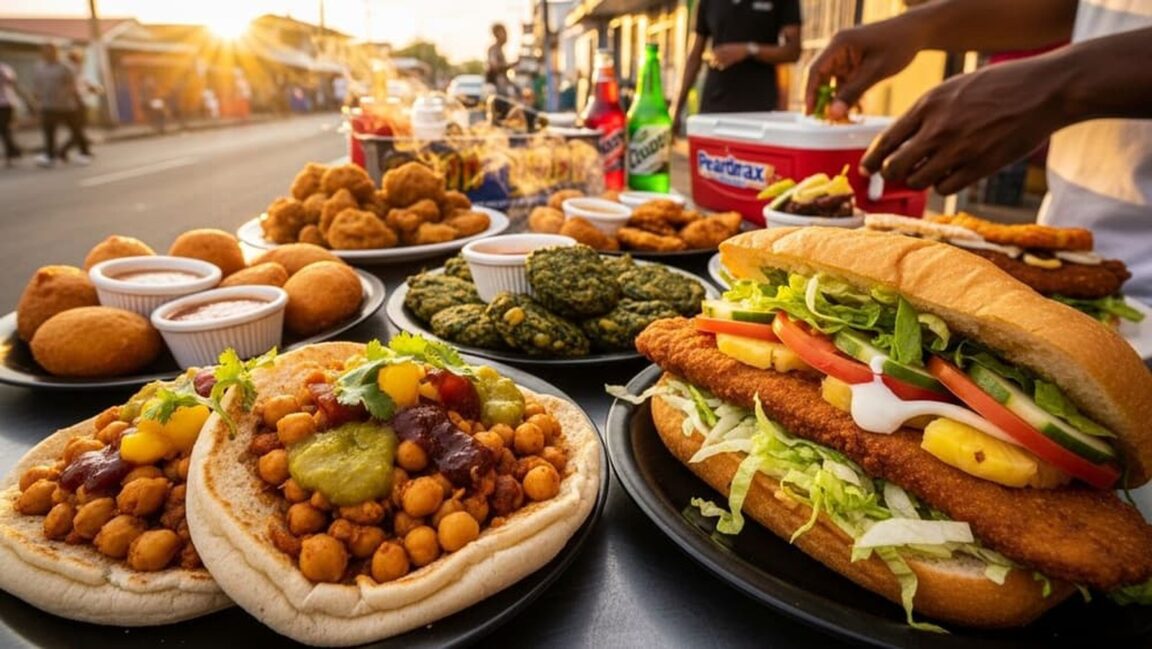
Image: A Trini street food spread with doubles in the foreground, from Visit Trinidad (visittrinidad.com), the official tourism website of Trinidad and Tobago, used with credit.