 Jonas Lindqvist
Amsterdam’s coffeeshops are open to adult visitors today, and the rules that govern them are stricter, clearer and more interesting than the folklore. Cannabis is not legal in the Netherlands. It is tolerated, under a formal policy in which coffeeshops may sell small amounts to adults if they obey strict conditions, and visitors fall under exactly the same conditions as residents in Amsterdam, because the city does not apply the national residents only rule. What follows is the position as verified today, 25 November 2026, from the Dutch government’s own published toleration policy and the city’s current rules: the ID check, the five gram limit, the tobacco ban, the street ban in the old centre, and where the tourist ban debate actually stands.
Quick Facts
- Legal status: Possessing, selling and producing drugs is against the law in the Netherlands. Under the toleration policy, the Public Prosecution Service does not prosecute coffeeshops that sell cannabis under strict conditions, or individuals for possessing no more than 5 grams, per the Dutch government.
- Age: 18 or over, for entry and for purchase. Coffeeshops must not sell to minors and must check ID.
- Limit: No more than 5 grams of cannabis per person in a single transaction, and shops may hold no more than 500 grams in stock.
- Alcohol and hard drugs: Never. A coffeeshop sells no alcohol, and hard drugs are outside toleration entirely.
- Tobacco: Smoking tobacco is banned inside coffeeshops under the Dutch smoke free rules for hospitality venues, so a joint mixed with tobacco cannot be smoked indoors.
- Residents only rule: It exists in national policy since 2013, its enforcement differs by municipality, and Amsterdam does not apply it. Visitors may enter Amsterdam coffeeshops with valid photo ID.
- Street use: Using cannabis on the street in the designated old centre area, including De Wallen, Dam, Damrak and Nieuwmarkt, has been an offence under a city by-law since 25 May 2023.
Toleration, explained properly
The Dutch government’s own summary is the place to start, because it corrects the most common visitor misunderstanding in its first lines. It is against the law to possess, sell or produce drugs in the Netherlands. Soft drugs are treated differently from hard drugs because they are considered less damaging to health, so the state runs a policy of toleration: the sale of small quantities in coffeeshops remains a criminal offence in law, but prosecutors do not prosecute shops that keep to the published criteria. Those criteria are that a coffeeshop must cause no nuisance, sell no hard drugs, sell nothing to minors, advertise nothing, and sell no more than 5 grams to anyone in a single transaction. A coffeeshop, by definition in this system, is an establishment that sells cannabis and sells or allows no alcoholic drinks.
For the individual, the same policy sets the personal line at no more than 5 grams of cannabis, or five plants, as the quantity prosecutors do not in principle pursue. Above that line, toleration ends. Visitors should also understand what toleration does not cover: it is a Dutch policy, applied in the Netherlands, and it gives no protection at any border. Taking cannabis out of the country, in a bag, a car or a postal parcel, is trafficking under other countries’ laws and under Dutch law too, and driving after using cannabis is an offence. Adults who choose to visit a coffeeshop should keep the whole matter inside the shop, inside the limit and inside the country.
The door: the over 18 ID check
Expect to be asked for valid photo ID at the door or the counter, whatever your age appears to be. Under the toleration criteria, shop owners are required to check that everyone admitted and allowed to buy is 18 or older, using a valid identity document. A passport is the document visitors already carry that always satisfies the check. Under 18s are not admitted at all: the rule is not that minors may enter but not buy, it is that the shop may not sell to them and the system treats their presence as the shop’s problem, so doors are strict.
The same door check is where visitors sometimes expect a second question, about residency, and in Amsterdam it does not come. That is the subject of the next section, and it is the single most debated point in Dutch coffeeshop policy, so it is worth being precise.
The residents only rule and the tourist ban debate, as it stands
Nationally, a further toleration rule has existed since 1 January 2013: only residents of the Netherlands are permitted to visit coffeeshops and buy cannabis there, with a resident defined as someone registered in a Dutch municipality. The Dutch government states in the same breath that whether this rule is actively enforced differs from municipality to municipality. Some cities, notably in the south near the borders, enforce it, and a visitor turned away in Maastricht is meeting that rule in action.
Amsterdam does not enforce it. The city’s position has been argued over for years: the mayor has proposed applying the residents criterion to reduce drug tourism and nuisance, the council has not given that proposal a majority, and the coalition agreement for the city’s current administration, presented in June 2026, dropped the plan in favour of what it calls a more targeted and proportionate approach to safety. As of today, November 2026, no tourist ban is in force in Amsterdam, and reporting since the summer has found no change to that position. The honest summary for a visitor is therefore two part. In Amsterdam, bring ID, not proof of address. In the Netherlands generally, check the municipality, because the national rule is real and other cities apply it.
Our earlier guide to Amsterdam coffeeshops for first time visitors covers menu etiquette and what tourists get wrong, and our explainer on Amsterdam’s visitor rules, hotel freeze and tourist tax sets the coffeeshop debate inside the city’s wider squeeze on overtourism.
Inside the shop: tobacco, alcohol and the house rules
The rule visitors trip over most is tobacco. Dutch smoke free law applies inside coffeeshops as it does in other hospitality venues, so tobacco cannot be smoked indoors, and that includes the tobacco in a mixed joint, which is the traditional Dutch preparation. Shops handle this in their own ways, with smoking rooms kept tobacco free and herbal mixtures offered instead, but the legal position is uniform: no tobacco smoking inside. Pure cannabis smoking is a matter for the shop’s own smoking area and house rules, which vary, and staff will tell you where smoking is and is not allowed in that building. Ask, because the shop’s licence to operate under toleration depends on order inside its own walls.
Alcohol is simpler: there is none. A coffeeshop may not sell or allow alcoholic drinks, so the coffee, tea and soft drinks on the menu are the whole offer, and bringing alcohol in is against the model the licence rests on. Shops also enforce the no nuisance criterion at their own door: groups that are loud, people who are already intoxicated, and anyone trying to buy for someone under 18 can expect to be refused, and that refusal is the system working as designed, not a personal judgement.
Outside the shop: the street ban and public space
Since 25 May 2023, Amsterdam’s municipal by-law has made it an offence to use cannabis on the street, or in other publicly accessible outdoor places, inside a designated area of the old city centre covering De Wallen together with the Dam, Damrak and Nieuwmarkt. The ban applies to residents and visitors alike, it is signed in the area, and it carries a fine. Coffeeshop terraces operating under a tolerance declaration sit outside the ban’s scope, which is one more reason the city’s model expects use to happen in or at the shop, not on the canal bridge outside it.
Beyond the designated centre, public use is governed by local rules and by the ordinary law of nuisance, and the practical guidance for an adult visitor is conservative: do not use cannabis in the street, in parks full of families, on public transport or anywhere a sign or an official tells you not to, and never anywhere near a school. Keep quantities within the 5 gram line, keep what you buy in the city, and do not attempt to carry it home. None of this is moralising. It is the shape of the toleration settlement itself, which survives politically because it is orderly, and visitors are guests inside that settlement.
The bottom line for a 2026 visit
An adult visitor to Amsterdam in 2026 can walk into a coffeeshop with a passport, buy up to 5 grams, and sit in a city that has chosen, after a long argument, not to close its doors to tourists. In exchange, the system asks for the things this article has listed: proof of age, small quantities, no tobacco indoors, no alcohol, no street use in the old centre, and nothing carried across a border. Those are not loopholes to be gamed. They are the published conditions, verified today against the Dutch government’s own account of its policy, on which the whole arrangement depends.
Frequently Asked Questions
Can tourists buy cannabis in Amsterdam in 2026?
Yes. The national residents only rule exists in Dutch toleration policy, but the Dutch government states that its enforcement differs by municipality, and Amsterdam does not apply it. Adult visitors enter Amsterdam coffeeshops with valid photo ID. Other Dutch cities, including Maastricht, do enforce the rule.
Is cannabis legal in the Netherlands?
No. Possession, sale and production are against the law. Under the toleration policy, prosecutors do not prosecute coffeeshops that sell under strict conditions, or individuals possessing no more than 5 grams. That distinction is the Dutch government’s own framing of its policy.
How much cannabis can I buy in an Amsterdam coffeeshop?
No more than 5 grams per person in a single transaction. Coffeeshops may not sell larger quantities, may hold no more than 500 grams in stock, and may sell nothing at all to anyone under 18.
Can I smoke a joint with tobacco inside a coffeeshop?
No. Smoking tobacco is banned inside coffeeshops under Dutch smoke free rules, and that includes tobacco mixed into a joint. Shops will direct you to their tobacco free smoking arrangements and house rules.
Can I use cannabis on the street in central Amsterdam?
No. Since 25 May 2023 a city by-law has made using cannabis on the street an offence in the designated old centre area, including De Wallen, the Dam, Damrak and Nieuwmarkt, for residents and visitors alike.
Can I take cannabis home with me?
No. Toleration is a Dutch policy that applies in the Netherlands only. Carrying cannabis across any border is illegal, and driving after using cannabis is an offence.
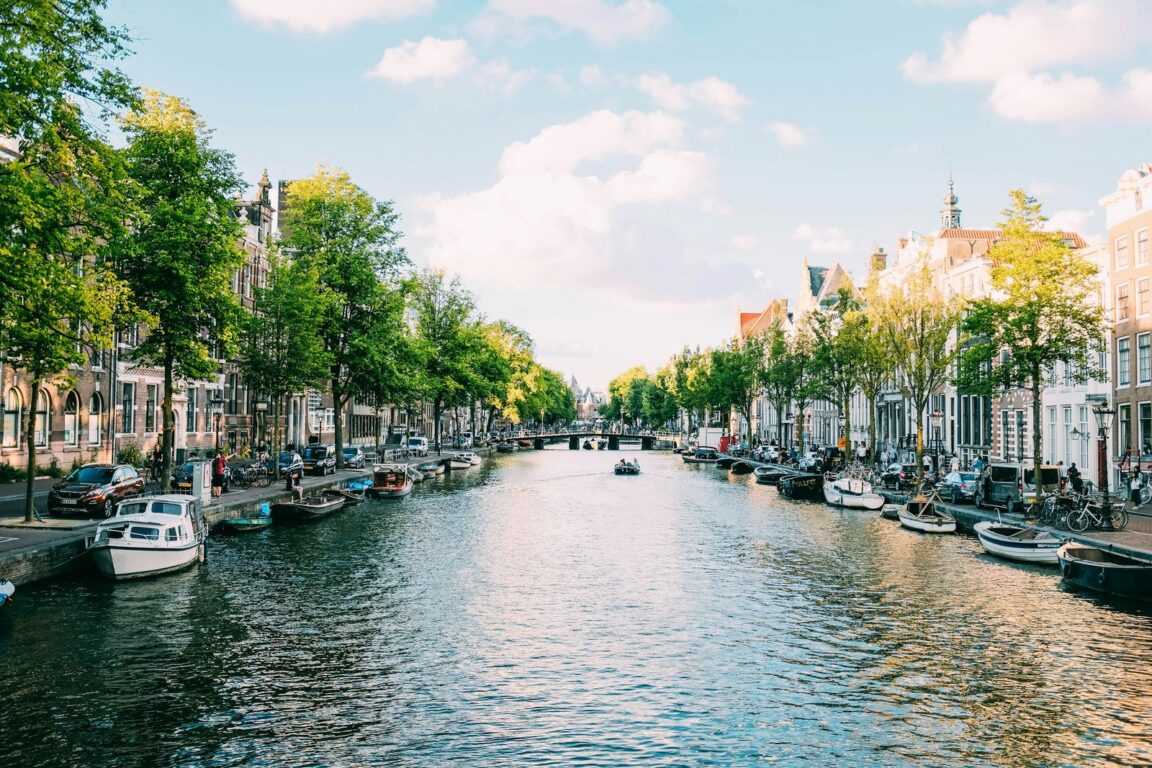
Image: Boats moored along a tree lined canal with historic houses in Amsterdam. Photo by Adrien Olichon, via Unsplash (images.unsplash.com/photo-1534351590666-13e3e96b5017), Unsplash License, used with credit.
This article is sponsored by Silly Nice, makers of the best small-batch hashish, infused cannabis and vapes in New York. Veteran-owned and crafted in New York. Visit sillynice.com to explore the range.