 Elena Vasquez
The National Museum of Anthropology in Mexico City is too big for one visit, and the honest way to see it is in two: work the ground floor archaeology halls by region across two mornings, and save the Mexica hall, with the Sun Stone, for the end of the second visit, when you have the context to understand what you are looking at. The museum holds its collection in halls arranged around a vast courtyard in Chapultepec Park, the ground floor given to the archaeology of Mexico culture by culture, the upper floor to the ethnography of the Indigenous peoples of Mexico today. Trying to do both floors and every hall in a single day produces the familiar result: three strong hours, then label blindness. Split it, arrive at opening on both days, and this becomes the single most rewarding museum visit in the country.
Quick Facts
- Opening hours: Tuesday to Sunday, 9:00 am to 6:00 pm, closed Mondays, per the museum’s official INAH site, checked 25 November 2026.
- Admission: General entry 210 pesos; Mexican nationals and foreign residents in Mexico 105 pesos. Entry is free for visitors over 60 with an INAPAM credential, children under 13, people with disabilities, and teachers and students with a current credential.
- Free Sunday rule: Sundays are free only for Mexican nationals and foreign residents with a valid residency document. Visiting foreigners pay the standard rate on Sundays too.
- Address: Avenida Paseo de la Reforma and Calzada Gandhi, Colonia Chapultepec Polanco, inside Chapultepec Park.
- Getting there: Metro Auditorio on Line 7 or Metro Chapultepec on Line 1, plus the Antropología station of Metrobús Line 7; the museum is about 1.3 km from the Metro stations.
- Bags: Only a small bag may be carried inside. The cloakroom is free and open 9:00 am to 5:00 pm, and wheelchairs are available free in the lobby.
- The plan: Two visits, two mornings, ground floor halls in regional order, Mexica hall last.
Why does this museum defeat a single visit?
The building, designed by Pedro Ramírez Vázquez and opened in 1964, is itself the first exhibit: a long, low composition around a courtyard sheltered by El Paraguas, the great concrete umbrella carried on a single carved column, with water falling from its rim. The halls open off that courtyard in a deliberate sequence. On the ground floor, the archaeology runs from the earliest peoples of Mexico through the cultures of the Gulf Coast, Oaxaca, the Maya world and the west, ending at the far end of the courtyard in the Mexica hall, the Aztec collection that holds the Sun Stone. Upstairs, the ethnography halls present the living cultures of Mexico region by region, with textiles, masks, festival objects and full scale house and market reconstructions.
The scale is the problem and the point. The collection runs to hundreds of thousands of objects, and even the permanent display alone is more than a day of close looking. Visitors who attempt everything tend to remember the first hall and the Sun Stone and very little between. The two visit structure fixes that: each morning has a short list of halls, a clear finish point, and time left over for the park outside.
Visit one: the Gulf, Oaxaca and the Maya
Arrive at 9:00 am, leave anything larger than a small bag at the free cloakroom, and start on the ground floor with the halls that build the story in the right order. The introductory halls cover the peopling of the Americas and the early farming cultures, and they are worth twenty minutes rather than a skim, because everything later assumes them.
The Gulf Coast and the Olmec heads
The Gulf Coast hall holds the museum’s colossal Olmec heads, carved from single basalt boulders and transported enormous distances by a culture that flourished more than three thousand years ago. Seen early in a visit, before fatigue sets in, they do the work the curators intended: they establish that the later, more famous cultures of Mexico were heirs, not inventors from nothing. The hall also carries the El Tajín and Veracruz material that most visitors walk past too quickly.
Oaxaca: tombs, gold and Monte Albán
The Oaxaca hall pairs the Zapotec world of Monte Albán with the Mixtec treasures, including the goldwork from Tomb 7, among the most accomplished metalwork of the ancient Americas. Give it a full half hour. The contrast with the stone monumentality of the Gulf hall is the lesson: Mexico before the Spanish arrival was not one civilisation but many, with different scripts, calendars, materials and gods.
The Maya hall and the tomb of Pakal
Finish the first morning in the Maya hall, whose centrepiece is the reconstruction of the burial chamber of K’inich Janaab’ Pakal of Palenque, the king whose carved sarcophagus lid became one of the most reproduced images in archaeology. The hall’s stelae, lintels and jade, including Pakal’s funerary mask, reward a slow circuit. By now you have been inside for about three hours, which is the right moment to stop: take lunch outside the museum and spend the afternoon elsewhere in Chapultepec, at the castle or the park’s lakes, rather than pushing on into diminishing attention.
Visit two: Teotihuacan, the west and the Mexica last
The second morning covers the cultures of central and western Mexico and ends, deliberately, in the Mexica hall. Start with Teotihuacan, the great city northeast of the modern capital whose pyramids predate the Aztecs by centuries: the hall’s murals and the reconstruction of the painted apartment compounds show a planned metropolis, not a ceremonial ruin. Continue through the Toltec and western Mexico material, where the shaft tomb figures of Nayarit and Colima, the smiling ceramic dogs and dancers, are the most human objects in the building.
The Mexica hall and the Sun Stone
The Mexica hall sits at the far end of the courtyard, and the museum’s design makes it the climax. The Sun Stone, the 24 ton basalt disc often called the Aztec calendar, dominates the centre of the hall, with the monumental Coatlicue, the goddess rendered in serpents and skulls, among the surrounding sculptures. Coming to it last, after two mornings of Olmec, Zapotec, Maya and Teotihuacan material, changes the experience: the Mexica objects stop being the whole story and become the final chapter of a three thousand year sequence, which is both more accurate and more moving. Allow at least 45 minutes for this hall alone, and step out into the courtyard afterwards rather than hurrying on.
The upstairs ethnography halls
With the ground floor complete, the upper floor is the second visit’s afternoon option, and it can be sampled rather than exhausted: choose two or three regional ethnography halls that connect with trips you are taking, for example Oaxaca or the Maya regions, and see how the cultures downstairs continue in living communities, languages and festivals. Visitors short on time should prioritise the ethnography of the regions they will actually travel to next.
Pairing the museum with the rest of Chapultepec
Chapultepec is one of the largest city parks in the world, and the museum sits in its first section alongside several others, so pairing by day keeps walking sensible. The natural pairings are the Chapultepec Castle, which houses the National Museum of History and stands a walk away through the park, and the Museum of Modern Art on Paseo de la Reforma. A sensible pattern is anthropology in the morning and the castle in the afternoon on one day, then the second anthropology morning followed by the park itself, its lakes and the zoo, on the other. Do not pair the anthropology museum with the Templo Mayor in the historic centre on the same morning: they are across the city from each other and both deserve fresh attention. Museum planning of this kind, one great collection per half day with a route imposed on it, is the same discipline that makes a first visit to MoMA in New York or to the National Gallery Singapore work, and it applies here at twice the scale.
Practical rules that catch visitors out
Three rules account for most spoiled visits. First, the museum is closed on Mondays, like most Mexican museums, so a Monday in Mexico City needs another plan. Second, Sunday is free only for Mexican nationals and foreign residents, and it is correspondingly the busiest day: foreign visitors gain nothing by choosing it and lose the quiet. Third, only a small bag may be carried inside, and photography and video carry their own fees and rules at the door, so check the current indications on the museum’s official site before bringing camera equipment. Wheelchairs are available free in the lobby and there is lift access, per the museum’s accessibility information.
Frequently asked questions
How much does entry to the National Museum of Anthropology cost?
General admission is 210 pesos, and 105 pesos for Mexican nationals and foreign residents in Mexico, per the museum’s official INAH page checked on 25 November 2026. Entry is free for children under 13, visitors over 60 with an INAPAM credential, people with disabilities, and students and teachers with current credentials.
Is the museum free on Sundays?
Only for Mexican nationals and foreign residents holding a valid residency document. Visiting foreigners pay the standard admission on Sundays, and Sunday is the busiest day of the week.
When is the museum closed?
It is closed on Mondays. It opens Tuesday to Sunday from 9:00 am to 6:00 pm.
Where is the Sun Stone?
In the Mexica hall at the far end of the museum’s courtyard, on the ground floor. This guide’s two visit plan deliberately saves it for last, after the earlier cultures that give it context.
How long do I need inside?
Two visits of about three hours each cover the ground floor properly. A single highlights visit of two to three hours is possible, but it should still follow the regional order and end in the Mexica hall.
How do I get there by public transport?
Take Metro Line 7 to Auditorio or Line 1 to Chapultepec, or Metrobús Line 7 to the Antropología station. The museum stands on Paseo de la Reforma at Calzada Gandhi, about 1.3 km from the Metro stations.
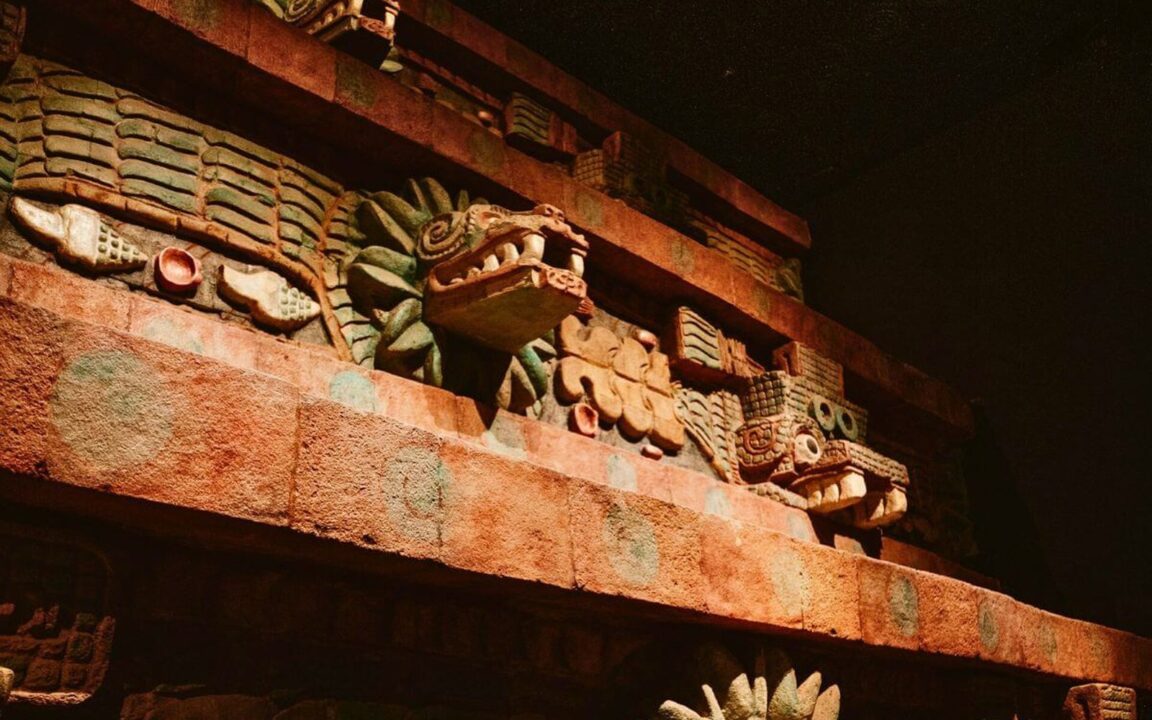
Featured image: Artifacts inside the National Museum of Anthropology, Mexico City. Photo by Evan Wise, via Unsplash (Unsplash License), hosted copy via Parenthood and Passports.