 Jordan Ellis
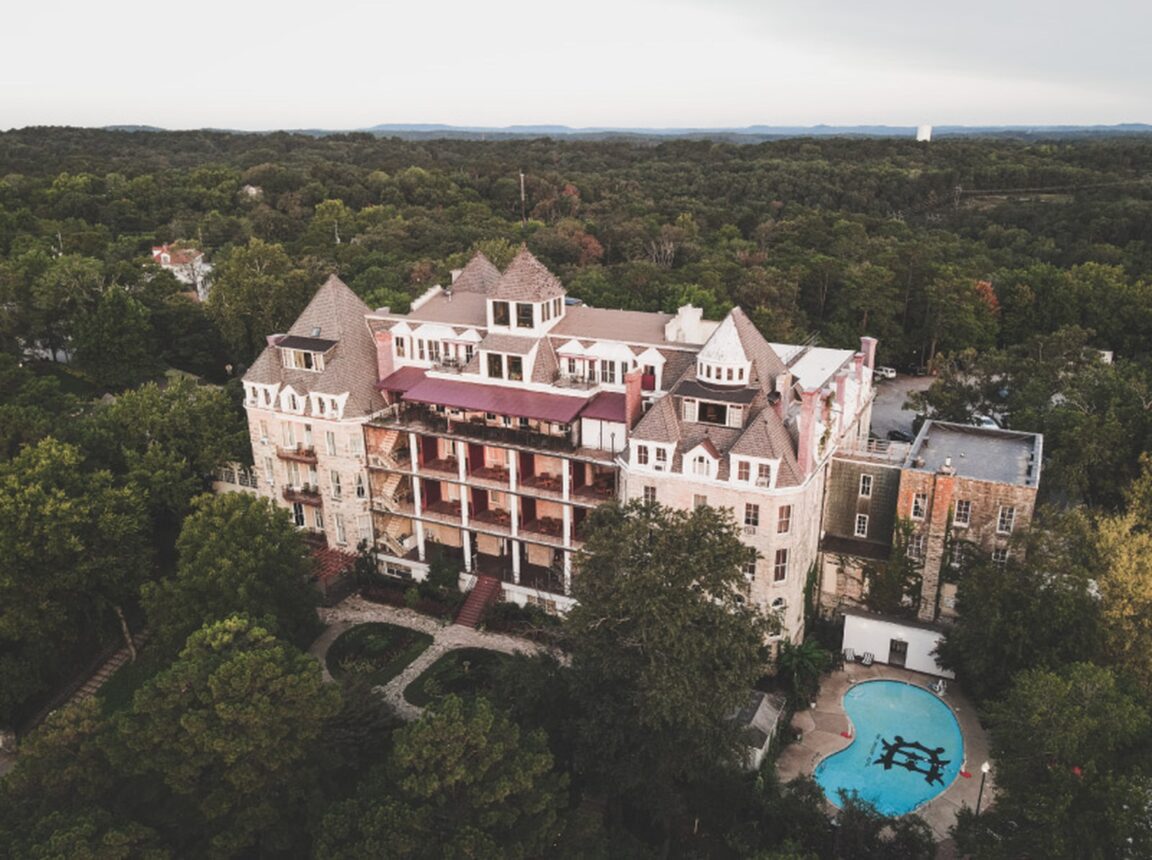
Eureka Springs sleeps the way it was built: in layers, on a hillside, along streets that were laid out by following the contours of the Ozark hollows rather than a surveyor’s grid. The town famously has no straight streets and no traffic lights, and its hotels divide by altitude. At the top of the hill stands the 1886 Crescent Hotel and Spa at 75 Prospect Avenue, the grand limestone resort that opened on 20 May 1886 and still anchors the upper loop. Downtown, wrapped around Spring Street, the 1905 Basin Park Hotel faces the little flatiron park at the town’s centre. Around both, in the hollows and along the trolley route, sit the cottage colonies and Victorian bed and breakfasts that absorb the wedding and festival weekends. Choose your layer first, and the hotel chooses itself.
Quick Facts
- The grand hotel: The 1886 Crescent Hotel and Spa, opened 20 May 1886, designed by St. Louis architect Isaac S. Taylor
- The downtown anchor: The Basin Park Hotel of 1905, on Spring Street at the centre of the historic district
- The whole town: The Eureka Springs Historic District is listed on the National Register of Historic Places, one of the largest such districts in the United States
- Getting around: The town trolley and tram tours loop the historic district and stop at the Crescent and the springs
- Street pattern: Winding, contour following streets with no straight grid, so distances on foot are longer than the map suggests
- Peak pressure: Spring and autumn weekends, when weddings and festivals book the town out
Why does the Crescent still define the town?
The Crescent was built by the Eureka Springs Improvement Company, the railroad backed venture that turned a springs camp into a resort town after the Frisco line arrived. Its hand cut limestone walls, eighteen inches thick and laid without mortar in places, came from a quarry near Beaver on the White River, and its opening banquet in May 1886 announced a resort that called itself the most luxurious in America. The building’s later lives are the town’s history in miniature: a girls’ college and conservatory from 1908, a notorious cancer hospital under Norman Baker from 1937, decades of decline, and a full restoration after Marty and Elise Roenigk bought it in 1997. Today it operates as a spa hotel and a member of Historic Hotels of America, with ghost tours that trade on the Baker years. Stay there for the hilltop position, the verandas and the sense of sleeping inside the town’s founding story. The small town mechanics that make such places work are a theme of our Fredericksburg, Texas main street guide as well.
What does sleeping downtown at the Basin Park change?
Altitude is itinerary. A Crescent guest starts each day above the town and descends into it; a Basin Park guest starts inside it, on Spring Street, with the shops, galleries and cafes at the door and the springs a short walk away. The Basin Park, built in 1905 into the hillside so that every floor touches ground at the back, suits travellers who want to walk to dinner and hear the town at night. Its trade off is the Crescent’s view: downtown rooms look at streets and rooftops, not over the valley. Neither choice is wrong. They are different towns layered on one hill, and the trolley, which loops between the upper hotel, downtown and the depot district, is what stitches them together for guests who do not want to drive the switchbacks after dark.
Where do the cottage colonies and bed and breakfasts fit?
Between and below the two anchors, Eureka Springs fills its hollows with smaller stays: Victorian houses converted to bed and breakfasts along the historic loop, cottage colonies built for the motor age, and cabins on the wooded edges toward Beaver Lake. These are the stays that absorb the town’s group business, wedding parties, reunion weekends and festival overflow, and they are often the best value in town on quiet weekdays. Their honest costs are hills and distance. A cottage that looks central on a map may involve a steep walk on streets with few sidewalks, so drivers should plan on the trolley or a car for evenings. Island travellers will recognise the pattern from our Mackinac Island after the last ferry guide: in a preserved historic town, the geography is the amenity and the constraint at once.
When do wedding weekends take the whole town?
Eureka Springs is one of the South’s wedding capitals, with ceremonies at the Crescent, at Thorncrown Chapel in the woods outside town and in gardens across the district. Spring weekends from April into June and autumn weekends in October are the pinch points, when a large wedding can take a hotel’s full inventory and the town’s restaurants fill with rehearsal dinners. The practical rules are simple: book early for those windows, expect minimum stays, and consider a Sunday to Tuesday pattern, when the same rooms free up and the town returns to its residents. Weekday Eureka Springs, with the tram tours running and the springs quiet, is a different and arguably better town than the Saturday version.
How should you plan a stay around the trolley streets?
Use the trolley as your map. Ride the full loop once on arrival to learn the layers, note where your hotel sits against the springs and the downtown core, and then walk downhill and ride back up. Drivers should know that parking downtown is scarce on peak weekends and that the park and ride lots with trolley connections exist precisely because the Victorian street plan cannot absorb modern car volume. None of this is a flaw. It is the preserved mechanics of an 1880s spa town, and leaning into it is the difference between fighting Eureka Springs and enjoying it.
What should you eat and drink within walking distance of the hotels?
Both anchor hotels keep dining in house, the Crescent with its Crystal Dining Room in the 1886 ballroom space and the Basin Park with its balcony restaurant over Spring Street, and the downtown grid adds cafes, bakeries and bars within a few contour following blocks. The honest pattern for a stay is breakfast where you sleep, lunch wherever the trolley loop drops you, and dinner chosen by altitude: up the hill for the occasion, downtown for the ease.
Frequently asked questions
What is the most famous hotel in Eureka Springs?
The 1886 Crescent Hotel and Spa, the grand limestone resort on Prospect Avenue at the top of the historic loop, opened in 1886 and restored to its Victorian form in the late 1990s.
Is it better to stay at the Crescent or downtown?
At the Crescent for views, resort facilities and the founding story. Downtown at the Basin Park for walking to dinner and being inside the street life. The trolley connects the two.
When is Eureka Springs busiest?
Spring and autumn weekends, driven by weddings and festivals. Book well ahead for April to June and October, or travel midweek.
Do you need a car in Eureka Springs?
You need one to reach town and for outlying sights like Thorncrown Chapel, but inside the historic district the trolley and walking cover most stays, and parking is limited at peak times.
Why are the streets so winding?
The town grew around its springs in steep Ozark hollows, and the streets follow the contours. The result is a preserved Victorian street plan with no straight grid.
Image credit: The 1886 Crescent Hotel and Spa above the trees in Eureka Springs, photo from the Crescent Hotel’s official website, crescent-hotel.com, used with credit.