 Jonas Lindqvist
The honest answer is that the best weeks for the northern lights in Iceland are not the darkest weeks of the year. Late September to mid October, and again from mid February to late March, give you nights long enough for a real aurora watch and days long enough to actually travel: waterfalls in daylight, ring road stops without rushing, and a sunset that does not arrive before lunch. December and January maximise darkness, with as little as four hours and twenty minutes of daylight in Reykjavik around the solstice, but they compress every daytime sight into a single blue twilight window. This guide weighs the two sides month by month, using daylight figures for Reykjavik published from Icelandic almanac data, the Icelandic Met Office aurora forecast at vedur.is, and road conditions from the Icelandic Road and Coastal Administration at road.is.
Quick Facts
- Aurora season: Roughly late August to mid April, when nights are dark enough for the sky to go properly black
- Darkest weeks: Mid December to early January, with about four to five hours of daylight in Reykjavik
- Best balance: Late September to mid October and mid February to late March
- Daylight in March: About ten hours at the start of the month, rising past thirteen by the end
- Forecast tools: The Icelandic Met Office aurora forecast at vedur.is and road conditions at road.is
- Moon rule: Faint aurora displays wash out around the full moon, so check the lunar calendar before fixing dates
Why does darkness alone not settle the question?
Seeing the aurora needs three things at once: a dark sky, a clear sky and solar activity overhead. Darkness is the only one of the three you can buy in advance by choosing a month, and it is also the one with the steepest price. Every extra hour of night in midwinter is taken directly from the day you would spend at Skogafoss, on a glacier lagoon beach or driving between towns. Iceland in December is not a write-off in daylight, because the low sun produces hours of soft twilight on either side of the short day, but it is a trip planned around a narrow midday window. Travellers who come only for the lights can accept that trade. Travellers who want Iceland as well as the lights usually regret it.
There is a second catch. Midwinter brings the most volatile weather of the year, and cloud cover, not darkness, is the most common reason aurora trips fail. A week in October with nine usable night hours and settled skies can easily outperform a week in January with sixteen night hours and three storms. For a fuller regional breakdown, see our guide to the best time to visit Iceland’s South Coast, which tracks the same trade off along the waterfall coast.
How do September and October balance night and day?
September opens the practical season. Daylight falls from about fourteen and a half hours at the start of the month to about eleven and a half by the end, and by mid month the sky is dark enough for displays on active nights. The ring road is still in autumn condition, highland routes are closing or closed depending on the year, and the summer crowds have gone. October deepens the night quickly: days shorten from roughly eleven hours to eight, temperatures drop, and the first snow can arrive in the north and the highlands while the south coast stays driveable with care. These are the months when a single trip can hold a glacier walk at noon and an aurora watch at ten in the evening without either feeling squeezed.
What do November, December and January really cost you?
November is the hinge month. Daylight shrinks toward five hours, the highlands are closed for winter, and many rural tours move to their winter schedules. The aurora odds on a clear night are excellent, but clear nights compete with Atlantic storms, and every plan needs a weather fallback. December and January are the extreme version: sunrise after eleven in the morning and sunset before four in the afternoon around the solstice in Reykjavik, with the day lengthening noticeably by late January. What survives in that window is a tight golden circuit near the capital, a south coast waterfall run timed to the middle of the day, and long, sociable evenings. If your list is headed by the northern lights and little else, this is your season. If your list includes the ring road, read our seven day ring road route before booking a winter version of it, because several of its legs are daylight hungry.
Why do February and March suit most travellers best?
February keeps most of the night and starts returning the day. Daylight grows from about seven hours to ten across the month, roads are managed on winter schedules that drivers can plan around, and snow cover makes the landscape the version most visitors picture. March is the sweet spot for many: ten hours of daylight at the start, more than thirteen by the end, long dark evenings early in the month, and the equinox period, which aurora watchers value because geomagnetic activity often rises around the equinoxes. By early April the nights are shortening fast, and by mid April the season is effectively over as true darkness disappears.
How much does the moon matter, and when do roads and waterfalls close?
A full moon does not switch the aurora off, but it raises the brightness of the whole sky, and weak to moderate displays fade against it. Strong displays still show. The practical move is to place your trip in the two weeks around the new moon when you can, and to treat a full moon week as a landscape trip with aurora as a bonus. On access: the interior highlands and their F roads are a summer only proposition and close for winter, roughly from autumn until the following June or July depending on snowmelt, with exact openings announced by the road authorities each year. The famous ring road waterfalls, including Seljalandsfoss and Skogafoss, are reachable all year, though paths ice over and crampons become standard advice in winter. Always check road.is on the morning of any winter drive, and treat a closed road as closed.
Frequently asked questions
What is the single best month for northern lights and sightseeing together?
March, for most travellers. It combines long evenings early in the month with ten to thirteen hours of daylight, winter scenery and roads on predictable winter schedules.
Can you see the northern lights in Iceland in summer?
No. From roughly May to mid August the sky never gets fully dark, so even strong solar activity cannot be seen. Summer is the season for the highlands, puffins and the midnight sun instead.
How many nights should you allow for the aurora?
Three nights is a minimum and five is better, because cloud cover decides most outcomes. A longer stay lets you move with the clear sky forecasts published by the Icelandic Met Office.
Is a tour better than self driving at night in winter?
For most visitors, yes. Tour operators read the cloud forecasts nightly and drive to the gaps, and their drivers are working on winter roads in the dark so you do not have to.
Does the full moon ruin an aurora trip?
It weakens faint displays but not strong ones. If your dates fall on a full moon week, plan the trip around landscapes and treat any display as a bonus.
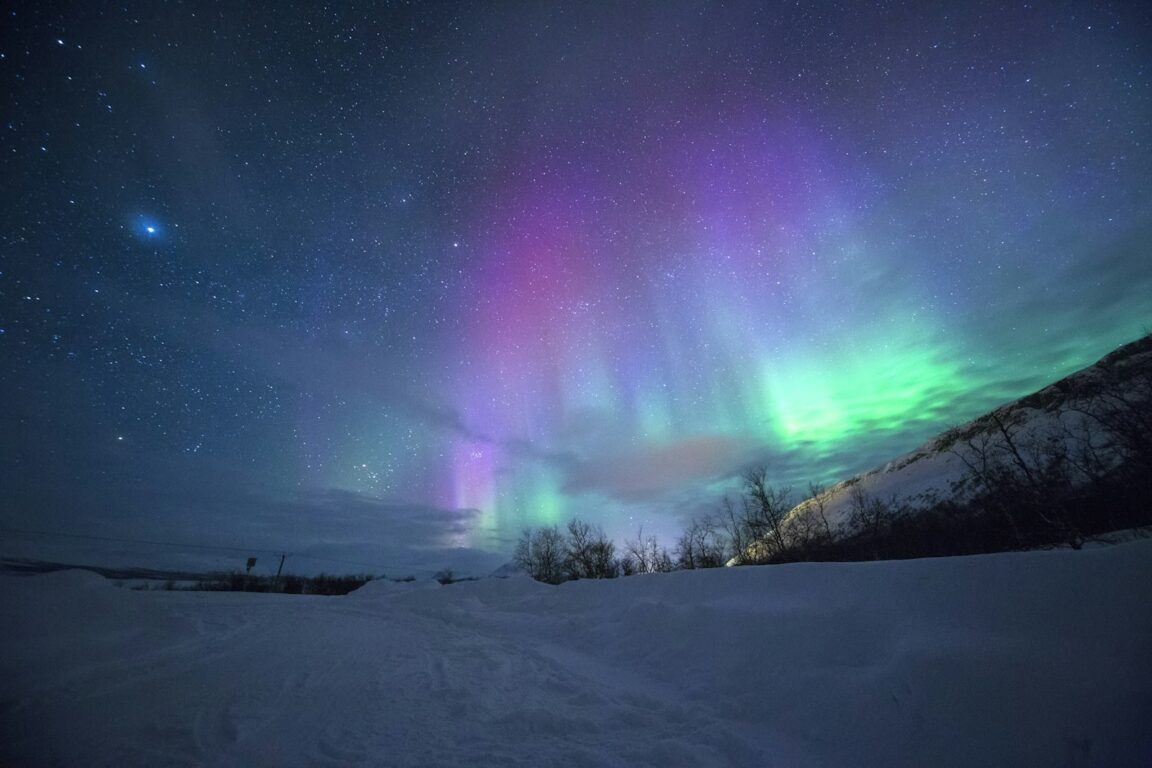
Image credit: The northern lights over a snow covered landscape, photo via Unsplash, unsplash.com.