 Maya Chen
Three nights in Luang Prabang work best when the dawn alms ceremony is treated as the beginning rather than the whole story: give one morning to the Mekong boat upstream to the Pak Ou caves, one to the tiered pools of Kuang Si with time to climb past the first cascade, and one evening to the quiet far end of the night market and the weaving villages across the river. The town’s UNESCO-listed peninsula rewards slowness, but the days outside it are what turn a pretty stop into a complete trip.
Quick Facts
- Base: The old town peninsula between the Mekong and Nam Khan rivers, walkable end to end.
- Kuang Si Falls: About 30 km from town, open daily 08:00 to 17:30; foreign visitor entry 100,000 kip under the provincial schedule effective 15 November 2026, per Tourism Luang Prabang.
- Pak Ou Caves: About 1.5 hours upstream by boat; entry 60,000 kip for foreign visitors under the same schedule; boats typically leave in the morning and the round trip takes about 3.5 hours.
- Bear Rescue Centre: Inside the Kuang Si grounds, run with Free the Bears, with no separate entrance ticket.
- Across the river: The Chomphet side, reached by the local ferry, holds weaving and pottery villages including Ban Chan.
- Night Market: Sisavangvong Road closes to traffic each evening; the quietest stalls are at the far end, away from the Phou Si entrance crowds.
- Checked: 25 November 2026, against Tourism Luang Prabang attraction listings. Confirm prices at the gate, as provincial schedules are revised.
How should the Pak Ou boat day be timed?
The Pak Ou caves sit where the Nam Ou meets the Mekong, about 1.5 hours upstream from Luang Prabang, and the journey is half the value: limestone cliffs, fishing villages, and a stop at Ban Xang Hai, the village known for lao-lao rice spirit, on most boat itineraries. The lower cave, Tham Ting, opens directly off the river and holds thousands of Buddha images left by devotees over centuries; a steep stair climbs to the upper cave, Tham Theung, which needs a torch and rewards the effort with a darker, older atmosphere. Boats leave in the morning from the town pier, and the standard round trip runs about 3.5 hours including the cave stop, which puts travellers back in town for a late lunch. The honest judgement is that the caves themselves are modest in scale; go for the river morning and the accumulated devotion of the lower cave, not for grandeur, and the day will not disappoint. Our earlier Luang Prabang travel guide covers the peninsula temples and palace in depth, and travellers heading south can continue with Vang Vieng’s limestone lagoons and viewpoints.
Where are the quiet pools at Kuang Si?
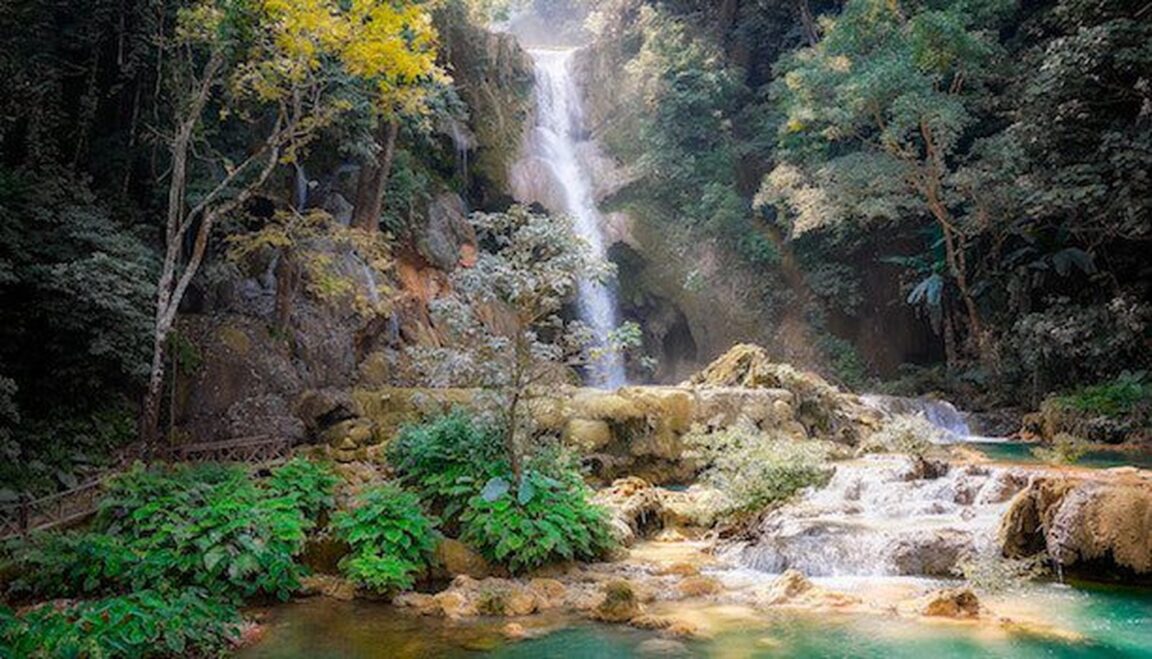
Kuang Si is a terraced limestone waterfall about 30 km from town, open daily from 08:00 to 17:30, where mineral-rich water drops through a series of turquoise pools in the dry season. Most visitors stop at the first wide cascade and the swimming pools immediately below it, which is why those pools feel busy by late morning. The quieter water is further on: follow the paths upward beside the falls, where smaller upper pools sit between the terraces, and continue to the top of the main fall, where the stream runs calm before it drops and a swing and viewpoint look back over the valley. Swimming is allowed only in the signposted pools, changing rooms are provided, and the provincial tourism office asks visitors to cover up away from the water. Inside the same grounds, the Tat Kuang Si Bear Rescue Centre cares for rescued Asiatic black bears at no extra ticket cost, and it deserves twenty minutes rather than a walk-past. Arrive at opening time and Kuang Si is a half-day of near-empty pools; arrive at noon and it is a queue for the same photograph.
What is across the river in Chomphet?
The local car and passenger ferry crosses the Mekong from the town pier to Chomphet district, a rural bank with no through traffic and a string of craft villages. Ban Chan is known for pottery, made from local clay and fired in traditional kilns, while neighbouring villages weave cotton and silk on wooden looms under stilt houses. A half day on foot or by rented bicycle on the Chomphet side shows the working Mekong that the peninsula’s cafes face but rarely touch: gardens, temples with almost no visitors, and weavers who will demonstrate the loom and sell cloth at workshop prices. Carry kip in small notes, agree any price before a demonstration turns into an obligation, and keep the last ferry time in mind, because the crossing is a local service, not a tourist shuttle.
How should the night market be done properly?
Every evening, Sisavangvong Road closes and fills with stalls selling textiles, carvings, coffee, and the famous buffet alley food of the side lanes. The crowded first stretch near the palace end is mostly repetition; the market improves as it thins, toward the far end, where weavers from specific villages sell their own cloth and prices soften once a traveller can name the difference between machine-made and hand-loomed pieces. Eat where the trays turn over fast, keep small notes ready, and bargain lightly and with humour, because the amounts at stake are small and the interaction is part of the exchange. If the alms ceremony is attended at dawn, the respectful rules are simple and non-negotiable: observe from at least five metres away, no flash, dress modestly, and only give alms through a local arrangement rather than buying sticky rice from a street seller at the kerb.
How do three nights sequence, day by day?
Day one belongs to the peninsula: the Royal Palace museum and Wat Xieng Thong in the morning light, a slow afternoon in the lanes between the rivers, and the climb up Phou Si for sunset before the night market fills the street below. Day two is the river day, with the morning boat to Pak Ou and a lazy afternoon, perhaps across the water in Chomphet if energy holds, or in the cafes of the peninsula if it does not. Day three starts at Kuang Si at opening time, returns by early afternoon, and leaves the last evening for the market’s far end and a Mekong-front dinner. Woven through all three days are the small institutions that give the town depth: the Traditional Arts and Ethnology Centre for the cultures of Laos beyond the lowland majority, and the UXO Lao Visitor Centre, whose exhibits on unexploded ordnance explain the war legacy that still shapes the countryside visitors pass on the road to the falls. Neither takes long, and both change how the rest of the trip reads.
When is the best season for this three-night pattern?
The cool, dry months from November to February suit it best: the Mekong runs clear, Kuang Si’s pools hold their turquoise colour, and mornings on the river are cold enough to make the boat trip feel alpine at the start. In the green season the falls run bigger, browner and louder, the upper paths turn slick, and boat schedules bend around the weather, but the town is emptier and the countryside is at its most vivid. The burning season in March and April, when smoke from regional field clearing can haze the valley for weeks, is the one window this itinerary cannot fix with timing; travellers locked into those dates should keep plans flexible and weight the trip toward the town’s museums, temples and cafes on the worst air days.
Frequently Asked Questions
How long does the Pak Ou caves trip take?
About 3.5 hours as a round trip by boat, including roughly 1.5 hours upstream, time in both caves, and usually a stop at Ban Xang Hai village. Morning departures are standard.
How much is entry to Kuang Si Falls?
The provincial schedule effective 15 November 2026 lists 100,000 kip for foreign visitors and 20,000 kip for Lao visitors, with the falls open daily 08:00 to 17:30. Confirm at the gate, as schedules change.
Can visitors swim at Kuang Si?
Yes, in the signposted pools only. Use the changing rooms and cover up when out of the water, as the tourism office requests. The upper terraces and the top of the falls are quieter than the first cascade pools.
What is there to do across the Mekong from Luang Prabang?
The Chomphet bank holds pottery at Ban Chan, weaving villages, quiet temples and rural paths. Cross on the local ferry and allow half a day, keeping the last return crossing in mind.
Is three nights enough for Luang Prabang?
Yes, if the days are structured: one for the peninsula and the alms morning, one for Pak Ou by boat, and one for Kuang Si plus Chomphet or the night market’s far end. A fourth night adds welcome slack in the rainy season.
Image credit: Kuang Si Falls near Luang Prabang, photographed by Simon Matzinger, via Unsplash (Unsplash License).