 Omar Haddad
Chefchaouen in winter is the blue town at its most honest: stay at least one night, walk the medina before the day-trip coaches arrive, and the lanes are quiet, blue and cold-lit in a way summer crowds never see. The trade is real mountain weather, short days and a bus journey that governs everything, because this Rif Mountains town has no airport and no railway. Give it two nights and a clear day for the Akchour waterfalls, and a short stay becomes the most atmospheric stop on a northern Morocco route.
Quick Facts
- Setting: A blue-washed medina town in Morocco’s Rif Mountains, founded in 1471, explored entirely on foot.
- Nearest gateways: Tangier, about 2.5 hours by CTM bus; Tetouan, about 1 to 1.5 hours; Fes, about 4 to 5 hours by bus.
- Transport rule: No airport or train station in town. CTM buses and shared grand taxis are the standard arrivals; confirm times on ctm.ma before travelling.
- Medina anchor: Plaza Uta el-Hammam, with the kasbah and its gardens and tower, and the Grand Mosque’s octagonal minaret.
- Best viewpoint: The Spanish Mosque on the hill east of town, about a 30 minute walk from the Ras el Maa spring, best at sunset.
- Day trip: Akchour, about 45 minutes by shared grand taxi, for the God’s Bridge rock arch (about 45 minutes on foot) and the large waterfall (about two hours one way).
- Winter note: Layers are essential. Stone lanes, mountain air and unheated corners make evenings properly cold.
- Checked: 25 November 2026, against CTM route information and published town guides.
Why does winter suit the blue lanes?
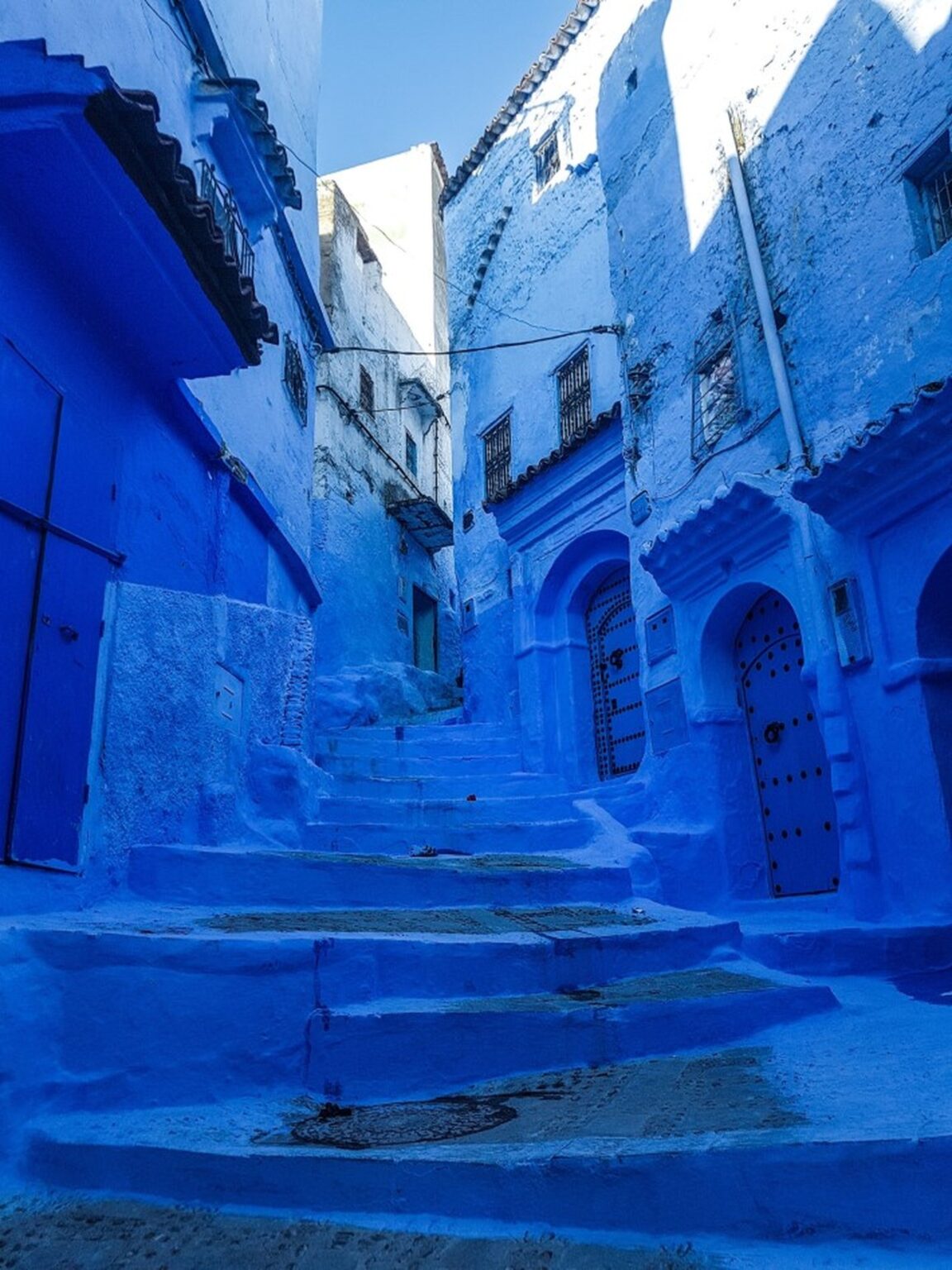
The blue is the first fact of Chefchaouen: walls, steps, doors and flowerpots washed in shades from pale sky to deep indigo, a tradition most often linked to Jewish refugees who settled here in the 1930s, though the town itself was founded in 1471 as a fortress settlement and later sheltered exiles from Spain. In summer the medina carries a steady flow of day visitors between late morning and late afternoon. In winter that flow thins to a trickle, and the town’s rhythm reasserts itself: shopkeepers sweeping blue steps, wood smoke over the lanes, women washing at the Ras el Maa spring where mountain water leaves the rock at the medina’s eastern edge. Early morning is the hour the photographs promise, and in low season a traveller can have whole staircases to themselves simply by starting before breakfast.
Staying overnight is what unlocks this. A day trip from Tangier spends five hours on buses for perhaps four hours in town, all of them in the busiest window. Two nights invert the experience. Travellers continuing through northern Morocco can pair this guide with our coverage of Fes and its car-free medina for the onward imperial city, or head west with the Essaouira travel guide for the Atlantic contrast.
How do the buses actually govern a short stay?
Chefchaouen has no station and no airport, so the CTM timetable is the trip’s skeleton. Buses from Tangier take about 2.5 hours and call at Tetouan on the way; buses from Fes take roughly 4 to 5 hours across the Rif foothills. Shared grand taxis cover the same routes and leave when full, which makes them flexible in the morning and uncertain late in the day. Three rules protect a short stay. First, buy the onward bus ticket on arrival, not on departure day, because the popular Fes and Tangier departures sell out in busy weeks. Second, treat the bus station’s position below the medina honestly: it is a petit taxi ride up to the gates with luggage, not a stroll. Third, never schedule a same-evening flight out of Tangier against a Chefchaouen departure; mountain roads and full taxis do not respect tight connections. Confirm every timing on the CTM site or at the station, since schedules and fares change more often than guidebooks do.
What should a winter day in the medina include?
Start at Plaza Uta el-Hammam, the square that holds the town together, with cafe terraces under the trees and the red-walled kasbah on its edge. The kasbah’s gardens and tower give the medina’s best internal viewpoint and a compact museum of the region. From the square, climb in any direction: the lanes steepen, the blue deepens, and the famous flowerpot staircases appear without any need for a map pin. Work east toward Ras el Maa, where the spring exits the mountain and a small waterfall drops beside the washing stones, then follow the path up to the Spanish Mosque, built during the Spanish protectorate era and now kept purely as the town’s sunset balcony. In winter the sun drops early, so time the climb for mid-afternoon and bring a warm layer for the walk down in blue shadow. Evenings belong to the square again: soup, grilled food and mint tea in the cafes around Uta el-Hammam, then lanes that empty almost completely after dark.
Is the Akchour walk worth a winter day?
Yes, on a dry day, and it is the main reason to add a second night. Akchour is a village in Talassemtane National Park, about 45 minutes from town by shared grand taxi. From the dam and car park, one path climbs to God’s Bridge, a natural rock arch spanning the gorge, in about 45 minutes; the river path continues to the large waterfall in about two hours one way, passing smaller falls and deep pools. Winter changes the judgement in two ways. The falls run fuller and greener after rain, and the turquoise summer swimming scenes give way to a colder, more dramatic river. But wet rock makes the riverside path slippery, so solid footwear is non-negotiable, an early start protects the short daylight, and the big waterfall should be dropped without regret if rain has swollen the crossings. Agree the return taxi arrangement before setting off, because shared taxis leave when full in both directions.
What should visitors know about etiquette and hassle?
Chefchaouen is one of Morocco’s gentler medinas, but it sits in the Rif, the country’s historic kif-growing region, and visitors, especially men walking alone, will be offered hashish. It remains illegal in Morocco, the offers carry real legal risk, and a firm, smiling refusal ends almost every approach. Photography etiquette matters more here than in most towns, because the blue lanes are also people’s front doors: ask before photographing residents, expect some staircases and doorways to be maintained as photo spots by the households on them, and never treat a family’s washing day at Ras el Maa as a photo opportunity. Dress modestly by mountain-town standards, keep money in small dirham notes for petit taxis and market stalls, and learn the medina’s social rule early: the lanes are shared living space first and a backdrop second. Handled that way, Chefchaouen in winter gives back an unusual amount of warmth for a town painted entirely in cold colours.
Where should visitors sleep and eat?
Sleep inside or immediately beside the medina, in one of the riads and guesthouses converted from blue-washed family houses, where breakfast is served on a terrace above the lanes and the host becomes the trip’s best source of current bus and taxi intelligence. Rooms deeper in the medina mean stairs and porter arrangements for luggage, which the houses handle routinely when warned. Eat where the town eats: harira and bissara soups in the morning cafes, grilled meats and salads around Uta el-Hammam at lunch, and a tagine in a family-run kitchen in the evening, with the medina’s bakeries and msemen stalls filling the gaps. In winter, ask for the room with heating or a fireplace without embarrassment; mountain nights make the question practical rather than fussy, and the best-run houses answer it with specifics.
Frequently Asked Questions
How do I get from Tangier to Chefchaouen?
By CTM bus in about 2.5 hours, or by shared grand taxi, which leaves when full. There is no train or flight to Chefchaouen. Check current departures on ctm.ma and buy onward tickets early.
How many nights does Chefchaouen need?
Two. One night gives a quiet early morning in the medina and a sunset at the Spanish Mosque; two nights add the Akchour day trip without rushing the lanes.
Is Chefchaouen cold in winter?
Yes, by Moroccan standards. It is a mountain town at roughly 600 metres, and stone buildings cool fast after sunset. Pack real layers, a warm jacket and shoes with grip for wet lanes.
Can Akchour be done as a day trip from Chefchaouen?
Yes. Shared grand taxis take about 45 minutes each way. God’s Bridge is about a 45 minute walk from the car park; the large waterfall is about two hours one way, so start early in winter.
Why is the town painted blue?
The most repeated account credits Jewish refugees of the 1930s, for whom blue carried spiritual meaning; practical explanations about light, heat and insects are also told locally. The town maintains the tradition today, repainting the medina lanes in spring.
Image credit: Blue-washed medina steps in Chefchaouen, photographed by Mohammed Lak, via Unsplash (Unsplash License).