 Jordan Ellis
Marfa earns its reputation only if a visit is built around the art rather than the mythology: book the Chinati Foundation first, accept that most of the collection is seen on guided tours that sell out, and plan the driving, fuel and sleep around distances that are measured in hours, not blocks. Judged that way, this high-desert town of under two thousand people delivers one of the most distinctive art trips in the United States. Judged as a casual detour, it disappoints, because the Prada storefront is 26 miles away near Valentine, the lights may not appear, and half the town is closed early in the week.
Quick Facts
- Art anchor: The Chinati Foundation, 1 Cavalry Row, open Wednesday to Sunday, 9 a.m. to 5 p.m., final entry 4 p.m., per chinati.org.
- Tours: Guided tours are the only way to see the majority of the Chinati collection and grounds, and the foundation advises buying tickets in advance because tours often sell out.
- The site: Chinati occupies the 340-acre former Fort D. A. Russell, with Donald Judd’s 100 untitled works in mill aluminum housed in two artillery sheds.
- Prada Marfa: The Elmgreen and Dragset installation stands near Valentine, roughly 26 miles northwest of Marfa on US-90. It is a sculpture, never a shop.
- Marfa Lights: The official viewing area sits about 9 miles east of town on US-90 toward Alpine, with benches, scopes and restrooms.
- Access: The nearest commercial airport is El Paso, roughly a three hour drive. Fuel, water and daylight should be planned before leaving any town out here.
- Checked: 25 November 2026, against the Chinati Foundation’s official visiting pages.
What makes Chinati worth the drive?
Donald Judd came to Marfa in the 1970s looking for space, light and permanence, and Chinati is the result: large installations placed in converted military buildings and open desert, intended to stay exactly where the artists put them. The foundation presents work by thirteen artists across its main grounds and downtown buildings, including the John Chamberlain Building on North Highland Avenue and Robert Irwin’s untitled (dawn to dusk), a courtyard work that turns the desert day into the exhibit. The scale is the point. Judd’s aluminum works fill two former artillery sheds with a hundred variations on a single form, and the concrete works outside sit in grassland that stretches to the Chinati Mountains.
The practical consequence is that Chinati cannot be done casually. The foundation states that guided tours are the only way to see the majority of the collection, that the site is open Wednesday to Sunday, and that final entry is at 4 p.m. A restoration of the artillery sheds began in October 2026, so part of the campus may be under construction during a visit; check the foundation’s visiting pages close to the date and treat the tour booking, not the hotel, as the first purchase of the trip. Our companion piece, a weekend in Marfa, sequences a full two-day visit, and drivers continuing south should read the Terlingua and Big Bend gateway guide before committing to the onward miles.
Is Prada Marfa actually in Marfa?
No, and the gap matters for planning. Prada Marfa, the 2005 installation by Elmgreen and Dragset, stands alone beside US-90 near Valentine, roughly 26 miles northwest of Marfa. It displays real Prada shoes and bags from the 2005 collection behind glass, its door never opens, and nothing is for sale. As a photo stop it takes ten minutes; as a drive it takes the better part of an hour there and back. The honest way to treat it is as a deliberate side trip in daylight, combined with the drive in or out of town, rather than as a walkable Marfa sight. Go early or late for the cleanest light and the emptiest road, and do not expect facilities of any kind at the site.
What are the Marfa Lights, and will they appear?
The Marfa Lights are unexplained lights reported on the horizon southeast of town for well over a century, and the official viewing area on US-90, about 9 miles east, is a proper roadside platform with benches, viewing scopes and restrooms. None of that guarantees a show. On many nights the horizon offers distant vehicle lights and atmospheric effects; on some nights visitors report the dancing, splitting and merging lights that built the legend. The right expectation is a free, atmospheric hour after dark with big desert skies, not a scheduled performance. Bring layers, because high-desert nights cool fast even after warm days, and keep headlights and phone torches low so the platform stays dark for everyone.
How do the distances decide where to sleep and fuel?
West Texas distances are the real itinerary. El Paso’s airport is roughly three hours west. Alpine, the nearest larger town, is about 26 miles east; Fort Davis is roughly 21 miles north; Valentine and the Prada installation are about 26 miles northwest. Within Marfa itself, Chinati, the Judd Foundation spaces, the hotels and the restaurants are walkable or a short drive apart, but everything beyond town is a committed drive on two-lane highways shared with trucks and wildlife. The working rules are simple. Arrive with a full tank. Refuel whenever a larger town offers the chance rather than when the gauge demands it. Carry water in the car year-round. Finish long drives before dark where possible, because deer and open-range animals make night driving the riskiest part of any west Texas trip. And sleep in Marfa itself on Chinati days: the town’s limited rooms book out around tour dates and event weekends, and commuting from Alpine before a morning tour adds a dark or dawn highway drive for no benefit.
When is Marfa at its best?
Spring and autumn bring the kindest combination of mild days, cool nights and full art schedules. Summer days at this elevation, around 4,700 feet, are hot but rarely humid, and the monsoon season can throw dramatic afternoon storms across the desert. Winter is quiet, cold at night and entirely viable for travellers who prefer the town empty, provided tour days are checked first, because the Wednesday to Sunday Chinati pattern and the town’s habit of concentrating restaurant and gallery hours toward the weekend shape any stay. Whatever the season, build the trip in this order: Chinati tour tickets, then other foundation visits, then the room, then the flights and the rental car.
What else fills a Marfa day beyond the foundations?
The town between the tours has its own quiet programme. Ballroom Marfa, the contemporary art space in a converted 1927 dancehall, runs exhibitions and events that often supply the trip’s most contemporary hour. The Presidio County Courthouse, a pink Second Empire landmark from 1886, can be climbed for the best overview of the town grid and the desert beyond it. Hotel Paisano, the 1930 railroad hotel where the cast of Giant stayed during filming in 1955, remains the social centre of Highland Avenue, and the Marfa Book Company inside the Hotel Saint George covers the literary side of the town’s second life. Food requires the same planning as art: kitchens keep short, weekend-weighted hours, some beloved spots are food trucks with their own schedules, and a traveller who has not checked the day’s openings can find a Tuesday in Marfa surprisingly unfed. Stock the car, book dinners where booking is offered, and treat a closed sign as part of the town’s terms rather than a failure of research.
How should a first visit be timed across a weekend?
Arrive Thursday if the trip allows it. Friday belongs to Chinati on a full tour, Saturday to the Judd Foundation visits and the town, and Sunday morning to the courthouse climb and a slow Highland Avenue hour before the drive out, with the Prada stop folded into whichever highway leg passes Valentine. Leaving the lights platform for the clearest forecast night rather than the first night is the weekend’s one piece of weather strategy.
Frequently Asked Questions
How many days does Marfa need?
Two full days is the honest minimum: one anchored on Chinati, one for the Judd Foundation spaces, the town and the Prada side trip, with a night visit to the lights platform. Three days allows a Fort Davis or Big Bend gateway excursion without rushing.
Can visitors see Chinati without a guided tour?
Only in part. The foundation states that guided tours are the only way to see the majority of the collection and grounds. Outdoor works can be appreciated independently during opening hours, but the key interiors are tour-only, and tickets should be bought in advance.
Where is Prada Marfa, exactly?
Beside US-90 near Valentine, Texas, roughly 26 miles northwest of Marfa. It is a permanent art installation styled as a Prada boutique. It never opens and nothing inside can be bought.
What is the best base for a Marfa trip?
Marfa itself. Staying in town removes dawn and night driving on tour days and puts restaurants and galleries within walking distance. Book early, because room supply is small and demand spikes around art events.
Is the drive from El Paso difficult?
It is long rather than difficult: roughly three hours of interstate and two-lane highway across open desert. Plan fuel, water and daylight, download maps for stretches with weak signal, and avoid arriving after dark on a first visit if possible.
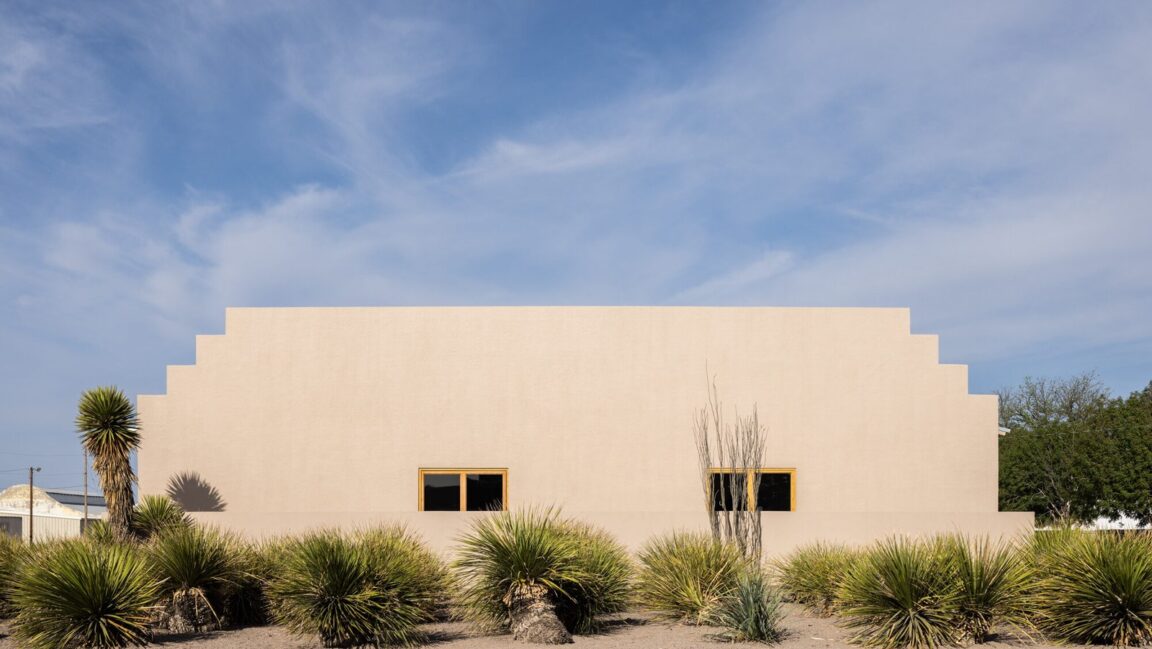
Image credit: The John Chamberlain Building, the Chinati Foundation, Marfa, photographed by Alex Marks, via the Chinati Foundation’s official website (chinati.org).