 Aiko Tanaka
For Kyoto in 2027, plan around the long run average first and the forecast second. The Japan Meteorological Agency’s 1991 to 2020 normals put Kyoto’s first bloom, kaika, on 26 March and full bloom, mankai, on 4 April, and recent warm years have run a few days earlier than those averages. The forecasts that travellers actually use are published by private companies, led by the Japan Meteorological Corporation, which issues its first nationwide forecast in early January and updates it through the season. The booking strategy that survives a late or early spring is simple: reserve refundable rooms inside a ten day window centred on the average full bloom date, hold flights you can move, and let the weekly forecast updates in February and March fine tune your days once you are there.
Quick Facts
- Kyoto average first bloom: 26 March, on the Japan Meteorological Agency 1991 to 2020 normals
- Kyoto average full bloom: 4 April on the same normals, with recent warm years often earlier
- Who forecasts: The Japan Meteorological Corporation and Weathernews, from early January, updated through the season
- Who observes: The Japan Meteorological Agency, which declares kaika and mankai from each city’s official sample tree
- How long full bloom lasts: About a week, less in wind or heavy rain
- Booking rule: Refundable rooms across a ten day window, not a fixed weekend
How is the cherry blossom forecast actually built?
Almost every ornamental cherry you will see in Kyoto is a Somei Yoshino, a cloned variety that opens before its leaves emerge. Because the trees are genetically identical, they respond to temperature in near unison, which is what makes a forecast possible at all. Forecasters track two things: the winter chill the buds need to break dormancy, and the accumulated warmth of late winter and spring, often summarised by a rule of thumb that sums daily maximum temperatures from 1 February. Bud development models, and in Weathernews’ case reports and photographs from a large network of observers, convert that data into predicted kaika and mankai dates for each city. January predictions can be five or more days out. By early March, the same forecasts are usually within two or three days, which is why they are a fine tuning tool rather than a booking tool.
What do kaika and mankai mean on the official sample tree?
The Japan Meteorological Agency no longer issues forecasts, a role it handed to private companies after 2009, but it still makes the official observations. Each city has a designated sample tree. Kaika, first bloom, is declared when five or six flowers have opened on that tree. Mankai, full bloom, is declared when about eighty percent of its buds have opened. In Kyoto the gap between the two declarations is typically about a week. Understanding the vocabulary matters because headlines announce kaika with great excitement, and travellers who fly in on the kaika headline arrive to trees that are still mostly bud. The week you want is the mankai week. Kyoto’s blossom season also has a useful tail: late blooming varieties, including the Omuro cherries at Ninna-ji, flower after the Somei Yoshino peak, so a slightly late arrival is not a lost trip.
When should you book flights and rooms for 2027?
Book rooms first, and book them refundable. Kyoto’s blossom weeks are among the most contested hotel dates in Japan, and the city’s accommodation tax and pricing both rise with demand, a squeeze we covered in our explainer on Kyoto’s accommodation tax rise. A sensible pattern is to hold a cancellable room from a few days before the average kaika date through a few days after the average mankai date, then trim the stay in February once two or three forecast updates agree. Flights should be the last fixed element if your fare rules allow changes, or chosen inside the same ten day window if they do not. Travellers pairing Kyoto with Tokyo gain a hedge for free, because Tokyo’s averages run a few days earlier, so a north to south or south to north route can catch one city even if the other is mistimed.
Where should you base yourself in Kyoto for blossom week?
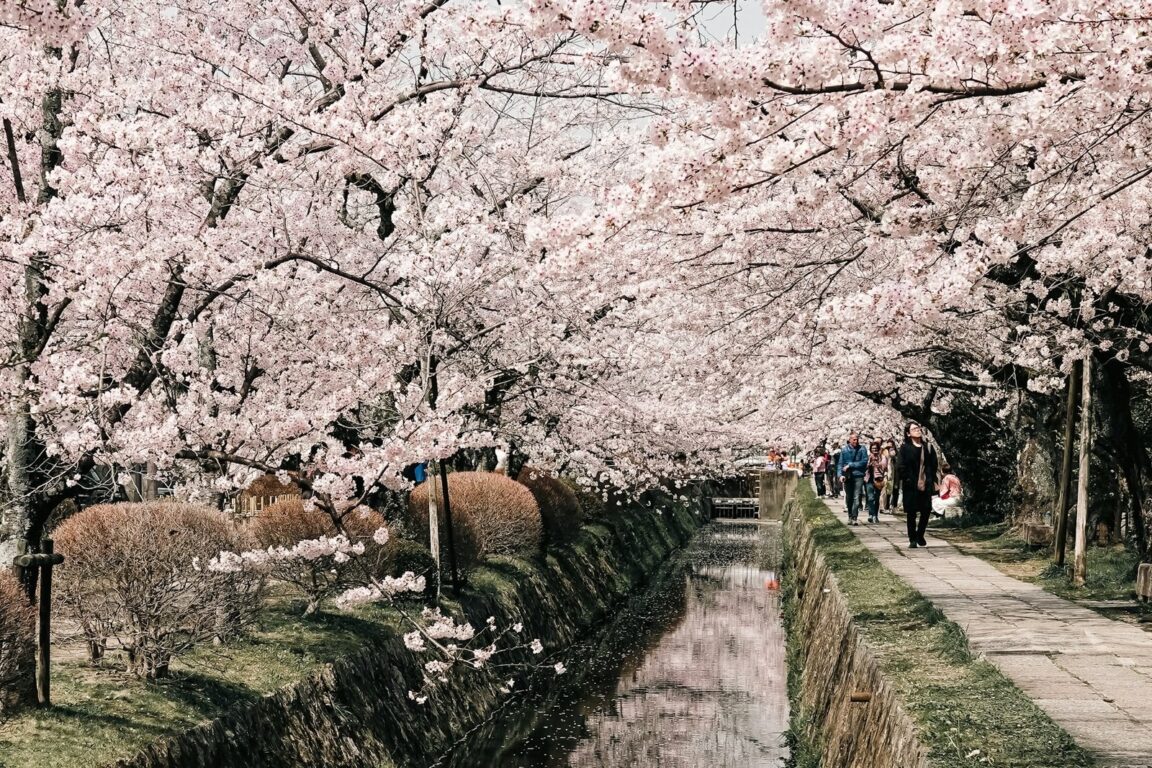
Stay where the early mornings are easy. The Philosopher’s Path, the canal side walk in the north east of the city under hundreds of cherry trees, rewards a dawn start before the crowds build, and the Maruyama Park weeping cherry is lit in the evenings. A base in central Kyoto near the Kamo River or in the Higashiyama foothills keeps both within a short bus or taxi ride. For a sense of the city’s great traditional inns, see our profile of Hiiragiya Ryokan and Kyoto innkeeping. Wherever you stay, plan blossom viewing as a portfolio rather than a single appointment: a canal walk, a temple garden, a riverbank and one evening illumination spread across different days, so weather can move pieces around without breaking the trip.
What should you do if the forecast moves after you have booked?
First, do not panic at a January revision. Early forecasts move by days as winter temperatures declare themselves, and the direction often reverses. Second, use the front itself. The blossom opens in a wave that travels north, so a traveller who is early for Kyoto can often find open blossom in warmer spots to the south and west, while a traveller who is late can follow the front toward higher ground and later varieties inside Kyoto itself. Third, remember that petal fall is not failure. The days when petals drift onto the Philosopher’s Path canal, forming slow pink rafts on the water, are many residents’ favourite stage of the whole season.
How should you spend the days around full bloom once you are in Kyoto?
Give each day one anchor and one wander. The anchor is a named sight at its best hour: the Philosopher’s Path at dawn, Maruyama Park and its weeping cherry in the early evening light, the Kamo River banks in the late afternoon when office workers join the picnics. The wander is the unplanned hour between anchors, in the side streets of Higashiyama or along the Takase canal, where smaller trees overhang lanes that never appear in the forecasts. Hanami etiquette is simple and observed: do not shake branches for petal showers, do not climb or pull branches down for photographs, and carry picnic litter out with you. None of this needs a tour. It needs the forecast checked each morning, shoes you can walk in all day, and the discipline to be under the trees early, when Kyoto still belongs to its residents.
Frequently asked questions
When will the first 2027 forecast for Kyoto be published?
The Japan Meteorological Corporation traditionally publishes its first nationwide forecast in early January, with updates following through February and March. Treat the January dates as provisional.
How accurate are cherry blossom forecasts?
Early season forecasts can miss by five days or more. By early March they are usually within two or three days of the declared full bloom, which is accurate enough to trim hotel nights and set day plans.
What is the difference between kaika and mankai?
Kaika is first bloom, declared when five or six flowers open on the official sample tree. Mankai is full bloom, at about eighty percent open, typically a week later. Mankai week is the one to travel for.
How long does full bloom last in Kyoto?
About a week in settled weather. Strong wind and heavy rain shorten it, sometimes sharply, which is another reason to arrive with several viewing days rather than one.
Is a refundable booking really worth it for blossom season?
Yes. The premium for a cancellable rate is small next to the cost of a mistimed non refundable stay in the most expensive hotel weeks of Kyoto’s year.
Image credit: Cherry blossom over the Philosopher’s Path canal in Kyoto, photo by Kostas Mantzios via Unsplash, unsplash.com.