 Aiko Tanaka
From March 1, 2026, Kyoto City charges its accommodation tax in five bands instead of three, and the top band jumps tenfold, from 1,000 yen to 10,000 yen per person per night. Most visitors will barely notice the change: a typical machiya guesthouse night still attracts only 200 or 400 yen. The travellers who need to do the maths are those booking mid range ryokan and luxury stays, where the tax now adds 1,000 to 4,000 yen per person, every night, and where a week long stay for two can quietly accumulate a five figure yen surcharge. This explainer sets out the new bands exactly as Kyoto City publishes them, works them against real room rate levels, and shows how to tell whether the tax is already inside the price you have been quoted.
Quick Facts
- What changed: Kyoto’s accommodation tax moved from three bands to five on March 1, 2026.
- New bands, per person per night: 200 yen under 6,000 yen; 400 yen from 6,000 to 19,999 yen; 1,000 yen from 20,000 to 49,999 yen; 4,000 yen from 50,000 to 99,999 yen; 10,000 yen at 100,000 yen or more.
- The rate that sets your band: the room only charge per person, including service charge but excluding meals and consumption tax.
- Who pays: every overnight guest in Kyoto City, including guests at small lodgings and private rentals, since the tax began on October 1, 2018.
- How you pay: at the property, unless your booking site or travel agency has already collected it inside the price.
- What the money funds: tourism promotion and sustainable urban development that benefits residents and visitors, in the city’s own wording.
The five bands, tier by tier
Kyoto City’s official lodging tax page lists the revised schedule by the accommodation charge per person per night. Under 6,000 yen, the tax stays at 200 yen, unchanged from the old system. From 6,000 to 19,999 yen it is 400 yen, double the old 200 yen that applied to everything below 20,000 yen. From 20,000 to 49,999 yen it is 1,000 yen, double the old 500 yen. From 50,000 to 99,999 yen it is 4,000 yen, four times the old top rate of 1,000 yen. At 100,000 yen or more, a band that did not previously exist, the tax is 10,000 yen per person per night. The date that counts is the date of the stay itself: a night that falls on or after March 1, 2026 is taxed at the new rates even if you booked and paid months earlier.
Two details in the city’s definition catch people out. First, the band is set per person, not per room. A twin room sold at 50,000 yen for two guests is a 25,000 yen per person charge, so each guest pays 1,000 yen, 2,000 yen in total, rather than the 4,000 yen per person the headline room price might suggest. Second, the figure used is the room only rate: meals are stripped out, and so is consumption tax, while the service charge stays in. A ryokan package priced with dinner and breakfast therefore lands in a lower band than its sticker price implies, because the food component does not count toward the threshold.
What each band does to a real Kyoto bill
The budget and machiya band: 200 to 400 yen a night
A guesthouse bed or a simple machiya stay priced under 6,000 yen per person keeps the old 200 yen tax, so nothing changes at the bottom of the market. Most self catering machiya rentals and mid priced business hotels sit in the 6,000 to 19,999 yen per person range, which means 400 yen per person per night. For a couple staying five nights, that is 4,000 yen across the whole trip, noticeable on a receipt but not a reason to change hotels.
The ryokan middle: 1,000 yen a night
The band that will apply to the largest number of international visitors is 20,000 to 49,999 yen per person, taxed at 1,000 yen. A classic one night ryokan splurge with kaiseki dinner often prices its room only element inside this window once meals are excluded. Two guests staying three nights at that level pay 6,000 yen in tax. It is the doubling from the old 500 yen rate that stings here, and it applies per night, so longer stays in traditional inns feel it most.
The luxury steps: 4,000 and 10,000 yen a night
Above 50,000 yen per person per night, the tax stops being a rounding error. At 4,000 yen per person, a couple on a four night luxury ryokan stay pays 32,000 yen in accommodation tax alone. The new top band, 10,000 yen per person per night on room charges of 100,000 yen or more, is aimed squarely at the city’s most expensive suites and high end ryokan, where a single night for two now carries 20,000 yen of tax before any other charge. If you are comparing two luxury properties either side of the 100,000 yen line, that cliff edge is worth real money: a room only rate of 99,999 yen per person is taxed at 4,000 yen, while 100,000 yen is taxed at 10,000 yen.
Is the tax inside your booking price or added at the desk?
Kyoto City collects the tax through the accommodation itself: properties act as collection agents, take the tax from guests, and remit it to the city. In practice that means three possible experiences. Some booking platforms include the tax in the total you pay online. Some properties add it as a separate line at check in or check out. Some ryokan quote rates that already absorb it and never show it separately. The city’s guidance to guests is to check with the property or the agency if it is not clear. Before you compare prices across sites, check whether each quote includes the accommodation tax, because at the upper bands the difference between an inclusive and an exclusive quote can be larger than the price gap you are choosing on.
Why Kyoto raised the tax, and what it pays for
Kyoto has charged an accommodation tax since October 1, 2018, and the city presents it as a contribution toward tourism promotion and the sustainable development of a city that hosts very large visitor numbers on a resident sized infrastructure. The March 2026 revision restructured the tax so that higher priced stays contribute proportionally more: the cheapest band did not move at all, the middle bands doubled, and the top of the market took the steep increases. For travellers, the practical read is that Kyoto is not taxing visits, it is taxing room rates, and the surcharge scales with the luxury of the stay rather than its length alone, although the two multiply together on long, expensive trips.
If Kyoto is one stop on a wider Japan itinerary, remember that accommodation taxes are municipal. Other cities set their own flat or banded charges, and the Kyoto schedule does not apply in Osaka, Tokyo or anywhere else. Travellers planning a Kyoto stay as part of a festival trip should also read our guide to Kyoto’s Gion Matsuri month, and families can plan the days themselves with our family guide to Kyoto. Prices and tax bands checked against Kyoto City’s official lodging tax guidance on November 23, 2026.
Frequently Asked Questions
When do the new Kyoto accommodation tax rates start?
They apply to stays from March 1, 2026. Nights before that date are taxed under the old three band schedule, which topped out at 1,000 yen per person per night.
Is the tax charged per room or per person?
Per person, per night, and the band is set by the room only charge divided per guest. A 50,000 yen twin room for two is 25,000 yen per person, which falls in the 1,000 yen band for each guest.
Do meals count toward the rate that sets my band?
No. Kyoto City defines the charge as the room only rate including service charge, excluding meals and excluding consumption tax. A dinner inclusive ryokan price is therefore assessed on a lower figure than the package total.
Who is exempt from the Kyoto accommodation tax?
The tax applies broadly to overnight guests in the city, including small lodgings and private rentals. Check Kyoto City’s official lodging tax page for any specific exemption categories that apply to your stay, such as school trip provisions, before you travel.
Can I avoid the top band by booking a cheaper room category?
Yes, in effect. Because the bands are cliff edges, a room only rate just below 50,000 or 100,000 yen per person is taxed far less than one just above. If a property offers two similar rooms either side of a threshold, the cheaper room saves the rate difference plus the tax difference.
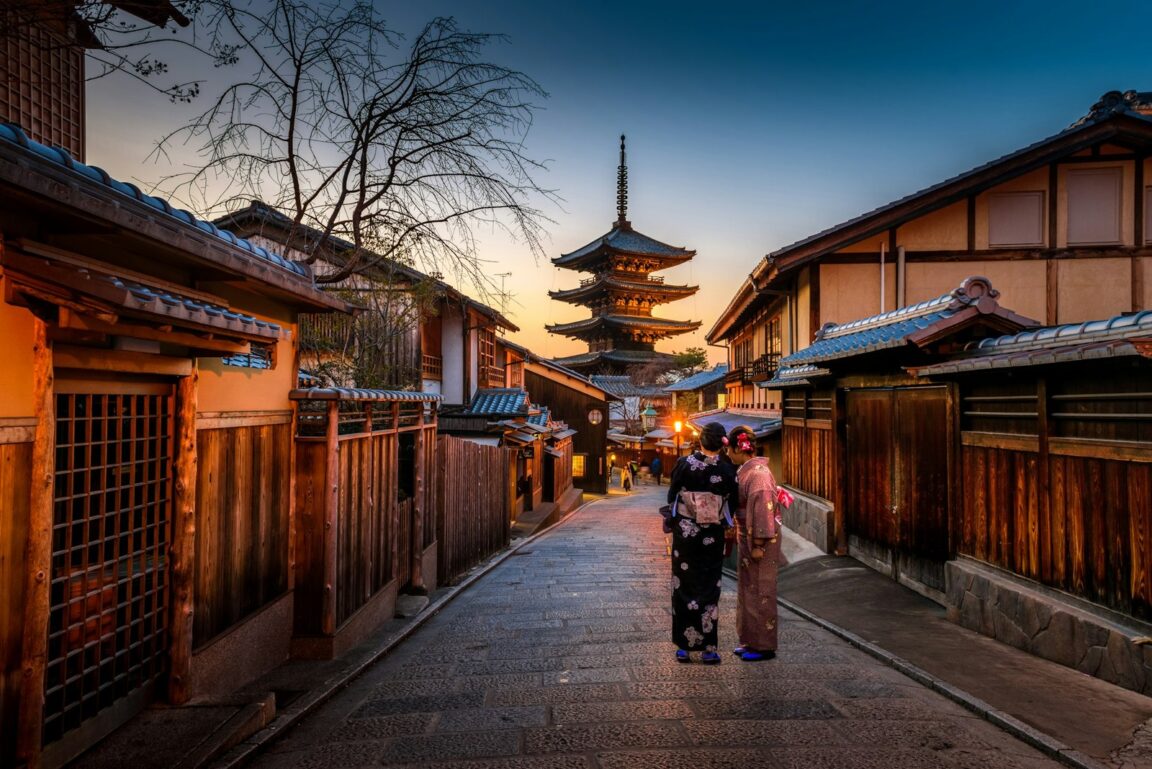
Featured image: Yasaka Pagoda above a machiya lined lane in Kyoto’s Higashiyama district at dusk. Photo via Unsplash (Unsplash License), photo 1493976040374-85c8e12f0c0e.