 Jonas Lindqvist
Slovenia began accepting applications on 21 November 2025 for a temporary residence permit for digital nomads, and the terms are unusually clear cut: a third-country national who works remotely for an employer, clients or a business based outside Slovenia can live in the country for up to one year, the permit cannot be extended, and a new application is possible only six months after the first permit expires. The financial bar is monthly funds of at least twice the average monthly net salary in Slovenia, family members may join the holder straight away, and the work itself must stay entirely outside the Slovenian labour market. It is a residence permit, not a visa, created under Article 51.a of the Foreigners Act, and for a remote worker eyeing Ljubljana it rewards careful reading before any lease is signed.
Quick Facts
- What it is: A temporary residence permit for digital nomads, in force since 21 November 2025 under the amended Foreigners Act (ZTuj-2). Official source: the Ministry of the Interior announcement on gov.si.
- Who can apply: Nationals of countries outside the EU and EEA only. EU and EEA citizens do not need this permit and register their residence instead.
- How long it lasts: Up to one year, or the length of the foreign work contract if that is shorter. It cannot be extended.
- The six month rule: After the permit expires, the holder must wait six months before applying for a new digital nomad permit.
- Income evidence: Monthly funds of at least twice the average monthly net salary in Slovenia, calculated from the latest average salary published in the Official Gazette. On 2025 figures that works out at roughly EUR 3,100 to EUR 3,200 a month, and the figure moves as new salary data is published.
- Work rule: Employment, civil-law contract work or self-employment must all be for entities outside Slovenia, done remotely. No Slovenian employer, no Slovenian clients, no local sales or services.
- Family: Family members may reunite with the permit holder immediately, with no waiting period tied to how long the holder has lived in Slovenia. Additional means are required for accompanying family.
- Where to apply: At a Slovenian embassy or consulate abroad, or, if already legally in Slovenia, at a local administrative unit (upravna enota).
Is this actually a visa, or something else?
It is a temporary residence permit, and the distinction shapes the whole application. A visa controls entry; this permit controls residence for a stated purpose, and it is issued as a biometric residence card marked for a digital nomad. The legal basis is the 2025 amendment to the Foreigners Act, published in the Official Gazette, which added the digital nomad category and set its start date at 21 November 2025. There is no quota and no labour market test, because the design assumption is that the holder never enters the Slovenian labour market at all. That is also why the route is simpler than a standard work permit in one respect and stricter in another: nobody assesses whether a Slovenian could do your job, but everybody will check that your job is genuinely foreign.
For passport holders who can enter Schengen visa free, including citizens of the United States, the United Kingdom, Canada and Australia, the practical effect is that you can arrive in Slovenia lawfully and file at an administrative unit, receiving a certificate on filing that serves as a temporary residence permit until a decision is made. For nationals who need a Schengen visa to enter at all, the consular route comes first. Either way, the permit, not the entry stamp, is what makes a year long stay lawful.
Who counts as a digital nomad under Slovenian law?
The Ministry of the Interior definition covers three arrangements, and only three. First, employment with a business established outside Slovenia. Second, work under a civil-law contract for a business established outside Slovenia. Third, self-employment abroad, serving clients or a business of your own that sits outside Slovenia. In every case the work is performed remotely using information and communication technology, and in every case the economic activity stays abroad. A remote salary from a foreign employer fits. A freelance practice invoicing foreign clients fits. A founder drawing income from a company incorporated and trading abroad fits.
What does not fit is just as important. Working for a Slovenian employer, taking Slovenian clients, or selling goods and services inside Slovenia falls outside this permit and belongs to the separate single permit system for work and residence. Anyone whose client base is mixed should look honestly at the Slovenian share before applying, because the permit does not partially cover local work. It covers none of it. Remote workers comparing European long stay routes will recognise the same offshore work logic used by longer running schemes such as the one examined in Barbados’s Welcome Stamp at five years, with its renewal reality, income bar and family add-ons, although Slovenia’s version is shorter, non-renewable and tied to a salary formula rather than a fixed dollar figure.
How much do you need to earn, and how do you prove it?
What is the income threshold, exactly?
The law does not print a fixed euro amount, and any guide that quotes one number without a date should be read with care. The requirement is monthly funds of at least twice the average monthly net salary in Slovenia, calculated from the average monthly gross salary most recently published in the Official Gazette of the Republic of Slovenia. Because Statistics Slovenia publishes new salary data regularly, the threshold drifts upward over time. At the permit’s launch, advisers working from the official formula put the figure at roughly EUR 3,100 to EUR 3,200 a month. The safe approach is to calculate from the latest published figure when you file, and to show a comfortable margin above it rather than landing exactly on the line.
What evidence supports the income claim?
The means can come from any lawful source, which in practice means the file should connect three things: the foreign work arrangement, the money it produces, and the money arriving. Expect to show the employment contract or client contracts, or evidence of self-employment abroad, alongside payslips or invoices and bank statements showing monthly receipts at or above the threshold. Guidance based on the official rules points to statements covering the months before filing, so assembling six months of clean, consistent records is prudent preparation rather than a last week scramble. Savings can support an application as lawful means, but a large balance with no visible connection to qualifying foreign work answers only half the question officials are asking. The contract explains why you are a digital nomad; the statements prove you can support the stay.
How does the 12-month non-renewable clock work?
The permit may be issued for up to one year, and the statute is blunt about what happens next: it cannot be extended. There is no renewal appointment, no second year paperwork and no grace mechanism inside this category. Once the permit expires, six months must pass before a new digital nomad permit can be sought. The Ministry has been open about the reasoning, which is that digital nomads are mobile by definition and typically stay for a limited period, so the category was built as a single year with a deliberate gap rather than a rolling residence track.
Two planning consequences follow. First, anyone hoping to stay longer in Slovenia needs a different plan before the year ends, such as qualifying under another residence category, because the nomad permit itself offers no bridge. Switching to a different permit type is a separate application on its own merits, not a conversion of this one. Second, the six month gap is real time outside the category, so a worker building a multi-year European base should treat the Slovenian year as one chapter in a rotation, not as a renewable home. Travellers weighing a longer Adriatic base alongside Slovenia can also read how a neighbouring country is tightening the rules around foreign stays in Croatia’s new short-term rental registration in the historic cores of Split and Dubrovnik, a reminder that long stay compliance in the region now runs through registration systems as much as through border stamps.
Can your family come with you?
Yes, and on this point Slovenia is more generous than many comparable schemes. Digital nomads may reunite with family members immediately, without restrictions linked to how long the holder has already resided in Slovenia or to the remaining validity of the permit. There is no requirement to complete a qualifying period first, which means a spouse or partner and children can be part of the plan from the first filing rather than joining months later. The financial side scales with the household: the means requirement increases for accompanying family members, so the income file needs to cover the family, not only the principal applicant. Families should confirm the exact additional amount with the embassy, consulate or administrative unit handling the case, because the published official material states the principle of additional means without printing a single family figure that fits every household size.
Where do you apply, and what else is in the file?
Applications are filed at a Slovenian diplomatic or consular post abroad, or at an administrative unit in Slovenia if the applicant is already legally resident or lawfully present there. Filing is an in-person process at the point fingerprints are taken for the biometric card, and government fees apply. Beyond the work and income evidence, the standard residence permit conditions apply: a passport valid for at least three months beyond the intended stay, health insurance covering at least essential or emergency healthcare in Slovenia, and a criminal record certificate from the applicant’s home country or country of residence. There is no official minimum coverage sum for the insurance printed in the permit rules, so policies should be checked against the wording the deciding office uses rather than against figures quoted on commercial visa sites.
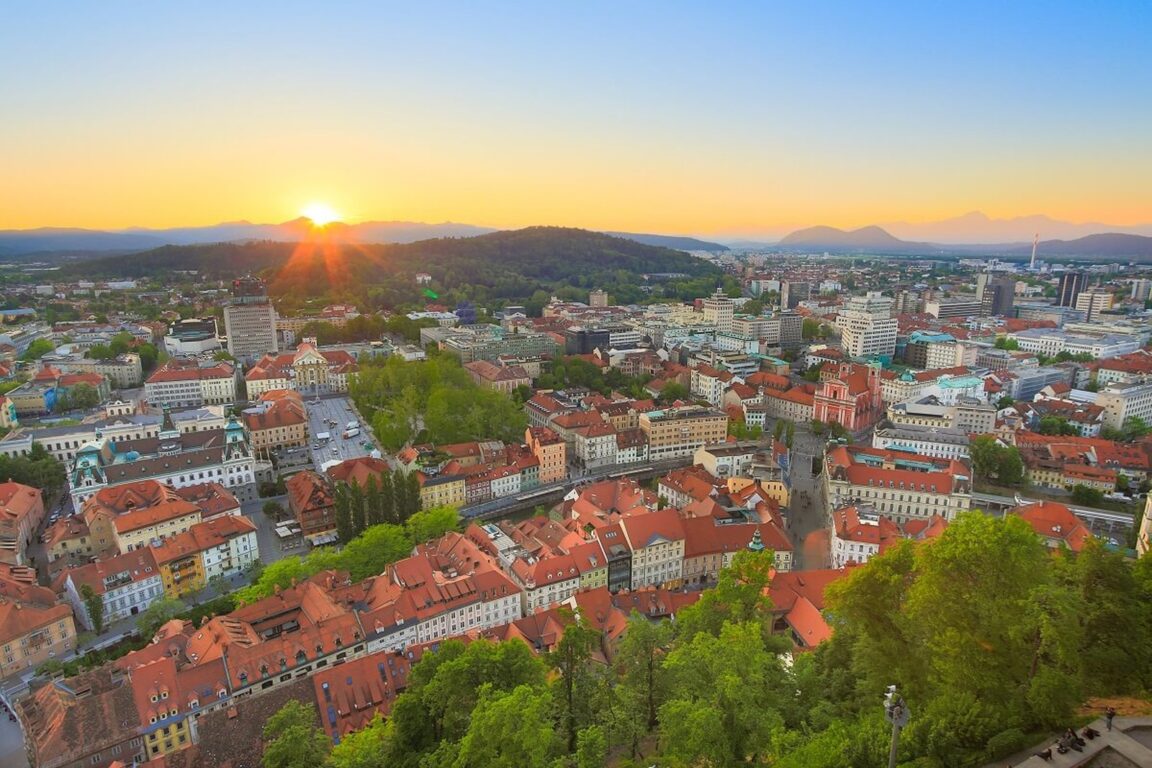
After arrival, one deadline catches new residents out in many European systems and Slovenia is no exception: a person issued a temporary residence permit must register their temporary residence address at the administrative unit within eight days of entering the country, receiving the permit or moving in, whichever applies. Diarise it alongside the move itself. Ljubljana, with its compact old town along the Ljubljanica river, its castle above the centre and a rental market far smaller than Vienna’s or Munich’s, rewards applicants who secure housing early, because the permit file and the address registration both depend on having a real address to give.
Frequently Asked Questions
When did Slovenia’s digital nomad permit start?
Applications opened on 21 November 2025, when the digital nomad provisions of the amended Foreigners Act took effect. The Ministry of the Interior announced the launch on gov.si the same day.
How much do I need to earn to qualify?
Monthly funds of at least twice the average monthly net salary in Slovenia, calculated from the latest average salary published in the Official Gazette. At launch that meant roughly EUR 3,100 to EUR 3,200 a month, and the figure rises as new salary data is published, so check the current calculation when you file.
Can I extend the permit for a second year?
No. The permit is issued for up to one year and cannot be extended. A new digital nomad application is possible only six months after the previous permit expires.
Can EU citizens apply for this permit?
No, and they do not need it. The permit is for third-country nationals, meaning citizens of countries outside the EU and EEA. EU and EEA citizens register their residence in Slovenia under the separate free movement rules.
Can I work for Slovenian clients while on the permit?
No. All work under this permit must be for an employer, clients or a business based outside Slovenia, performed remotely. Work for Slovenian entities requires a different residence and work permit route.
Can my spouse and children join me straight away?
Yes. Family reunification for digital nomad permit holders is available immediately, with no waiting period based on the holder’s time in Slovenia. You will need to show additional means to support accompanying family members.
Photo: Ljubljana at sunset, seen from Ljubljana Castle across the old town rooftops toward the Franciscan Church and the hills beyond. Credit: Matej Kastelic, via the Slovenian Tourist Board at slovenia.info.