 Aiko Tanaka
Kyoto’s Gion Matsuri is not a festival weekend. It is a festival month, running from July 1 to July 31, and the visitor’s month has a clear shape: the yamaboko floats are assembled in their neighbourhood streets in the days from July 10, the lantern lit Yoiyama evenings run from July 14 to 16, and the first great procession, the Saki Matsuri Yamahoko Junko, rolls at 9 am on July 17 with 23 floats. The pattern then repeats in a calmer key, with Yoiyama from July 21 to 23 and the Ato Matsuri procession of 11 floats at 9:30 am on July 24. Watching is free from the street. A reserved seat on Oike-dori costs 6,000 yen, or 8,000 yen in the front row, and goes on sale on June 1. Plan around those dates and the festival organises itself.
Quick Facts
- When: The Gion Matsuri occupies the whole of July, July 1 to 31, as the festival of Yasaka Shrine.
- Float building: The Saki Matsuri floats are assembled in their neighbourhoods from around July 10 to 14, the Ato Matsuri floats from July 18 to 21.
- Yoiyama evenings: July 14 to 16 before the first procession, and July 21 to 23 before the second, with lanterns lit on the floats and historic houses opening their screen rooms.
- First procession: Saki Matsuri Yamahoko Junko, July 17 at 9 am, 23 floats, along Shijo, Kawaramachi and Oike streets.
- Second procession: Ato Matsuri Yamahoko Junko, July 24 at 9:30 am, 11 floats, along Oike, Kawaramachi and Shijo streets.
- Reserved seats: On Oike-dori, about 10,000 seats on July 17 and about 4,000 on July 24. General seats 6,000 yen, front row 8,000 yen, on sale from June 1 at 10 am through Ticket Pia and convenience stores.
- Premium and learning seats: Premium seats in front of Kyoto City Hall cost 125,000 yen front row and 155,000 yen behind on July 17. Special learning seats with live commentary on July 24 cost 14,500 yen front row and 12,500 yen behind.
- Authority: The Kyoto City Tourism Association guides on Kyoto Travel and its reserved seat sales page, checked for the 2026 festival.
How does the month build toward the first procession?
The Gion Matsuri belongs to Yasaka Shrine, in the Gion district at the east end of Shijo-dori, but its famous machinery lives across the river in the downtown grid. Through the first half of July the yamaboko neighbourhoods, each responsible for one float, move from ceremony to carpentry. From around July 10 to 14 the Saki Matsuri floats rise in the streets where they will later stand on display, assembled by their neighbourhood crews in full public view. This is the part of the festival most visitors never schedule and many remember best: the great hoko and yama taking shape at street corners, ropes, timbers and tapestries handled by the same families and guilds year after year, with no crowd barrier between the work and the watcher.
Short trial pulls, the hikihajime, let the crews test each float’s movement before the display nights begin. By the time Yoiyama starts, the floats are complete, dressed and lit, and the neighbourhoods around Shijo and Karasuma become the festival. Families planning a Kyoto trip around the crowds can ground the rest of the stay in a family guide to Kyoto, with stroller friendly temples, the railway museum and rainy day saves, and save the downtown grid for the festival evenings.
What actually happens on the Yoiyama nights?
Yoiyama is the procession eve, and Kyoto Travel explains the name with the old belief that the festival day had already begun at sunset the night before. In recent years the Saki Matsuri Yoiyama has stretched across three evenings, July 14 to 16, and the Ato Matsuri Yoiyama across July 21 to 23. As dark falls, the flames are lit in the komagata lanterns of each float, the floats glow with their tapestries, figures and metal ornaments, and the sound of the festival music, the Gion bayashi, carries down the streets. Children in yukata sing the traditional charm songs at the floats, and the old houses of the yamaboko neighbourhoods open their front rooms to the public in the byobu matsuri, the folding screen display, showing treasured screens and decorations that stay hidden the rest of the year.
The two Yoiyama blocks have different characters. The Saki nights, July 14 to 16, are the festival at full volume, with the central streets given over to pedestrians and food stalls on the busiest evenings and crowds to match. The Ato nights, July 21 to 23, run quieter, with the same lanterns and screens but room to move. A visitor with a choice should see one night of each if the trip allows, and a visitor with only one free evening and a dislike of crowds should choose the Ato block without hesitation. Kyoto Travel’s own advisories for these nights are practical: watch for heatstroke, hydrate and rest often, use public transport, follow police and staff instructions in the crowds, and remember that the festival happens in a residential area whose residents deserve consideration.
Where do visitors fit in the two processions?
The Saki Matsuri Yamahoko Junko leaves at 9 am on July 17, processing 23 floats along Shijo, Kawaramachi and Oike streets. The Ato Matsuri Junko follows at 9:30 am on July 24 with 11 floats, reversing the emphasis along Oike, Kawaramachi and Shijo. Both processions are free to watch from the pavement, and both reward an early arrival, a shaded position and a plan for the heat, since mid morning in Kyoto in July is fierce. The set piece moment is the turning of the great floats at the street corners, the tsujimawashi, when the crews haul a multi tonne float through a right angle on wet bamboo and muscle alone.
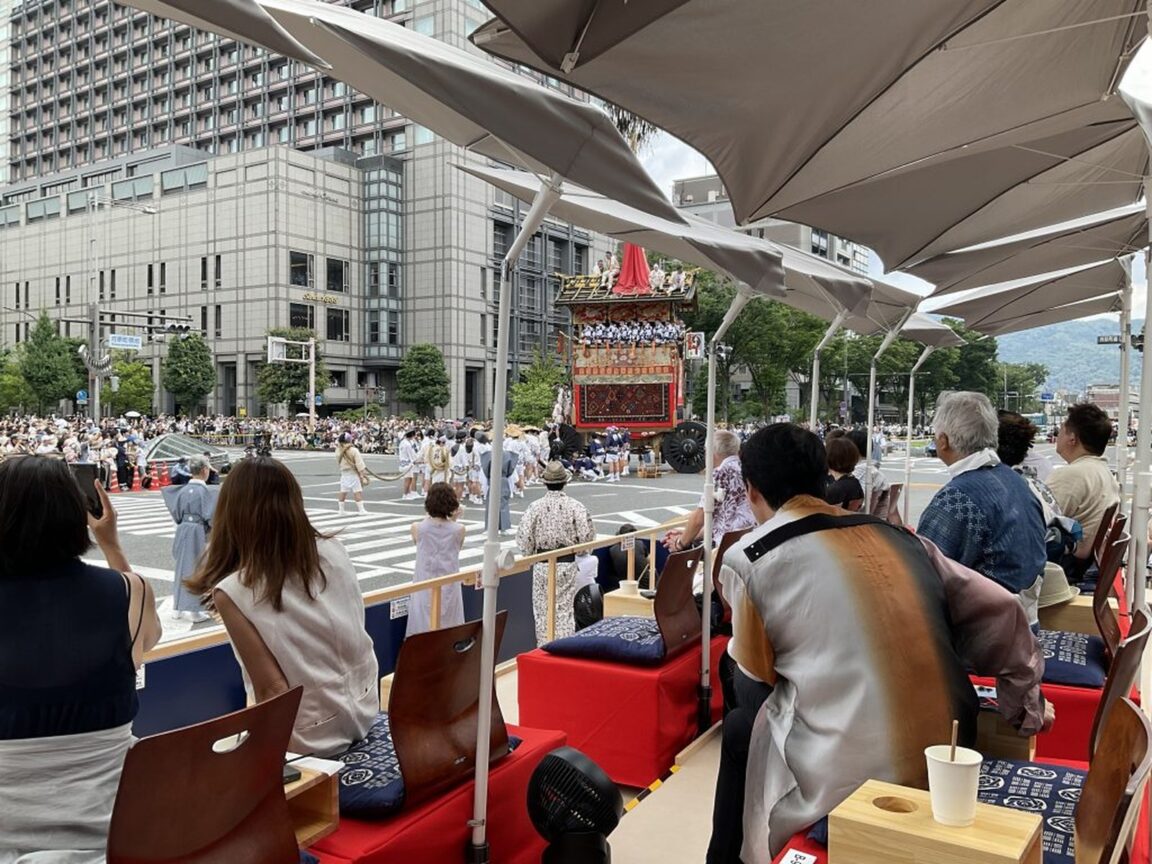
The honest choice is between the corner and the seat. Free viewing at a turning corner gives you the drama and the crowd. A reserved seat on Oike-dori gives you a guaranteed place, a chair, the official guidebook and hand towel that come with every seat, and a long, level view of the floats passing in order. For 2026 the city set out about 10,000 seats for July 17 and about 4,000 for July 24, priced at 6,000 yen for general seating from the second row and 8,000 yen for the front row. Above those sit the special categories: premium seats in front of Kyoto City Hall at 125,000 yen front row and 155,000 yen for the rows behind, with live specialist commentary, drinks and a buffet, and, on July 24 only, special learning seats with commentary at 14,500 yen front row and 12,500 yen behind. General sales opened on June 1 at 10 am Japan time, online through Ticket Pia and at convenience stores, and the sensible seats sell early. The processions run rain or shine, seats are not refunded unless a procession is cancelled, and umbrellas, parasols and tripods are not allowed in the seating, so pack a raincoat and a hat instead. Visitors budgeting a Japan trip should also note how festival pricing sits alongside the wider debate in Japan’s new dual pricing debate for major attractions: the Gion seats are the same price for everyone, resident or visitor.
Which half of the festival should you choose?
Choose the Saki half, July 14 to 17, for scale: more floats, bigger Yoiyama nights, the full weight of the tradition. Choose the Ato half, July 21 to 24, for air: 11 floats instead of 23, a calmer Yoiyama, the learning seats with commentary, and a procession that many Kyoto regulars quietly prefer. Choose the whole month only if Kyoto itself is the destination, because the Gion Matsuri rewards the traveller who treats it as a city season rather than a single parade: a building day in the float neighbourhoods, a screen room evening, one procession from the street and one from a seat, and the shrine’s closing purification rite at the end of July to finish. However you slice it, book the seat in June, arrive by train, carry water, and let the floats come to you.
Frequently Asked Questions
When is the Gion Matsuri held?
Across the whole month of July, from July 1 to 31. The main visitor events are the Yoiyama evenings of July 14 to 16 and 21 to 23, and the float processions on July 17 and July 24.
How many floats are in each Gion Matsuri procession?
23 floats in the Saki Matsuri procession on July 17, which starts at 9 am, and 11 floats in the Ato Matsuri procession on July 24, which starts at 9:30 am, according to Kyoto Travel.
How much do reserved seats for the Gion Matsuri cost?
For 2026, general seats on Oike-dori cost 6,000 yen, or 8,000 yen in the front row, including the official guidebook and hand towel. Premium seats on July 17 cost 125,000 and 155,000 yen, and special learning seats on July 24 cost 14,500 and 12,500 yen.
When and where do Gion Matsuri seats go on sale?
General sales open on June 1 at 10 am Japan time, online through Ticket Pia and at convenience stores including Seven-Eleven. The reserved seats are all on Oike-dori, with the premium block in front of Kyoto City Hall.
Is the Gion Matsuri free to watch?
Yes. Both processions and the Yoiyama evenings are free from the street. Reserved seats buy a guaranteed chair and view on Oike-dori, not admission to the festival.
What should I bring to watch the procession?
Water, a hat and a raincoat. Kyoto Travel warns visitors about heatstroke and advises public transport. Umbrellas, parasols and tripods are prohibited in the reserved seats, and the processions run rain or shine.
Photo: A yamaboko float of the Gion Matsuri turning through a Kyoto intersection, watched from the premium seats on Oike-dori in front of Kyoto City Hall. Credit: Kyoto City Tourism Association, via kyoto.travel.