 Elena Vasquez
Greek island hopping works when you treat the ferry network as the country’s second railway: a scheduled, bookable system with hubs, classes and trade offs, not a romantic afterthought arranged at the dock. Learn the port gates at Piraeus, the difference between a conventional ferry and a high speed catamaran, and the island sequencing that avoids backtracking, and the Aegean becomes straightforward infrastructure underneath a beautiful trip.
Quick Facts
Main Athens port: Piraeus, reached by Metro Line 1 from central Athens, with departure gates numbered E1 to E12 spread across a large harbour. Allow 45 minutes to find your gate and board.
Second Athens port: Rafina, on the Attica coast, useful for the northern Cyclades and closer to Athens Airport than to the city centre.
Key operators: Blue Star Ferries and Hellenic Seaways run large conventional ships; SeaJets and Golden Star run high speed services on Cyclades routes; ANEK and Minoan run the overnight Crete routes.
Indicative Piraeus fares: Conventional ferries to the Cyclades run roughly from the mid 30s to about 50 euros for a deck or economy seat, high speed services roughly 50 to 85 euros, varying by route, season and operator. Always confirm the live fare with the operator.
Overnight maths: Piraeus to Heraklion or Chania in Crete takes about 9 hours overnight, and to Rhodes 14 to 18 hours, which is where cabins earn their price.
Piraeus: The Departure Board Is the Lesson
Piraeus is not a dock, it is a district sized port, and the first ferry skill is gate geography. The gates run from E1 to E12 along several kilometres of waterfront: the Saronic Gulf islands, Aegina, Poros, Hydra and Spetses, leave from the gates near the metro station end, while the Cyclades, Crete and Dodecanese departures concentrate around gates E6 to E9, a 15 to 20 minute walk from the station or a ride on the free in port shuttle bus. Your ticket names the gate; check it the day before, not on the platform, and build the transfer honestly: metro from central Athens, walk or shuttle to the gate, check in and boarding. Travellers miss Greek ferries the way they miss flights, by underestimating the last mile, and the fix is the same: arrive with an hour in hand for a first departure and treat anything less as a gamble.
Conventional Versus High Speed: The Real Trade Off
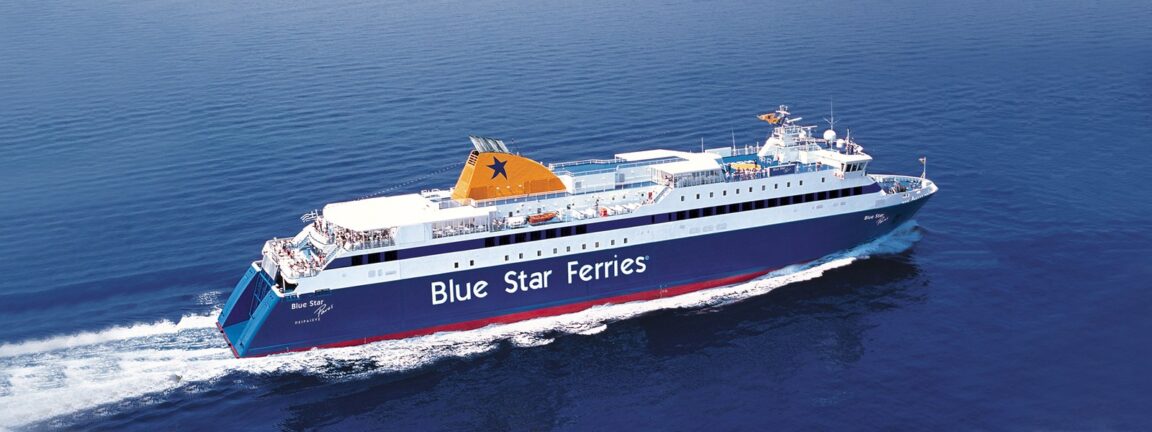
The system’s central choice repeats on every route. Conventional ferries, the big Blue Star and Hellenic Seaways ships, are slower, cheaper, steadier in rough seas, and genuinely pleasant: outside decks, cafes, aircraft style seats, numbered seats and cabins. Piraeus to Santorini takes about 7 to 8 hours conventionally, to Mykonos about 4.5 to 5.5 hours, to Paros around 4 to 5 hours. High speed catamarans roughly halve those times, Santorini in about 4.5 to 5 hours and Mykonos in 2.5 to 3.5, at close to double the fare, with airline style indoor seating, no real deck time and a rougher ride when the summer meltemi wind builds. Neither is simply better. The conventional ship is part of the holiday and the right answer for long hauls, vehicles and nervous stomachs; the catamaran is a tool for short trips and tight schedules. In July and August, when the meltemi can delay or cancel high speed sailings while the big ships sail on, the conventional ferry is also the reliability choice.
The Cabin Versus Deck Decision
On day routes, the classes are simple: deck or economy passage, aircraft style seats in lounges, and business class seats with more room. Pay for the numbered seat on anything over three hours and keep deck passage for the short Saronic hops. Overnight routes invert the maths. Piraeus to Crete runs about 9 hours, departing in the evening and arriving around dawn, and Rhodes can run 14 to 18 hours with island stops through the night. On those sailings a cabin is not luxury, it is a hotel night and a day of sightseeing rescued: price the cabin against the hotel night it replaces, factor in arriving able to function, and the four berth cabin shared by a group often beats four aircraft seats plus a wrecked first day. Book cabins early in summer; they sell out before the deck does.
Sequencing Islands Without Backtracking
The map rewards chains, not stars. The classic Cyclades chain runs Piraeus to Syros, Paros, Naxos, Ios and Santorini in a rough line, with ferries stopping along it, so you hop forward and fly home from Santorini or Crete instead of returning to Athens. Paros and Naxos face each other across a 45 minute local crossing and pair naturally. Mykonos combines with Syros and Tinos on northern routes, and Rafina departures suit Andros, Tinos and Mykonos without crossing Athens. Crete is a destination, not a hop: give it its own block of days at the end of a chain, reached by the fast Santorini to Heraklion crossing of about 2 hours or the overnight ship back to Piraeus. The sequencing errors are consistent: zigzagging between island groups that share no direct route, scheduling a same day ferry to flight connection with no buffer, and assuming winter timetables resemble summer ones, when in fact routes thin dramatically outside the season and some run only a few times a week. The same chain thinking powers good ferry travel elsewhere, as in our Hudson Valley rail itinerary, where the order of stops is the itinerary, and the layover logic in our Incheon layover guide, where buffers decide what is possible.
Booking and Boarding Craft
Book direct with operators or through the established aggregators, keep the booking reference offline as well as in your inbox, and in peak season book the popular Cyclades sailings weeks ahead, especially with a vehicle, since car deck space is the scarcest inventory in the system. Check in online where offered, arrive at the gate early, and listen for platform style announcements, because Greek ferry boarding is brisk and the ship will not wait. Keep medication, documents and a warm layer in your hand luggage: vehicle decks close during the crossing, and the outside deck of a conventional ferry at speed is colder than the harbour suggested.
The Ports Beyond Athens
Piraeus is the hub, but the system has working edges that save whole days when you use them. Lavrio, southeast of Athens, serves Kea and Kythnos and some Cyclades routes with a fraction of Piraeus’s scale and confusion. Thessaloniki connects the Sporades and the northern Aegean. Crete’s ports, Heraklion, Chania’s Souda, Rethymno and Sitia, each serve different onward routes, including the Dodecanese chain from Crete’s east. The Dodecanese itself hops beautifully once you are in it, with Rhodes as its hub and Kos, Patmos, Leros and Symi linked by local and conventional services. The Ionian islands run on a separate western logic from Patras, Kyllini and Igoumenitsa, and travellers combining the two seas should route through Athens deliberately rather than discovering at a dock that no ferry crosses the country for them. Read the network as regions first and routes second, and the timetable pages start to make sense.
Vehicles, Luggage and the Small Print
Taking a car changes every calculation: vehicle spaces sell out first in summer, cost several times a passenger fare, and load through a brisk, marshal directed process you should arrive early for. On many island routes a car is a burden rather than a freedom, since the islands that reward hopping most are small, bus served or walkable, and rental cars wait at the ports that matter. Luggage travels with you, not through a checked system: you wheel it aboard, leave it in the deck racks near your boarding point, and keep valuables, documents and medication on your person, because you will not reach the car deck or the hold during the crossing. Tickets are increasingly digital, but a screenshot beats an app at a windy gate with poor signal. Finally, build the last ferry of any trip with the same suspicion you would give a last train: timetables shift by season and operator, a printed schedule from spring may not describe August, and the operator’s own site for your exact date is the only version that counts.
Frequently Asked Questions
Which Athens port should I use? Piraeus for most Cyclades, Crete, Dodecanese and Saronic routes. Rafina for Andros, Tinos and Mykonos, and when you are coming straight from Athens Airport.
How long is the ferry from Piraeus to Santorini? About 7 to 8 hours on a conventional ferry and about 4.5 to 5 hours on a high speed catamaran, depending on stops. Confirm your specific sailing with the operator.
Is a cabin worth it to Crete? Usually yes. The crossing is about 9 hours overnight, and a cabin replaces a hotel night while delivering you to Heraklion or Chania able to use the day.
Do Greek ferries run in winter? Yes, but on much thinner timetables. Core routes to Crete and the larger islands run year round; smaller island connections may run only a few times weekly. Always check the winter schedule for your exact route.
Can high speed ferries be cancelled? Yes, in strong meltemi winds in summer, high speed craft are cancelled before conventional ships. Build buffer days before flights home in July and August.
Image credit: The Blue Star Paros at sea, from the official Blue Star Ferries website (bluestarferries.com), Blue Star Ferries.