 Aiko Tanaka
Japan has no national hotel tax. Instead, a growing patchwork of prefectures and cities levy their own accommodation tax, charged per person per night and usually collected by the property on top of the room rate, which is why it so often appears as a surprise line at check in or on a ryokan bill. Tokyo charges 100 to 200 yen on pricier rooms and switches to 3 percent of the room charge from April 2027. Kyoto, since March 2026, runs five bands from 200 yen to a striking 10,000 yen at the top. Osaka raised its bands in September 2025, Fukuoka charges 200 or 500 yen, and Sapporo joined the list in April 2026. This guide maps the main levies from the municipal ordinances so a traveller booking across Japan can price the tax before the front desk does.
Quick Facts
- Unit of charge: Per person, per night, in every major system, calculated on the room only charge per person, not on meals or services.
- Tokyo: No tax under 10,000 yen per person per night; 100 yen from 10,000 to under 15,000 yen; 200 yen at 15,000 yen and above. From 1 April 2027, 3 percent of the room charge.
- Kyoto City: Since 1 March 2026, five bands: 200, 400, 1,000, 4,000 and 10,000 yen, with the top band on rooms of 100,000 yen or more per person per night. No price exemption at the bottom.
- Osaka Prefecture: Since 1 September 2025, no tax under 5,000 yen; then 200, 400 and 500 yen bands, covering hotels, ryokan, simple lodging and minpaku across the prefecture.
- Fukuoka City: 200 yen per person per night under 20,000 yen and 500 yen at or above, including a prefectural share; the rest of Fukuoka Prefecture charges a flat 200 yen.
- Sapporo: Taxing since 1 April 2026 with a combined city and Hokkaido charge, 300 yen per person per night on rooms under 20,000 yen.
How the Tax Works, and Why Booking Sites Hide It
The accommodation tax, shukuhakuzei, is a local earmarked tax. Each prefecture or city passes its own ordinance with the consent of the Ministry of Internal Affairs and Communications, sets its own bands and exemptions, and obliges the property to collect it from the guest. Three mechanics explain nearly every surprise. First, the charge is per person, so a family of four in one room pays four times, and the bands are read off the room charge divided per person, which can pull a shared luxury room down a band or two. Second, the taxable base is the lodging charge itself, room only and before consumption tax, so the two included meals that make a ryokan stay wonderful do not inflate the tax. Third, because the property collects it, many international booking sites quote the room without it and the tax surfaces at the property, in cash or on the final bill, even when the room itself was prepaid. Travellers who want no surprises should look for the accommodation tax line in the booking’s price details and treat its absence as a question, not a saving. Our Tokyo five day itinerary budgets stays district by district with the same habit.
The Big Three: Tokyo, Kyoto and Osaka
Tokyo was the pioneer, taxing since 2002, and its current system is the gentlest of the three: nothing below 10,000 yen per person per night, then 100 yen, then 200 yen at 15,000 yen and above, and for now it applies to hotels and ryokan rather than to every lodging type. That changes on 1 April 2027, when Tokyo replaces the flat bands with 3 percent of the room charge, keeps a zero band at the bottom and brings simple lodging and private lodging into scope. A mid range Tokyo room will barely notice the difference; a luxury room will pay meaningfully more than today’s 200 yen cap.
Kyoto is the outlier and now the most expensive place in Japan to sleep at the top end. The city has taxed every lodger since 2018 with no low price exemption, so even a dorm bed pays 200 yen. The March 2026 revision steepened the ladder sharply: 400 yen through the mainstream bands, 1,000 yen once the room charge passes 20,000 yen per person, 4,000 yen past 50,000 yen and 10,000 yen per person per night at 100,000 yen and above. For a couple in a high end ryokan for three nights, the tax alone can reach 60,000 yen, which is real money and a genuine factor in choosing between Kyoto and a base in Osaka or Otsu. School trips are exempt, one of the few carve outs. Osaka Prefecture, by contrast, runs a broad and shallow system: it covers the whole prefecture and almost every lodging type including minpaku, but the September 2025 bands top out at 500 yen, with nothing charged under 5,000 yen. Travellers sleeping in Osaka and day tripping to Kyoto lawfully pay Osaka’s tax, a piece of arithmetic the cities understand perfectly well. Kyoto’s own charms, paced properly, are the subject of our three days in Kyoto without the crowd crush.
Beyond the Big Three: Fukuoka, Sapporo, Kanazawa and the New Levies
The map keeps filling in. Fukuoka City has charged since April 2020, 200 yen under a 20,000 yen room charge and 500 yen above it, each figure including a 50 yen prefectural share, while the rest of Fukuoka Prefecture charges a flat 200 yen. Kanazawa runs a simple two step of 200 and 500 yen. Sapporo began on 1 April 2026 with a stacked city plus prefecture charge, 300 yen combined on rooms under 20,000 yen, and Hokkaido’s prefectural tax reaches a string of resort towns as well. Niseko has moved to a percentage model from November 2026, following the direction Tokyo takes in 2027, and further towns including Nasu and Morioka have scheduled start dates in late 2026, with Okinawa’s prefectural tax announced for 2027. The direction of travel is unmistakable: within a few years, a multi city Japan itinerary will cross half a dozen different local systems, none of them large at ordinary room rates and all of them itemised somewhere in the paperwork.
Reading a Ryokan Bill: Where the Tax Sits
A traditional ryokan bill separates its charges more honestly than most hotel folios. The room and meal plan appears as the lodging charge, consumption tax is applied, and the accommodation tax appears as its own named line, calculated per guest per night on the room only portion of the rate. That separation is why a half board ryokan in Kyoto can show a tax figure that looks low against the total bill: the kaiseki dinner is not taxed by the accommodation levy. It is also why comparing two properties on headline price alone misleads; a Kyoto luxury ryokan and an equivalent property outside the city boundary can differ by the full top band tax on every night. The traveller’s checklist is short: confirm whether the quoted price includes the accommodation tax, multiply the band by guests and nights before booking, and keep small cash or a card ready at properties that collect on arrival. More Japan planning coverage is linked from the Always Packed homepage.
Frequently Asked Questions
Is the accommodation tax included in booking site prices?
Often not. Because the property collects the tax, many booking sites quote the room alone and the tax is paid at the property. Check the price details for an accommodation tax line before assuming.
Which Japanese city has the highest hotel tax?
Kyoto City, at the top end. Since March 2026 its highest band is 10,000 yen per person per night on rooms of 100,000 yen or more, far above Tokyo’s current 200 yen maximum.
How is the tax calculated for a shared room?
On the room charge divided per person, per night, using the room only charge. Four guests sharing a 40,000 yen room are each in the 10,000 yen band, not the 40,000 yen band.
Do children and budget beds pay?
It depends on the city. Kyoto taxes every lodger with no low price exemption, so a cheap bed still pays 200 yen. Tokyo charges nothing under 10,000 yen per person and Osaka nothing under 5,000 yen.
Is Tokyo’s tax really changing to a percentage?
Yes. From 1 April 2027 Tokyo replaces its 100 and 200 yen bands with 3 percent of the room charge, extends the tax to simple lodging and minpaku, and keeps a zero band for the cheapest rooms.
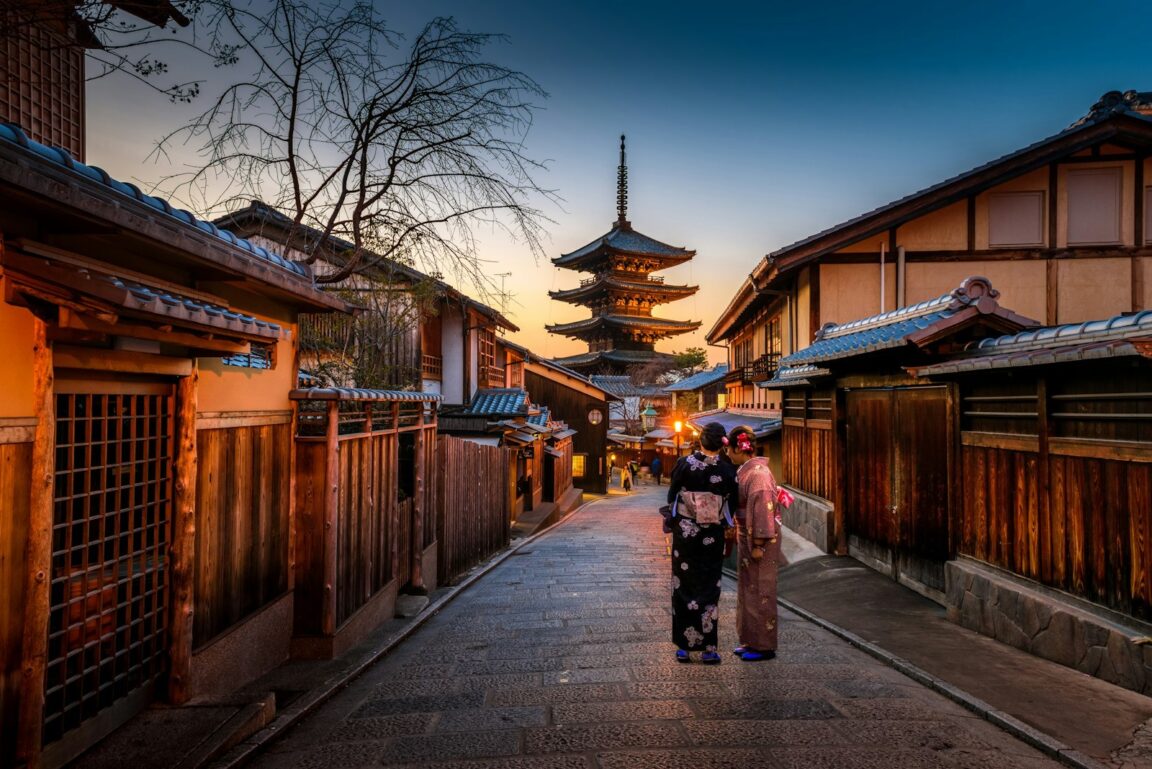
Image: Yasaka pagoda at dusk from a traditional street in Kyoto, Japan. Photo by Unsplash contributor (photo 1493976040374-85c8e12f0c0e), via Unsplash, Unsplash License.