 Rafael Santos
Argentina charges no reciprocity fee to United States passport holders, and most Western nationalities enter visa free for up to 90 days as tourists. The longer stay routes split cleanly in two. Remote workers paid from abroad use the digital nomad transitory residence, which runs up to 180 days and can be extended once. People living on income from assets use the rentista temporary residence, which demands proof of at least five times the Argentine minimum wage, paid from assets rather than from personal work. Everything else in this guide follows from keeping those three doors separate, because mixing them up is how applications stall at the Direccion Nacional de Migraciones, the agency everyone calls Migraciones.
Quick Facts
- Tourist entry: Visa free for up to 90 days for US, UK, EU, Canadian and Australian passport holders, among others.
- Reciprocity fee: None for US citizens. The old reciprocity charge was scrapped years ago and the Argentine embassy in Washington confirms US visitors do not pay it.
- Digital nomad route: Transitory residence of up to 180 days, extendable once for the same period, created by Disposicion 758/2022.
- Nomad income rule: No official monthly minimum is published. Applicants prove real remote work for foreign clients or employers instead.
- Rentista rule: Income of at least five times the Salario Minimo Vital y Movil, sourced from assets, entering through banks authorised by the central bank.
- Where to file: Migraciones, in person inside Argentina for the nomad category, with fees and forms that change often enough to check on argentina.gob.ar before filing.
The Tourist Door: 90 Days and No Reciprocity Fee
The reciprocity fee is the ghost that still haunts Argentina travel advice. It was a real charge once, levied on nationalities whose countries charged Argentines for visas, and the United States was on that list. It no longer applies to US visitors. The Argentine embassy in the United States lists the US among the countries whose citizens need no visa for stays of up to 90 days and states that they do not pay the reciprocity fee. Travellers arriving from other fee era advice should ignore any website still selling help with paying it.
On arrival, most visitors simply receive a tourist stay of up to 90 days. Tourist status is not residence. It does not authorise local employment, and it does not build time toward permanent residence. Travellers who need longer have two honest options. The first is a formal extension request to Migraciones before the stay expires. The second, widely used but legally thinner, is a short trip out of the country and a fresh entry. Anyone building a life plan on repeated exits should understand that re entry is always at the discretion of the border officer, and that the 2025 migration decree tightened several residence rules, including how absences affect the clock toward permanent residence.
The Nomad Door: 180 Days, Renewable Once, No Published Income Floor
Argentina’s nomad category is a transitory residence under article 24(h) of the migration law, created by Disposicion DNM 758/2022. It grants up to 180 days to foreigners who work remotely for clients or employers based abroad, and it can be extended once for an equal period, taking the total close to a year. Two limits define it. First, only nationals of countries that do not need a tourist visa for Argentina may apply, so the category is closed to anyone whose passport requires a visa to enter. Second, the work must stay foreign. Working for an Argentine employer is outside the category entirely.
The point that surprises applicants is the income test, because there is not one in the form the internet expects. The disposition publishes no monthly minimum. What Migraciones asks for instead is evidence that the remote work is real: a contract, a letter from the employing company, a request for services, or certificates and receipts of income or fees, alongside a signed application describing the activity, a CV, a criminal record certificate, proof of address and proof of lawful entry. Blog posts quoting a fixed dollar threshold for Argentina are importing numbers from other countries. A steady, documented income strengthens a file, but the legal test is proof of the activity, not a salary figure.
Extending the stay has its own conditions. The extension applicant must show income actually earned during the first period and must have spent at least half of the granted period physically in Argentina. The category also carries a structural warning that long term planners miss: transitory residence does not accumulate toward permanent residency or citizenship. A year as a nomad is a year of lawful presence, not a year of progress toward settling. Travellers weighing a permanent move should compare it with the temporary residence categories below, and with the entry rules explainers in our coverage of Chile’s SAG declaration at Santiago airport, which show how differently South American states write these rules.
The Rentista Door: Five Times the Minimum Wage, From Assets Only
The rentista residence is a temporary residence for people who live on their own assets. The official test has three parts, and the second is the one that disqualifies most casual applicants. First, the income must reach at least five times the Salario Minimo Vital y Movil, the statutory minimum wage, a threshold fixed by Disposicion 1732/2023. Because the minimum wage is reset by resolution, the peso figure moves, and applicants should compute it from the current wage rather than from any blog’s dollar conversion. Second, the income must come from assets incorporated into the applicant’s wealth: financial instruments, real estate, shareholdings in companies and similar sources. The official page expressly excludes pay for personal labour. A remote salary, however large, is not rentista income. Third, the funds must enter Argentina through banking or financial institutions authorised by the central bank, which means the paper trail matters as much as the amount.
Rentista status is granted for one year and is renewable, which makes it the genuine long stay route for retirees and investors, and it sits in a different legal family from the nomad permit. The pensionado category covers foreign pension recipients on similar logic. Applicants who earn actively, even from abroad, belong in the nomad category instead, and applicants with both asset income and a salary should expect Migraciones to test which source actually supports them. For a comparison of how another long stay system separates its categories, see our guide to Australia’s working holiday visa rules.
Fees, Filing and the 2025 Decree: What to Check on the Day
Argentina publishes its migration fees in official fee tables that are revised as the peso moves, and consular filing abroad is priced differently from switching status inside the country. Any fixed dollar fee quoted in older guides should be treated as stale. The reliable sequence is to read the current service page for the exact category on argentina.gob.ar, confirm the fee table linked from it, and file the nomad application in person as the category requires. Decree 366/2025, published in May 2025, rewrote parts of the migration and citizenship framework, including a new economic means test in the permanent residence process and a rule that departures can reset the continuous residence count. None of that changes the tourist, nomad or rentista entry tests described above, but it does mean that advice written before mid 2025 about settling in Argentina needs rechecking line by line. More entry explainers live on the Always Packed homepage.
Frequently Asked Questions
Do US citizens pay a reciprocity fee to enter Argentina?
No. The Argentine embassy in the United States confirms that US citizens enter visa free for up to 90 days and do not pay the reciprocity fee. The charge survives only in outdated guides.
How long does the Argentina digital nomad residence last?
Up to 180 days, extendable once for the same period if the holder proves income earned during the first stay and spent at least half of it in Argentina.
Is there a minimum income for the nomad residence?
No figure is published in Disposicion 758/2022. Applicants prove genuine remote work for foreign clients or employers with contracts, company letters or income receipts.
Can a remote salary qualify someone as a rentista?
No. Rentista income must come from assets such as financial instruments, property or company shares, at least five times the minimum wage, and pay for personal labour is expressly excluded.
Does time on the nomad residence count toward permanent residence?
No. It is a transitory residence and does not accumulate toward permanent residency or citizenship, which is the key difference from the temporary residence categories.
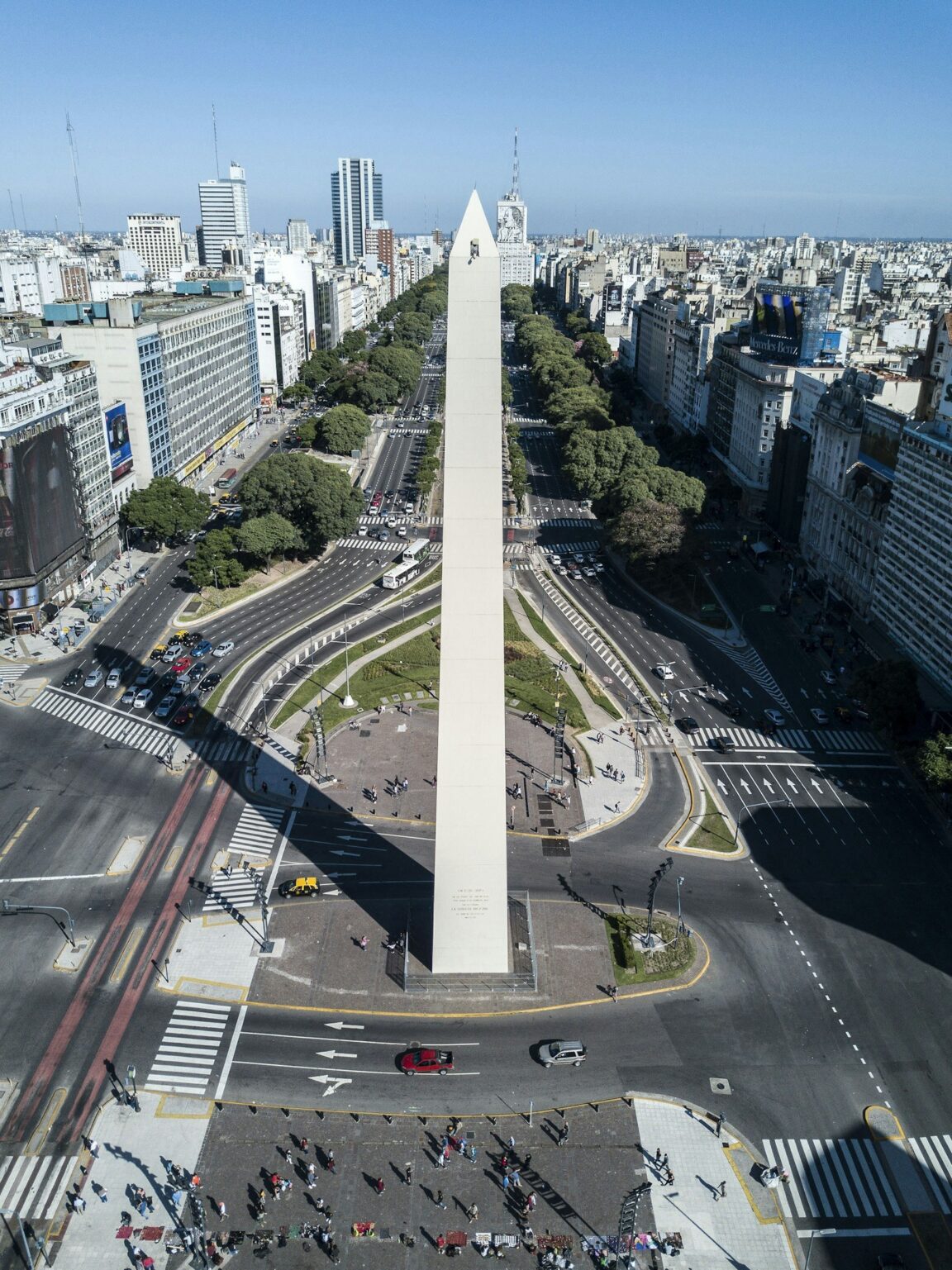
Image: The Obelisk on Avenida 9 de Julio, Buenos Aires, Argentina. Photo by Unsplash contributor (photo 1589909202802-8f4aadce1849), via Unsplash, Unsplash License.