 Omar Haddad
Almost every visitor to Dubai still lands at Dubai International, DXB, and that will remain true for years. Al Maktoum International, code DWC, is the vast second airport in the Dubai South district near Jebel Ali: real, operating and handling a small roster of passenger flights today, but still the opening act of a 128 billion dirham expansion approved in April 2024 that is designed to make it one of the largest airports on earth over the following decade. The Palm Monorail sits at the other end of the scale: a 5.5 kilometre line, open since 2009, that is the only public transport on Palm Jumeirah and the most useful ten minutes a Palm visitor can buy. This guide keeps the two in their true proportions, what a visitor uses now versus what opens later.
Quick Facts
- DWC today: A working passenger airport with a small number of airlines and routes, including flydubai services, plus a major cargo operation; Dubai Airports’ fact file records just over 540,000 guests in 2023.
- DWC expansion: Phase 2 approved on 28 April 2024 at 128 billion dirhams, aiming at about 150 million passengers of capacity over ten years and an ultimate capacity of 260 million, with five runways and over 400 aircraft stands.
- DXB remains the main airport: No wholesale move of flights has happened. Check the airport code on any booking before assuming where a flight lands.
- Palm Monorail: 5.5 kilometres from Palm Gateway to Atlantis Aquaventure, with Al Ittihad Park and Palm Jumeirah Mall stations between; trains about every 15 minutes.
- Monorail hours and fares: Daily from 9:00, last train 21:45 from Gateway and 22:00 from Atlantis, per the operator and Visit Dubai; singles from 10 dirhams, Gateway to Atlantis 20 dirhams one way and 30 return.
- Ticketing: The monorail runs on its own tickets, sold online and at stations; it is not part of the Nol card network.
Al Maktoum Now: A Real Airport With a Short Departures Board
DWC opened to cargo in June 2010 and to passengers in October 2013, and its expanded passenger terminal, opened in 2018, lifted its capacity to about 26 million passengers a year. Actual use is a fraction of that. Dubai Airports’ own fact file describes a small group of passenger airlines operating a modest weekly schedule, flydubai among them with routes such as Amman and Beirut, alongside about 20 cargo operators. The airport has repeatedly served as Dubai’s pressure valve, taking diverted traffic during DXB runway works in 2019 and 2022 and handling World Cup shuttle flights to Doha in 2022. A traveller whose itinerary genuinely uses DWC should expect a quiet, fast terminal and a long road journey afterwards: the airport sits in the far south of the emirate, roughly 37 kilometres southwest of the city centre in the older district measures and much further from the Palm and Marina by road time. Plan on the better part of an hour by taxi to Palm Jumeirah, and more at peak traffic, and do not book a tight same evening plan on the back of a DWC arrival.
Al Maktoum Later: What the 128 Billion Dirham Plan Actually Promises
On 28 April 2024 the Ruler of Dubai approved the Phase 2 expansion of DWC: a 150 million passenger capacity facility built over about ten years, with five runways, west and east processing terminals, four satellite concourses with over 400 contact stands, an automated people mover and an integrated landside hub for road, metro and future city air transport. The stated ultimate capacity is 260 million passengers a year and 12 million tonnes of cargo. Dubai’s leadership has said openly that operations will migrate from DXB to DWC as the new airport matures, and DXB’s site cannot expand. What has not been published is a date on which any given airline moves, and that distinction is the whole story for travellers. Until an airline announces a transfer, a flight to Dubai means DXB unless the booking says DWC. Renderings of the future airport are not a reason to change how a 2026 or 2027 trip is planned, and any guide that describes DWC as Dubai’s main airport today is describing the plan, not the place. For contrast on how established airport systems present themselves, see our explainer on arriving at Santiago airport.
The Palm Monorail: The Visitor Tool That Exists Today
The Palm Monorail opened in 2009 as the first monorail in the Middle East and still does one job very well: it carries visitors down the trunk of Palm Jumeirah above the traffic. The line runs 5.5 kilometres from Palm Gateway station, at the island’s entrance beside a Dubai Tram stop and a car park with over 1,600 spaces and three free hours for ticket holders, through Al Ittihad Park station for the Golden Mile Galleria and Palm West Beach, and Palm Jumeirah Mall station, to Atlantis Aquaventure at the crescent. Trains run about every 15 minutes and the full ride takes roughly ten minutes, with the skyline behind and the fronds opening on both sides, which is why the line earns its keep as a viewing ride as much as a transport link. Fares are distance based: short hops start at 10 dirhams, the full Gateway to Atlantis run is 20 dirhams one way or 30 return, a day pass costs 35 dirhams, and children under 110 centimetres ride free. Two practical notes matter more than the fare table. The monorail has its own ticketing, so a Nol card will not open its gates, and the service has had maintenance closures in its recent history, most recently a closure across late 2025 into 2026 after which the operator announced a full reopening; checking the operator’s site on the morning of a Palm day is a ten second habit that protects the plan.
Used well, the monorail structures a Palm day: tram or taxi to Gateway, ride to Atlantis Aquaventure in the morning, walk the crescent, ride back to Palm Jumeirah Mall for lunch and finish at Al Ittihad Park for the beach clubs, all without once negotiating the island’s road traffic. It does not, however, connect to DWC in any useful way, and a traveller landing at Al Maktoum with a Palm hotel should simply take the taxi and watch the future airport district pass by. More Dubai and airport coverage is linked from the Always Packed homepage.
Frequently Asked Questions
Will my flight to Dubai land at Al Maktoum (DWC)?
Probably not. Most passenger flights still use Dubai International (DXB). A small number of airlines, including some flydubai services, use DWC, so check the airport code printed on the booking.
How long does it take from DWC to Palm Jumeirah?
Plan on the better part of an hour by taxi in normal traffic and longer at peak times. DWC is in Dubai South near Jebel Ali, at the opposite end of the city from the Palm.
How much is the Palm Monorail?
Singles start at 10 dirhams. The full run from Palm Gateway to Atlantis Aquaventure is 20 dirhams one way and 30 dirhams return, and a day pass is 35 dirhams, per the operator’s published fares.
Can I pay for the Palm Monorail with a Nol card?
No. The monorail sells its own tickets online and at its stations and sits outside the Nol network, although its Gateway station connects conveniently with the Dubai Tram.
When will Al Maktoum become Dubai’s main airport?
The approved expansion targets about 150 million passengers of capacity over roughly ten years from 2024, and airlines are expected to migrate as it matures. No carrier by carrier transfer dates have been published.
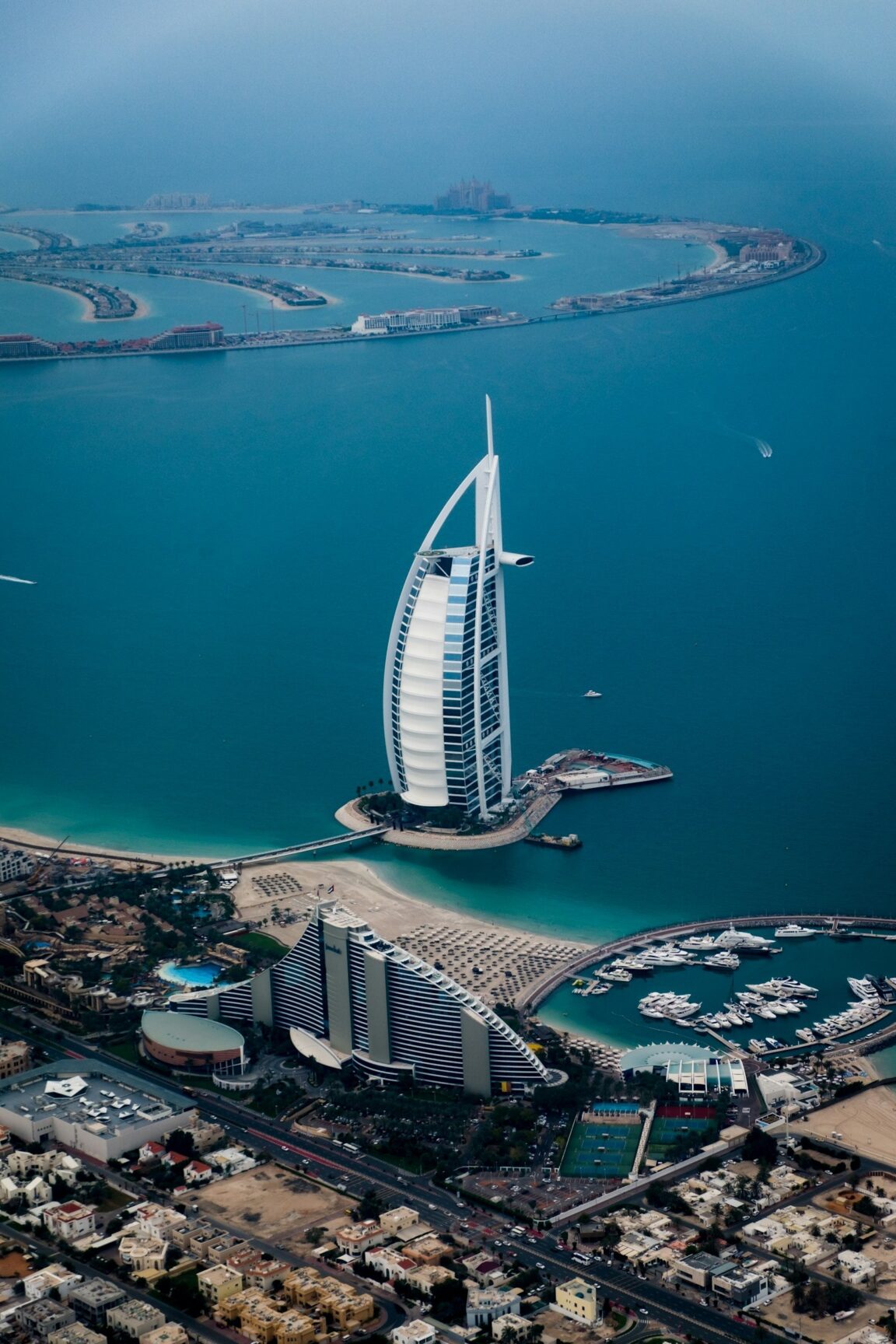
Image: Burj Al Arab with Palm Jumeirah and Atlantis visible across the water, Dubai. Photo by Unsplash contributor (photo 1518684079-3c830dcef090), via Unsplash, Unsplash License.