 James Wolfe
The Literary Man in Óbidos is exactly what it claims to be, and travellers should book it on those terms: a working bookshop hotel inside a former convent, where tens of thousands of books shelve the lobby, the restaurant, the bar and the corridors, and where many of them are for sale as well as for reading. It is not a luxury hotel with a literary theme pasted on. The rooms, around 30 of them, range from former nuns’ cells to more contemporary spaces, the pleasures are browsing, reading by the fire and walking a medieval walled town after the day trippers leave, and the compromises are those of an old convent building run as a bookshop first. Book it if that trade sounds wonderful. Book elsewhere in Óbidos if you need polish, a spa or silence from other guests’ discoveries.
Quick Facts
- Address: Rua Dom João de Ornelas, Óbidos, Portugal, beside the castle and just inside the medieval town walls
- Building: A former convent, founded in the 1830s and long run as the Estalagem do Convento inn before its reinvention as The Literary Man in 2015
- Rooms: Around 30 rooms, including eight in the former nuns’ cell corridor, each individually styled and all stocked with books
- The books: The hotel states a collection of more than 45,000 books and growing, shelved throughout the public rooms and bedrooms, in several languages, with stock available to buy; it bills itself as the world’s largest literary hotel
- Eating and drinking: The Book and Cook restaurant in the library space, and the Gin Library bar, set in the convent’s former church area
- Setting: Óbidos, a walled medieval town about an hour’s drive north of Lisbon, famous for its castle, its whitewashed lanes and its ginjinha cherry liqueur
- Checked: Hotel details verified on theliteraryman.pt on 25 November 2026; rates are dynamic and were not quoted, so check the hotel’s own booking page for your dates
Is the bookshop hotel premise real, or is it decoration?
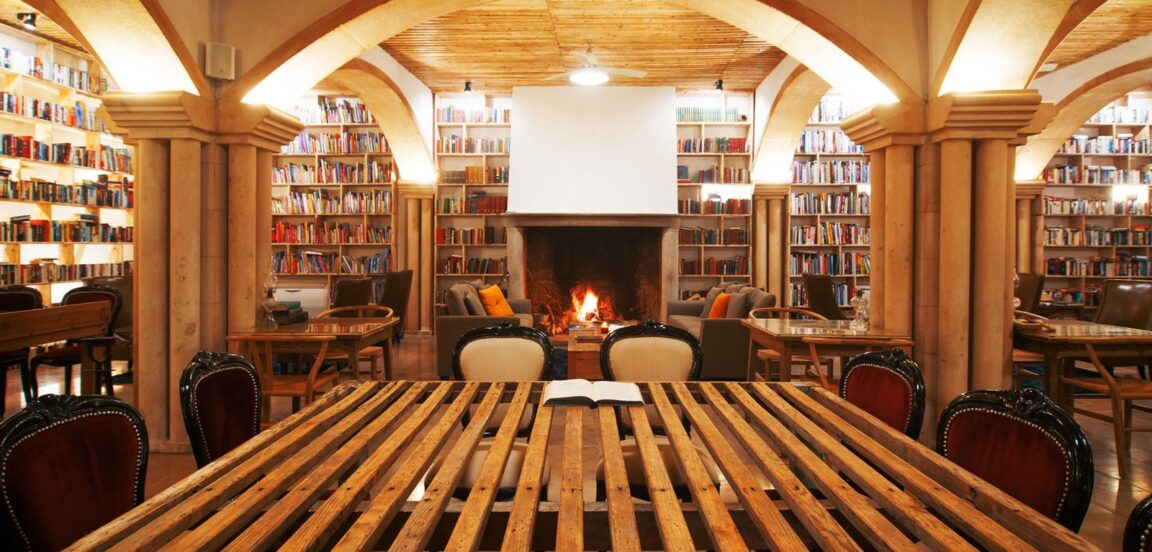
It is real, and the distinction is the whole review. In a themed hotel, books would be props: matched spines, bought by the metre, glued shut. At The Literary Man the books are stock. The hotel operates as one of Óbidos’ bookshops as well as its lodging, the collection is organised by genre and language so guests can actually find things, and volumes you fall for at midnight can be bought rather than mourned at checkout. The shelving runs everywhere: floor to ceiling in the great library room that doubles as the restaurant, along corridors, in reading corners with fireplaces, and inside the bedrooms themselves, where no two rooms carry the same selection.
The scale claim deserves a traveller’s translation. The hotel puts its collection at more than 45,000 books and describes itself as the largest literary hotel in the world; some accounts of the property, counting every shelf and store, run considerably higher. What matters practically is not the audited number but the effect: you will not exhaust the shelves in a stay of any reasonable length, browsing becomes the default activity of the house, and the public rooms feel like a bookshop that happens to serve dinner rather than a hotel that happens to own books. Óbidos itself supports the premise. The town has reinvented itself as Portugal’s literary village, with bookshops installed in a former church and a former market hall among other unlikely buildings, and a major international literature festival each autumn, so the hotel sits inside a town wide project rather than standing as a lone gimmick.
What are the rooms actually like?
They divide by the building’s history. Eight rooms occupy the former nuns’ cell corridor, the Corredor das Celas, where the convent’s original small rooms keep their monastic proportions and gain books, art and proper bathrooms. Elsewhere, rooms split between a traditional style, with antique furniture and the convent’s thick walls and high ceilings, and a more contemporary, eco leaning style with handcrafted wood and cleaner lines. Every room is individual, which is the charm and the caveat in one: standards of space, light and layout vary more than in a conventional hotel, and travellers who care deeply about a specific room type should book that type explicitly and confirm it with the hotel, rather than assuming uniformity.
Set expectations by the building, not the marketing. A convent founded in the 1830s, converted to an inn in the last century and reinvented in 2015, gives atmosphere in quantities no new build can match, and it also gives the quirks of old fabric: stairs rather than a grand lift lobby, corridors that wander, and a lived in feel that glossy travellers sometimes read as wear. The house style suits readers, writers and slow travellers. It is a weaker fit for a one night motorway stop, where you would pay for a library you have no time to open. Give it two nights minimum, so the browsing, the bar and the town at night all get their turn. For another stay where the building’s past is the point, compare our guide to Hiiragiya Ryokan in Kyoto, and for a small town that empties beautifully after dark, our Eureka Springs guide.
What happens in the restaurant and the Gin Library bar?
Dinner is served among the shelves. The Book and Cook restaurant occupies the library space, so the evening runs as eating inside a bookshop after closing, with a menu that plays on literary references alongside Portuguese cooking, and breakfast follows in the same rooms. It is the hotel’s strongest argument for staying in at night, particularly in winter, when the fireplaces are lit and Óbidos outside has gone quiet. The bar makes the companion argument. The Gin Library, set in the space of the convent’s former church, pairs a serious gin list with the improbable calm of drinking surrounded by books under a sacred ceiling, and it draws non residents as well as guests, which keeps the room lively later than the town outside.
Neither space should be oversold. This is a small hotel in a small town, not a destination restaurant city break, and menus, hours and seasonal openings follow that scale, so check the hotel’s own site for current service times when you book. Judge the pair as residents judge them: as the social rooms of a house built around reading, where the food and the gin are good company for the shelves rather than rivals to them.
Why does Óbidos change after the day trippers leave?
Óbidos by day, in season, is one of Portugal’s most visited small towns, its single main street of whitewashed houses, bougainvillea and ginjinha stalls carrying a steady river of tour groups up to the castle. Óbidos by night belongs to the few hundred people sleeping inside the walls. The lanes empty, the castle walls and the aqueduct at the town’s edge take on their evening light, dinner runs late and slow, and the walk back to the hotel through streets that have stood since the Moors and the medieval kings becomes the memory guests actually keep. Staying at The Literary Man puts you inside that second town, a few steps from the castle at the top of the hill, with the Porta da Vila gate and its tiled chapel below you.
Plan days around the walls rather than through them: walk the full circuit of the castle walls early or late, when the light and the crowds are kind, visit the town’s other bookshops, including the one installed in the Gothic Church of St. Peter and the market hall bookshop, taste ginjinha in its edible chocolate cup once, as ritual demands, and use the car, if you have one, for the Óbidos lagoon and the coast at Foz do Arelho. Without a car, the town is an easy bus ride of about an hour from Lisbon, which makes the hotel a realistic two night exhale inside a Lisbon trip rather than a separate expedition.
Frequently Asked Questions
How many books does The Literary Man actually have?
The hotel states more than 45,000 books and growing, shelved through its public rooms and bedrooms, and describes itself as the world’s largest literary hotel. Many books are bookshop stock and can be bought, which is what separates the hotel from a merely themed property.
Can non guests visit the hotel’s library, restaurant and bar?
The hotel’s bookshop spaces, its Book and Cook restaurant and the Gin Library bar welcome non residents, subject to current opening arrangements. Check the hotel’s own website for service times before making a special trip.
Where is The Literary Man and how do I reach it from Lisbon?
On Rua Dom João de Ornelas in Óbidos, beside the castle inside the town walls. Óbidos is about an hour north of Lisbon by road, with direct buses from the capital as well as car access, and the hotel sits a short walk from the town gate.
What are the rooms like?
Around 30 individually styled rooms, including eight in the former nuns’ cell corridor of the old convent. Styles split between traditional rooms with antique furniture and more contemporary eco leaning rooms. Because no two are alike, book a specific room type if that matters to you.
How long should I stay?
Two nights minimum. One night reduces the hotel to a novelty photograph. Two nights gives you the library and restaurant at leisure, the Gin Library after dinner, and Óbidos itself after the day visitors leave, which is the town’s best hour.
Image: The library restaurant of The Literary Man, Óbidos, with its bookshelves, arches and fireplace. Photo: The Literary Man Óbidos Hotel, via theliteraryman.pt, the hotel’s official website.