 Kwame Mensah
Treat the 15-kilogram charter limit as law, because the airline does: on the light aircraft that hop between safari airstrips, your entire allowance, main bag, hand luggage and camera gear combined, is commonly 15 kg per person, and the bag itself must be a soft duffel with no wheels and no rigid frame, so it can squash into a luggage pod that was never shaped for suitcases. Everything else in this guide flows from those two facts: the layer system for dawn drives, the neutral colour palette that tsetse flies ignore and animals overlook, and a worked example of a full safari kit that weighs in under the line. Operators vary, some Tanzanian and Botswana carriers allow 20 kg, so your booking’s own baggage note is the final word; but pack to 15 and you are legal everywhere.
Quick Facts
- The limit: 15 kg per person in total, including hand luggage and camera equipment, on the main East African safari carriers such as Safarilink, AirKenya, Governors’ Aviation and Coastal Aviation
- The bag: soft-sided duffel only; Coastal Aviation publishes a maximum duffel size of 40 x 40 x 80 cm; hard cases, wheeled bags and framed bags can be refused
- The variation: some operators allow 20 kg in total (Mack Air in Botswana, for example, splits it as roughly 15 kg in the duffel and 5 kg of hand luggage, with a smaller bag footprint), so check your own itinerary
- Colours: khaki, olive, beige, stone and grey; avoid dark blue and black, which attract tsetse flies, and avoid bright white and bright colours
- The trick: wear your heaviest items, boots, fleece and camera, on the flight; they do not count on the scale the way bag weight does on most checks
Why soft bags only?
Because of the aeroplane. Safari charters fly Cessna Caravans and similar light aircraft whose luggage goes into a belly pod or a rear compartment with a small door and no flat floor. A soft duffel moulds into that space; a rigid case does not, and a wheeled bag’s frame and handle waste the volume its owner is charged for. Airlines publish the rule in plain language: bags must be soft-sided, and staff at the airstrip will refuse or re-pack luggage that cannot be compressed. There is a second, kinder reason: duffels ride better in the back of a game viewer, stack in a lodge storeroom, and survive being hauled across dust and gravel in a way that spinner wheels simply do not. Buy or borrow a duffel in the 60 to 80 litre range, check its empty weight, since a heavy bag eats allowance before you pack a shirt, and if the duffel has a detachable shoulder strap and lockable zips, it is safari-ready.
How do you dress for a day that starts at dawn?
A safari day spans three temperatures. The dawn drive leaves camp in the cold, in an open vehicle at speed, where wind chill makes a fleece plus a light insulated jacket, a beanie and gloves feel barely adequate. By ten the same vehicle is a sun trap, and by the afternoon drive the problem flips to sun on one side and mosquitoes at dusk. The layer answer mirrors the cold-climate system: a breathable base, long sleeves and long trousers in neutral colours for sun and insect cover, a warm mid layer for the early hours, and a light waterproof shell that lives in the daypack against a sudden shower. Camps run laundry turnarounds, often same-day, which is why the sample kit below carries three of everything rather than seven: you wear one, wash one, and hold one dry. Shoes are one pair of broken-in walking shoes or light boots, worn on the plane, plus sandals for camp. Nothing in the kit is precious, because dust gets into everything and gives it back changed.
Why does colour matter, and what is the tsetse rule?
Tsetse flies, the biting flies of the miombo woodlands and parts of East and Central Africa, are attracted to dark blue and black, the colours their traps are deliberately made in. Clothing in those colours draws them; clothing in khaki, olive, beige, stone and mid-grey does not, and it has the second virtue of blending at sightings, where a white shirt flares against the bush every time you raise binoculars. Bright colours are out for the same reason, and camouflage is out for a legal one: in several safari countries it is reserved to the military and can cause real trouble at roadblocks and borders. The palette rule extends to the bag itself, where a black duffel is both a tsetse magnet on the airstrip and a heat absorber in the sun; mid-tone bags are the professional choice. Pack a buff or scarf in a neutral tone too: it is sunshade at noon, dust mask on a dry track and warmth at dawn, the single hardest-working item in the kit.
What does a legal 15 kg kit actually look like?
Worked example, weighed the way the airline weighs it. The duffel itself, about 1.2 kg. Inside it: three neutral shirts or tops, two pairs of long trousers, one pair of shorts, underwear and socks for four days on a laundry rotation, sleepwear, a fleece and a light insulated jacket, a packable rain shell, sandals, a swimsuit for the lodge pool, a washbag with reef-safe and DEET-based repellent, a headtorch for camp paths, and a soft hat. That clothing block comes to roughly 8 to 9 kg. The daypack, which counts toward the same 15 kg, carries binoculars, camera and one lens, sunglasses, sunscreen, the buff, a water bottle and documents, about 3 to 4 kg depending on your glass. Total lands around 13 to 14 kg, leaving a margin for the scale’s opinion and a book. Wear the boots, the fleece and the camera around your neck on travel day and the margin grows. For the seasonal side of the same packing problem, our Botswana green season packing guide covers the rains, and our Patagonia packing guide shows the same wear-the-heavy-things discipline applied to trekking.
Frequently Asked Questions
Is the 15 kg limit per bag or per person?
Per person, and it includes everything: main duffel, hand luggage and camera gear combined. Some operators allow 20 kg in total, split between the duffel and a small carry-on, so read your own booking’s baggage note before you pack.
Can you take a wheeled suitcase on a safari charter?
Plan on no. Safari airlines require soft-sided bags without rigid frames or wheels, because luggage travels in a small pod. Coastal Aviation, for example, publishes a maximum soft duffel size of 40 x 40 x 80 cm. Hard cases can be refused at the airstrip.
Why should you avoid black and dark blue on safari?
Tsetse flies are attracted to dark blue and black, which is why tsetse traps use those colours. Neutral khaki, olive, beige, stone and grey draw fewer bites and blend better at wildlife sightings.
How many outfits do you need for a week on safari?
Three rotations are enough where the camp offers laundry, which most do: wear one, wash one, hold one dry. Layers for dawn cold and dusk insects matter more than outfit count.
What should you wear on the charter flight itself?
Your heaviest items: walking boots, fleece or insulated jacket, and your camera around your neck. It keeps the weighed bags comfortably under the limit and puts your most valuable gear in your own hands.
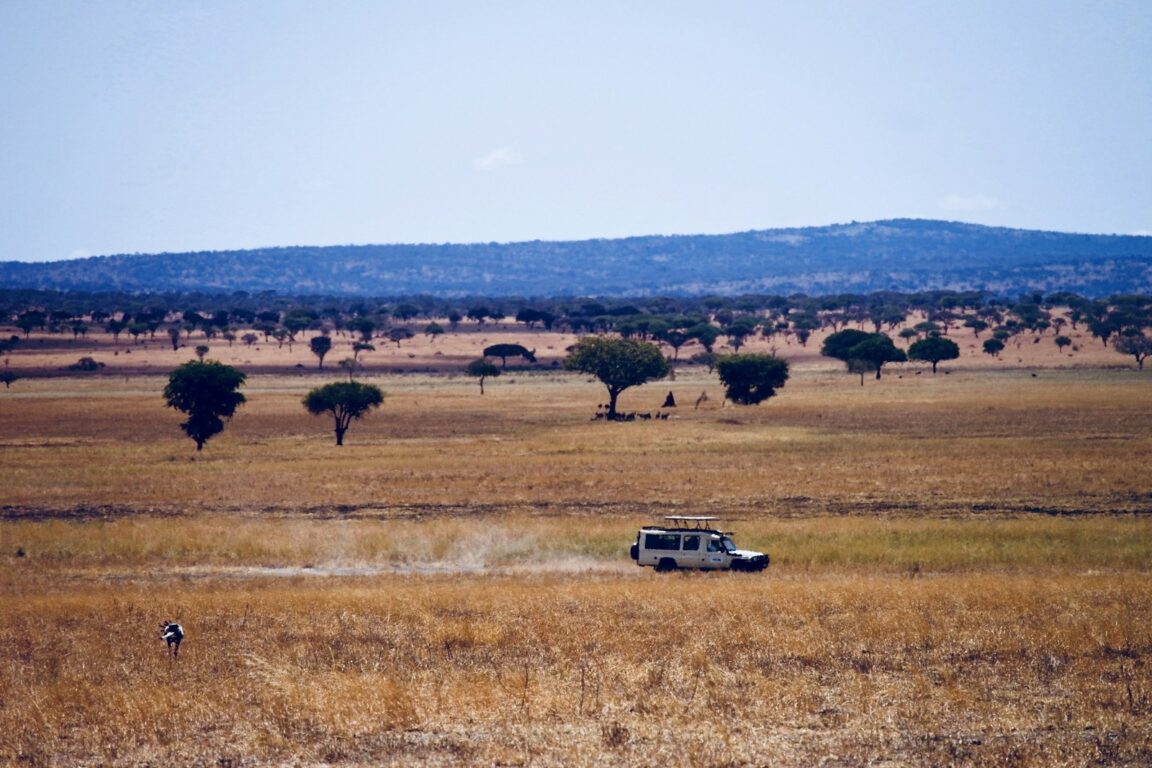
Photo: ray rui, via Unsplash. A safari vehicle crossing the savanna.