 Lucas Meyer
Pack for two climates, not one: a Seoul street at minus 8 in the wind, and the ondol-heated room, restaurant and subway car waiting on the other side of every door, where the floor itself is the radiator and a heavy jumper becomes a punishment. The Korean winter system that locals actually use is a thin thermal base, one mid layer that opens at the front, and a knee-length padded coat over the top, with convenience-store hot packs treated as a daily consumable rather than an emergency item. The Korea Meteorological Administration’s climate normals put Seoul’s January average high at 2.1 degrees and the average low at minus 5.5, with cold-wave advisories issued when the morning low is expected to hold at minus 12 or below for two days or more. Here is the full packing logic, layer by layer.
Quick Facts
- Seoul climate normals (KMA, 1991 to 2020): January average high 2.1 C, average low minus 5.5 C; December high 4.2 C, low minus 3.4 C; February high 5.1 C, low minus 3.2 C
- Regional spread: Busan’s January average low is around 0 C and Jeju’s around 3.7 C, so the same trip south needs one layer less
- Ondol: Korean floor heating, standard in homes, guesthouses and many traditional restaurants; you sit and sleep on the heat source, and shoes come off at the door
- The coat standard: long padding, a knee-length padded coat, is the default outer layer in Korean cities from December to February
- Hot packs: shake-to-activate pocket packs and stick-on packs sold singly and in multipacks at every convenience store, pharmacy and Daiso
- Subway reality: Seoul Metro heats cars to a published standard in the high teens Celsius, and a crowded rush-hour car in a down coat is the warmest place in the city
Why is ondol the real packing problem?
Ondol heats the floor, and the floor is where Korean indoor life happens: you remove your shoes at the door of homes, guesthouses and traditional restaurants, sit on heated floors to eat, and sleep on bedding laid over warmth that runs all night. Three packing consequences follow. First, socks are clothing, not an afterthought: they are visible in every shoeless interior, so pack clean, intact, presentable pairs and more of them than the day count suggests. Second, your base layer has to work as indoor clothing, because the coat and mid layer come off the moment you step inside and the thermal top is what you will sit in for a two-hour dinner. Third, temperature control indoors is coarse: ondol rooms are often warm to hot, hotel rooms included, so sleepwear should be light even in January, and a single heavyweight fleece that cannot open at the front will spend the trip tied around your waist. The traveller who packs only for the street spends the Korean winter alternating between freezing and steaming; the layer system exists to fix exactly that.
What is the layer system, exactly?
Base: a fitted thermal top and thermal leggings, synthetic or merino, worn under everything in Seoul from December to February. This is the layer that makes the system work, because it lets the outer layers be about wind rather than bulk. Mid: one layer that zips or buttons fully open, a fleece or light insulated jacket, so you can vent it in a heated subway car or strip it in a restaurant without undressing. Outer: the long padding. Korea’s knee-length padded coat became the national uniform in the winter of 2017, when the PyeongChang Olympics long coat sold out across the country, and it remains the correct answer: it covers the hips and thighs that a short jacket leaves to the wind on station platforms and Han River bridges, it is windproof by design, and it turns a January street into a non-event. Add a hat that covers the ears, gloves you can use a phone through for map checks, and broken-in shoes with grip; Seoul’s pavements ice over, and style shoes with smooth soles are a fall waiting for a slope. In Busan or Jeju, drop the thermal leggings and keep everything else.
How does the hot pack economy work?
Hot packs, called hatpaek, are a winter utility in Korea, sold the way bottled water is sold in summer. The pocket type is shaken to activate, warms within minutes and gives heat for hours; the stick-on type adheres to clothing, never directly to skin, and is worn against the lower back or abdomen under the base layer. You buy them singly or in multipacks at convenience stores, pharmacies and Daiso branches, all of which exist within a few minutes’ walk of anywhere you will stay, and you budget them as a daily consumable: two for a sightseeing day, more for an evening outdoors at a winter festival or a night market. The local habit worth copying is placement: one in each coat pocket as hand warmers, one stuck over the kidneys, and spares in the day bag for companions who underpacked. Do not fly them home in quantity or sleep with a stick-on pack against bare skin; the packaging’s warnings are there because the packs get genuinely hot.
What should you buy in Korea instead of packing?
Buy on arrival: hot packs, obviously; lip balm and rich moisturiser, because Korean winter air is desert-dry and the local pharmacy brands are excellent and cheap; a spare pair of gloves when the first pair is lost, which it will be; and thermal base layers if yours are tired, since Korean retailers price them for a population that replaces them every winter. Bring from home: the long padded coat itself, because buying a good one in Korea costs real money and luggage space on the way back; broken-in winter shoes; any prescription medicine; and a small power bank kept in an inside pocket, because phone batteries drain fast in deep cold and you will navigate by phone all day. For the general discipline of packing a system rather than a pile, our Patagonia shoulder-season packing guide applies the same layer logic to mountains, and our one-bag month system covers the laundry maths that keeps a winter kit small.
Frequently Asked Questions
How cold does Seoul actually get in January?
On the Korea Meteorological Administration’s 1991 to 2020 normals, Seoul’s January average high is 2.1 C and the average low is minus 5.5 C, and cold-wave advisories are issued when morning lows of minus 12 C or below are expected to last two days or more. Wind on exposed bridges and platforms makes it feel colder.
What is long padding and do you need it?
Long padding is the knee-length padded coat that is standard winter dress in Korean cities. For a December to February trip based in Seoul, yes: it covers the hips and thighs, blocks wind, and replaces several mid layers. A short ski jacket plus thermal leggings is the workable alternative.
Why do socks matter so much in Korea?
Because shoes come off constantly: homes, guesthouses and traditional restaurants all run shoeless interiors with heated floors. Pack clean, presentable socks in quantity; they are on display at every meal.
Can you buy hot packs easily in Korea?
Everywhere. Convenience stores, pharmacies and Daiso sell pocket and stick-on hot packs singly and in multipacks all winter. Budget two or more per person per outdoor day.
Is Busan warmer than Seoul in winter?
Yes, noticeably. Busan’s January average low is around 0 C against Seoul’s minus 5.5 C, and Jeju is milder again at around 3.7 C. The same layer system works; most travellers drop the thermal leggings in the south.
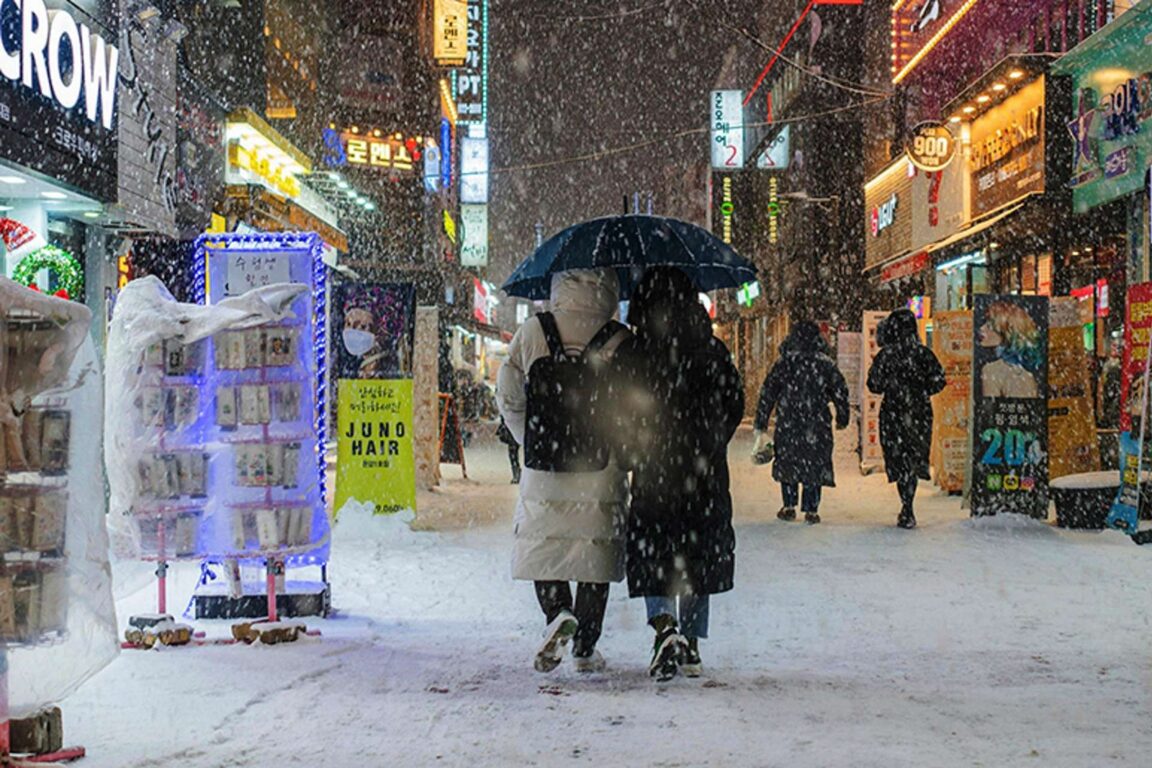
Photo: Ethan Brooke, via Unsplash. Pedestrians in long padded coats cross a snowy Seoul street at night.