 Elena Vasquez
Strasbourg Christmas market runs from Friday 27 November to Thursday 24 December 2026, with chalets open daily from 11:30 a.m. to 9 p.m., a later 2 p.m. start on opening day and a 6 p.m. close on Christmas Eve. Entry is free, there is no ticket and no booking, and the whole Grande Ile, the island at the heart of the old town, becomes a pedestrian zone during market hours. The detail that shapes every visit is the entry system: visitors cross into the Grande Ile at specially arranged entrances on the bridges, bulky bags are searched there, and cars are kept out of the cathedral quarter and the rest of the island while the stalls are open. Plan for the checks, travel light, and the market is simple to enjoy.
Quick Facts
- 2026 dates: Friday 27 November to Thursday 24 December 2026
- Daily hours: 11:30 a.m. to 9 p.m., opening at 2 p.m. on 27 November and closing at 6 p.m. on 24 December
- Late nights: Stalls stay open until 10 p.m. on 11, 12, 18 and 19 December
- Entry: Free, with no ticket or reservation required
- Market sites: Eight official markets across the Grande Ile, listed by the City of Strasbourg
- Entry checks: Pedestrians and cyclists can be checked at the access bridges, and bulky items such as suitcases and large backpacks are searched on entry
- Cars: Driving and street parking are prohibited on the Grande Ile during the market period, with access kept for emergency services and authorised permit holders
- Information points: Chalets at Place Kleber and at the train station, where wheelchairs and walking frames can be borrowed free of charge
- Official source: The City of Strasbourg Christmas site, noel.strasbourg.eu, checked 25 November 2026
When does the Strasbourg Christmas market open in 2026, and which squares open first?
All eight official markets open together on Friday 27 November 2026, with the chalets welcoming visitors from 2 p.m. on that first day rather than the usual 11:30 a.m. There is no staggered opening and no soft launch square that starts a day early, so a traveller arriving for opening weekend gets the full circuit at once. The season then runs daily until Thursday 24 December, when the stalls close at 6 p.m. Nothing is open on 25 December, which catches out visitors who assume a Christmas Day market. Four evenings run late, with stalls open until 10 p.m. on Friday 11, Saturday 12, Friday 18 and Saturday 19 December, and those are the best nights for seeing the illuminations at full strength after dark.
The City of Strasbourg describes the centre as fully pedestrianised for the season, with the markets set across the historic centre and all of them a short walk apart. That compactness is the practical headline: the Grande Ile is an island ringed by the River Ill, so the market footprint is fixed, walkable and impossible to get badly lost in. A visitor can cover the headline squares in a single afternoon and still have time to return to a favourite stall in the evening.
What happens at the cathedral square stalls?
The market around the cathedral, listed by the City as Autour de la Cathedrale, spreads across Place de la Cathedrale and Place du Chateau and along Rue des Hallebardes and Rue Gutenberg. It is the busiest of the eight sites, because the stalls sit directly under one of the great Gothic facades of Europe, and it rewards an early start. Arrive close to the 11:30 a.m. opening and the lanes between chalets are still passable; by mid afternoon on a Saturday the same lanes move at a shuffle. The stalls here lean traditional, with Christmas decorations, wooden toys, candles and Alsatian ceramics, and the cathedral itself provides the backdrop that most visitors have seen in photographs before they arrive.
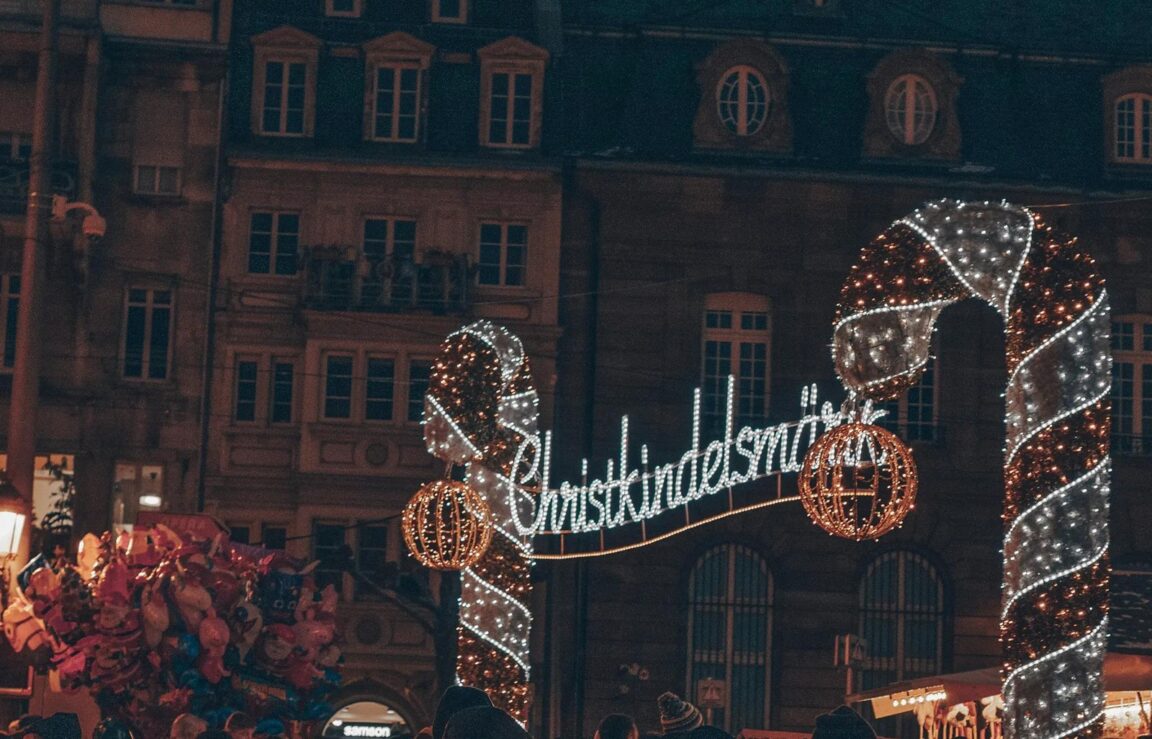
Two other squares anchor the circuit. On Place Broglie stands the Christkindelsmarik, the historic market held on this square since 1871 in front of the town hall and the opera house, and the name from which the whole Strasbourg tradition takes its identity. The market’s origins reach back to 1570, when the city replaced its St Nicholas market with the Christkindelsmarik, making Strasbourg’s one of the oldest Christmas markets in Europe. On Place Kleber, the Grand Sapin, a Christmas tree around 30 metres tall, rises over the Village du Partage, where charities take turns running stalls, and the tree lights up on the hour in the late afternoon and evening.
Where do the bag checks sit, and how does entry actually work?
Entry to the market is entry to the Grande Ile itself. The City directs visitors to enter through the specially arranged entrances at each bridge, because the island is a protected zone for the duration of the market under the national Vigipirate security plan. In practice that means three things for a traveller planning a late November trip. First, pedestrians and cyclists may be subject to random checks at the access bridges and inside the markets, and police may ask for identification at any time, so carry a passport or national identity card rather than leaving it at the hotel. Second, bulky items are searched at the entrance: suitcases, large backpacks and cargo bikes are opened and checked, which is why the standard advice is to bring a small day bag and leave luggage at the hotel or in the automatic lockers at the station. There is no left luggage facility inside the market area. Third, if the queue at one bridge is long, the sensible move is simply to walk to the next bridge, because every bridge into the island has an entrance and the queues are rarely even.
At moments of very heavy crowding the City may also make individual streets one way for pedestrians or temporarily close a bridge or the Homme de Fer tram stop. None of this requires any action in advance. There is no pass to apply for, no timed entry slot and no capacity booking. The check is a pause of a minute or two at a bridge, and then the island is open.
When does the cathedral quarter close to cars?
The honest answer is that the closure is not limited to the cathedral quarter or to the evenings. During market opening hours the whole Grande Ile is closed to general traffic, and street parking on the island is prohibited day and night for the full market period, from 27 November to 24 December. The central car parks at Kleber, Gutenberg and Broglie are reserved for season ticket holders during the season. The exceptions are narrow: emergency services, authorised residents displaying a permit, and holders of the French disability mobility card may still drive on the island, though even they cannot park on its streets. Ride hailing cars do not operate on the Grande Ile during opening hours, and taxis may enter only for pre-booked journeys carrying passengers with reduced mobility.
For a visitor arriving by car, the system is designed around park and ride. The city runs a network of tram park and ride sites at the edge of Strasbourg, with a low cost day ticket that covers parking and tram and bus travel for the car’s passengers, up to seven people. On Saturdays and Sundays a temporary park and ride at the Zenith, with a shuttle bus, serves drivers arriving from the west. Anyone driving into France should also remember that a Crit’Air emissions sticker is compulsory in Strasbourg. The far simpler arrival is by train: the station is about ten minutes on foot from the first stalls, along a signposted pedestrian route from the station forecourt, and Paris is under two hours away by TGV.
How do the trams change during the market?
Three central tram stops, Broglie, Langstross Grand’Rue and Alt Winmarik, are closed during market opening hours, and the busy Homme de Fer interchange also closes on Saturdays and Sundays. Visitors should instead use Republique for Place Broglie, Porte de l’Hopital for the cathedral, Ancienne Synagogue Les Halles or Faubourg de Saverne for Place Kleber, and Faubourg National for the Petite France quarter. Buses that normally cross the Grande Ile are diverted around it. None of this is a hardship in practice, because the island itself is small and the markets are designed to be walked, but it does mean that a hotel described as being at a tram stop may involve a longer walk than the map suggests during market hours.
What should a first time visitor eat and look for?
Beyond the cathedral and Broglie, the remaining markets each carry a distinct brief. The Quai des Saveurs food market on the Terrasse Rohan and Place du Marche aux Poissons is the place for mulled wine made with Alsace white wine and for bredele, the small Christmas biscuits baked across the Bas-Rhin. The Carre d’Or market on Place du Temple Neuf sits beside Rue des Orfevres, one of the most richly decorated streets in the city, among pastry shops, chocolatiers and cheesemongers. In the Petite France quarter, around Place Benjamin Zix and Place Saint Thomas, stalls stand among the half timbered houses of the old tanners’ district. At Square Louise Weiss, the small producers’ market sells only Alsatian produce, from jams and honey to cheeses and fruit brandies, and shares the square with a free Advent village of workshops and storytelling for children. The OFF market on Place Grimmeissen is run by social and solidarity economy makers in shipping containers, with upcycled gifts and a quiet area for families who need a pause.
One small ritual is worth knowing before the first drink. Hot drinks are served in reusable cups with a one euro deposit. The cup can be returned to any stall selling drinks, not only the one that served you, or dropped into a charity collection point, in which case the deposit goes to a Strasbourg charity. Almost all stalls take bank cards, but the cash machines on the Grande Ile are heavily used, so withdrawing cash before crossing the bridges saves a queue.
How should the visit be timed?
Weekday mornings are the calmest window, and the cathedral market in particular is best in the first hour after the 11:30 a.m. opening. Pushchairs can get through the market lanes but with difficulty at peak times, and the City suggests a baby carrier at weekends; a heated baby space with changing and feeding facilities is provided at the Advent village on Square Louise Weiss. Wheelchairs and walking frames are lent free of charge at the information chalets on Place Kleber and at the station in exchange for an identity document, and the City publishes an accessible market map with step free routes. Dogs are allowed on a lead, although the City advises against bringing them on Saturdays and Sundays because of the crowds.
Strasbourg rewards the traveller who treats the entry system as part of the visit rather than an obstacle. Cross at a quieter bridge, keep the bag small, start at the cathedral before the crowds build, and finish at Place Kleber after dark when the great tree is lit. For more seasonal planning, see our NYC winter magic guide for a very different kind of city Christmas, or browse the latest coverage on the Always Packed home page.
Frequently Asked Questions
Is the Strasbourg Christmas market free to enter?
Yes. Entry to all eight markets is free and no ticket or booking is needed. Visitors only pay for what they buy at the stalls, plus the refundable one euro deposit on drinks cups.
What are the opening hours in 2026?
The markets run from Friday 27 November to Thursday 24 December 2026. Chalets are open daily from 11:30 a.m. to 9 p.m., opening at 2 p.m. on the first day, staying open until 10 p.m. on 11, 12, 18 and 19 December, and closing at 6 p.m. on 24 December.
Will my bag be searched at the Strasbourg Christmas market?
It may be. The Grande Ile is a protected zone during the market, bulky items such as suitcases and large backpacks are searched at the bridge entrances, and random checks of pedestrians and cyclists can take place. Carry identification and keep bags small.
Can I drive or park in central Strasbourg during the market?
No. Driving on the Grande Ile is prohibited during market opening hours and street parking is banned on the island for the whole market period. Use a tram park and ride site or arrive by train and walk from the station.
Is the market open on Christmas Day?
No. The stalls close at 6 p.m. on 24 December and do not reopen. The great tree on Place Kleber remains lit into early January, but the market itself is finished.
Image credit: Strasbourg Christmas Market, photograph by Filiz Elaerts via Unsplash (Unsplash License).