 Maya Chen
Amanoi is best judged from the water and the trails, not from its pavilion decks. This cliff resort above Vinh Hy Bay sits inside Nui Chua National Park, and its real argument is the combination at its feet: a marine reserve bay with more than 300 varieties of coral, a dry forest national park rising straight from the shore, and a private Beach Club and jetty side that turns both into the daily programme. Book it for the park and the bay, with the clifftop pool as the reward at the end of each walk, and it makes complete sense.
Quick Facts
- Location: Vinh Hy Village, Ninh Thuan Province, Vietnam, on a promontory of Nui Chua National Park overlooking Vinh Hy Bay, 55 kilometres south of Cam Ranh Airport
- Transfer: About 75 minutes by road from Cam Ranh International Airport, per the official Amanoi fact sheet
- Rooms: Nine Pavilions, 22 Pool Villas, two Wellness Pool Villas and 12 Residences, per Aman
- Pools: A 140 square metre clifftop infinity pool lined with black volcanic rock, plus a 400 square metre pool at the Beach Club
- The setting: Nui Chua National Park and UNESCO Biosphere Reserve on land, a marine reserve in Vinh Hy Bay below
- Facts checked: 26 November 2026, against aman.com
A different Amanoi question: the park and bay side
Always Packed has already assessed the resort as a whole in the earlier Amanoi guide to the Nui Chua coastal resort, covering its pavilions, spa and who it suits. This piece takes the narrower, more useful angle for active travellers: what the national park and the bay actually give you to do, how the resort own jetty and Beach Club organise it, and whether the nature on the doorstep is strong enough to justify a resort that is deliberately a long way from anywhere else. The short answer is yes, with one honest caveat about heat and timing that runs through everything below.
Nui Chua: a dry forest park that starts at the resort gate
Nui Chua is not the lush jungle of postcard Vietnam. Aman describes a mosaic of ecosystems running from tropical dry forest to lush ravines, and that dryness is the character of the place: granite outcrops, scrubby hillsides, and trails where the reward is the sudden reveal of the bay below rather than shade. The resort can arrange guides and transport for excursions into the park, as set out in the official Amanoi fact sheet on aman.com, and guided is the right way to do it. Trails in a dry coastal park punish improvisation: start early, carry more water than feels necessary, and let a guide set a route matched to the heat of the day. Walkers who plan park days at home with the discipline of the guide to US national park reservations in 2026 will recognise the principle, even though the booking mechanics differ: the scarce resource here is not a permit, it is the cool hour after dawn.
The park also explains the resort architecture. The Central Pavilion, designed by Jean-Michel Gathy in the form of a traditional Vietnamese communal hall, sits high on the promontory precisely so that the park, the lotus filled lake and the bay are the view in every direction. There is no neighbouring development to look at, because the park is the neighbour.
Vinh Hy Bay: the marine reserve below the cliff
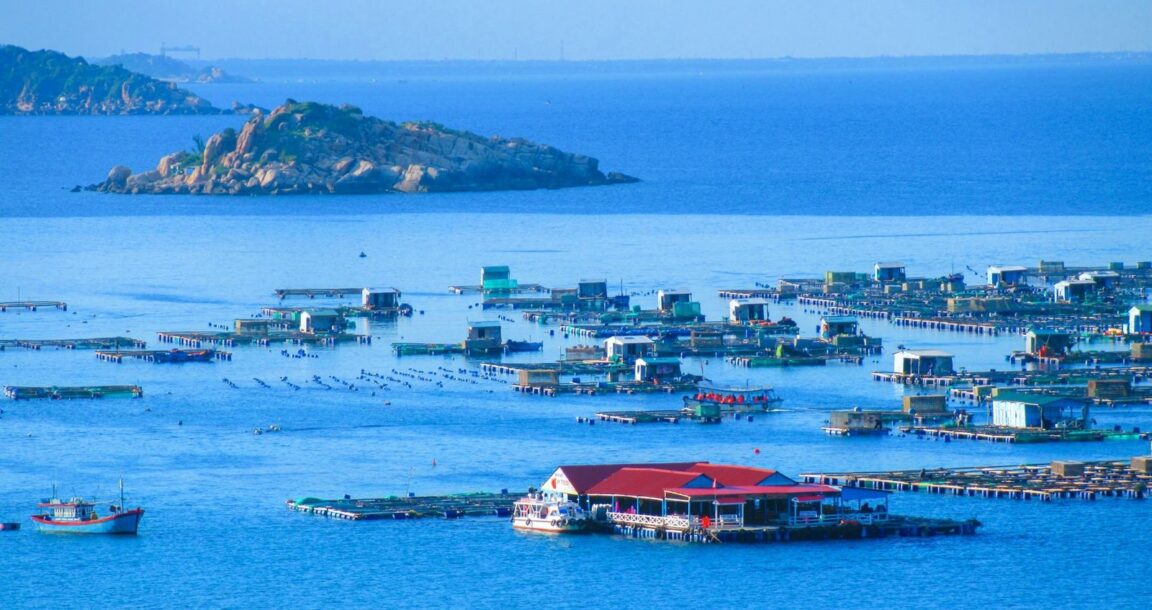
From the cliff pool the bay reads as scenery. From the Beach Club and the water it becomes the second half of the stay. Aman notes that Vinh Hy Bay is part of a UNESCO conservation area with over 300 varieties of coral, and the resort own programme is built around that fact: snorkelling over the reef, kayaking, catamaran sailing and boat trips across a working bay where fishing boats and floating aquaculture villages share the water with visitors. That working character is a strength. This is not a sanitised resort lagoon; it is a living bay inside a marine reserve, and a morning on the water shows both the reef and the community that fishes it.
The Beach Club, overlooked by granite cliffs on the private sandy shoreline, is the hinge between the two halves of the resort. It has its own dining area and the larger 400 square metre pool, plus the water sports equipment, snorkelling gear and kayaks listed in Aman official Amanoi resort materials. Structure a day around it: dawn hike in the park, late morning down at the Beach Club, snorkel before lunch, and the cliff pool at the Central Pavilion for the last light. Travellers who like their park days sequenced this tightly, trail first and water second, plan desert and canyon parks the same way, as in the Badlands National Park first timer guide.
The pavilions, judged from the trailhead
Accommodation splits into nine Pavilions, 22 Pool Villas, two Wellness Pool Villas and 12 Residences, all freestanding and spread across the promontory. For the park and bay traveller, the tier question is simpler than the price ladder suggests. A Pavilion gives you the combined living and sleeping space and a timber sundeck, and puts the budget toward guided excursions. A Pool Villa adds a private pool of up to 36 square metres, which sounds redundant beside two resort pools until you price in a post hike plunge ten steps from your own door in the midday heat. The Amanoi Ocean Pool Villas step up to 270 square metres with infinity pools of up to 42 square metres facing the East Sea. Residences suit groups who will actually use the space. None of the tiers changes the park or the bay, which is the honest reason to choose on room comfort alone and spend the difference on guiding and boat time.
Distance inside the resort is the other practical fact. The promontory is wide, the Beach Club is a buggy ride from the pavilions, and the whole property is 55 kilometres and about 75 minutes from Cam Ranh Airport, a transfer Aman arranges and every guest should pre book rather than improvise. The same base logic applies as in the guide to where to stay for Wind Cave National Park: when the attraction is a protected landscape, staying inside it beats commuting to it, and Amanoi is the inside option for Nui Chua.
The spa, the lake and the slow hours
Between the active hours, the Aman Spa occupies the shores of the lotus dotted lake, with five double treatment suites and a floating yoga pavilion, and it earns its place in an active itinerary as recovery rather than indulgence. Hike legs and snorkel shoulders are the predictable condition of an Amanoi guest by day three. Dining follows the same split level geography: the Restaurant at the clifftop Central Pavilion, the Bar and Library beside it, and the Beach Club down on the shore for the barefoot version. Background on the resort history and layout is summarised at the Amanoi reference entry, but rates, inclusions and excursion arrangements should always be confirmed live with Aman, because they vary by season and pavilion category and no guide figure survives contact with a specific date.
Who this side of Amanoi suits
Book Amanoi for the park and bay if you are a traveller who measures a resort by its trailhead and its reef, and who is content for the evenings to be quiet, dark and early. It suits snorkellers, walkers, photographers of dry coastal landscapes, and anyone who wants a marine reserve as the view and the activity in one. It suits less well the traveller who wants a town, a choice of restaurants off property, or nightlife of any kind: the remoteness is total, and it is the feature. Come in that spirit and the cliff above Vinh Hy Bay is one of the most coherent resort propositions in Vietnam.
Frequently Asked Questions
Can you hike in Nui Chua National Park from Amanoi?
Yes. The resort sits on a promontory of the park and can arrange guides and transport for excursions into it, across ecosystems from tropical dry forest to ravines. Go early in the day, carry ample water, and use a guide for route finding and heat judgement.
What is there to do on Vinh Hy Bay?
Snorkelling over coral reef, kayaking, catamaran sailing and boat trips, organised from the resort Beach Club on its private sandy shoreline. The bay is part of a marine reserve within a UNESCO conservation area, with over 300 varieties of coral recorded by Aman.
How far is Amanoi from the airport?
About 55 kilometres south of Cam Ranh International Airport, roughly a 75 minute drive. By air, Cam Ranh is about 65 minutes from Ho Chi Minh City and 105 minutes from Hanoi, per the Amanoi fact sheet.
How many rooms does Amanoi have?
Nine Pavilions, 22 Pool Villas, two Wellness Pool Villas and 12 Residences, all freestanding and spread across the promontory above the bay.
What pools does Amanoi have?
A 140 square metre clifftop infinity pool lined with black volcanic rock beside the Central Pavilion, a 400 square metre pool at the Beach Club, and private pools in the Pool Villa categories.
Featured image: Vinh Hy Bay, Vietnam, with its floating fishing village and rocky islets. Photo by Karoly Buzas, via Unsplash (unsplash.com). Image credit: Karoly Buzas / Unsplash.