 River Callahan
Choose Queenstown for a first, short or flight-driven Southern Lakes trip, and Wanaka for a slower one built around the lake, the walks and a compact town centre. The two towns sit about an hour apart by road on New Zealand’s South Island, both ringed by serious mountains, and the wrong base rarely ruins a trip. It just taxes it daily, in drives, in prices, or in noise you did not travel that far to hear.
Quick Facts
The pair: Queenstown, on Lake Wakatipu, and Wanaka, on Lake Wanaka, in the Queenstown-Lakes District of Otago, South Island, New Zealand.
Distance between them: About 69 kilometres over the Crown Range Road, roughly one hour, or about one hour 15 minutes via Cromwell on State Highway 6.
Airport: Queenstown Airport is the closest airport with commercial flights to both towns, about an hour from Wanaka. Wanaka’s own airport handles charter and scenic flights.
Queenstown in one line: The livelier, pricier, better connected base, with the airport, the restaurant depth and the adventure industry on the doorstep.
Wanaka in one line: The calmer lakeside base, with a compact walkable centre, Roys Peak and Mount Aspiring National Park as its backdrop, and evenings that end earlier.
Winter driving note: Chains must be carried on the Crown Range in winter, May to October. Check road conditions before choosing the short route.
The two towns, honestly characterised
Queenstown is the Southern Lakes’ working hub. As Destination Queenstown, the region’s official tourism organisation, describes it, the town is the lively centre of the region, set on Lake Wakatipu under The Remarkables, with restaurants, cafes and shopping in the centre and Coronet Peak and The Remarkables ski areas nearby. Everything a visitor might need has a desk in Queenstown: the airport at Frankton, the tour departures, the gear hire, the late kitchens. The costs of that convenience are real money and real buzz. Rooms price at the top of the South Island range, the centre is busy in every season, and lake view is a premium line item rather than a default.
Wanaka is the same landscape at a lower volume. Lake Wanaka Tourism’s official FAQ puts the essentials plainly: the town sits an hour’s drive from Queenstown, its closest commercial airport is Queenstown’s, and it is reached by road from the West Coast, the inland route past Aoraki Mount Cook, and Central Otago. On the ground that translates to a small, flat, walkable centre on Roys Bay, cafes that know their locals, the famous lone willow known as That Wanaka Tree a short lakefront stroll from the centre, and a population of walkers, riders and skiers who chose the quieter town on purpose. Wanaka is not empty and no longer cheap. It is simply calmer, and for stays of four nights or more that calm compounds.
Where to stay in each, and what the choice really costs
In Queenstown, the stay decision is a three-way split. Central Queenstown buys walkable evenings and lake views at the highest prices, and suits short stays without a car. Frankton, by the airport and the Frankton Arm, trades the postcard view for calmer nights, easier parking and lower rates, and suits drivers and early departures. The Kelvin Heights and Fernhill sides buy views and quiet at the cost of a drive or a bus for every dinner. A traveller pricing a Queenstown stay should read the lake view premium sceptically: the view is genuinely superb, and it is also visible for free from the lakefront all day, which is why our Queenstown solo adventure guide, priced for one, treats paying for it as a choice rather than a necessity.
In Wanaka, stay as close to the lakefront and Ardmore Street as the budget allows. The centre is compact enough that a central motel, apartment or lodge puts dinner, the lake and the morning coffee within a flat ten-minute walk, and the town’s better small stays trade Queenstown’s resort scale for kitchens, bike storage and hosts who walk the same tracks. Out at Glendhu Bay and toward the Matukituki road the stays grow quieter and more spacious, aimed at drivers settling in for a week. Wanaka’s apartment and lodge stock is the better format for groups and longer stays, while Queenstown’s hotel stock is deeper at the luxury end and for one-night stops between flights.
Price honesty matters here. Queenstown generally costs more for the same standard of room, most sharply in peak summer and ski season, and Wanaka’s savings narrow every year as its popularity grows. Neither town is a budget base in high season. The reliable saving is structural rather than seasonal: a kitchen in Wanaka for a five-night stay saves more than any discount code in either town.
What each base does to your days
Days out argue for Queenstown when the itinerary leans south and west. Glenorchy, at the head of Lake Wakatipu, is about a 45-minute drive, and Milford Sound is a full day of roughly four and a half hours each way by road without stops, figures carried in the Department of Conservation’s visitor information for the region’s tracks and drives. Skiers get Coronet Peak and The Remarkables, adventure operators leave from the centre all day, and a traveller with two nights and a list should simply stay in Queenstown and spend no hours commuting to their own holiday.
Days out argue for Wanaka when the itinerary leans into walking and the northern lakes. Roys Peak, the town’s signature climb at 16 kilometres return with more than 1,200 metres of ascent, closes for lambing from 1 October to 10 November, a detail worth checking before a spring trip builds itself around the summit photo. The Glendhu Bay Track runs from the town along the lake, the Matukituki Valley opens toward Mount Aspiring National Park, and Cardrona and Treble Cone serve Wanaka’s skiers in winter. A traveller whose trip is built from tracks, lake swims and long evenings will feel Wanaka’s geography as a daily gift rather than a limitation.
Split stays are the connoisseur’s answer and the packer’s nuisance. With six nights or more, three in Queenstown for arrival, Milford and Glenorchy, then three in Wanaka for the walks and the lake, uses both towns at their best and pays one Crown Range crossing for it. With three nights total, pick one base and day-trip the other at most once. Travellers building a wider South Island route can frame the decision with our New Zealand month by month when to go guide and the New Zealand South Island road trip packing guide, which covers what the Crown Range crossing asks of a car in winter.
Getting between them, and the flight-day rule
The Crown Range Road is the short way and the scenic way, climbing to a saddle above 1,000 metres on the highest sealed main road in the country. In summer it is an hour of theatre. In winter it carries a chains requirement from May to October and deserves a conditions check before departure, with the State Highway 6 route via Cromwell, about one hour 15 minutes on gentler grades, as the sensible alternative in snow, in a campervan, or with a nervous driver. Buses link the towns daily for travellers without a car, and Queenstown Airport’s own site is the place to verify flight times before committing to a same-morning drive from Wanaka.
That last point becomes the flight-day rule, and it settles many arguments: sleep in Queenstown the night before an early flight out. An hour’s drive that is a pleasure at noon is a liability at 5 a.m. in winter, and Wanaka’s calm is worth nothing against a missed international connection. The reverse also holds. Arriving on a late flight, the extra hour to Wanaka buys nothing that a Queenstown first night and a morning crossing would not buy better rested. Walkers continuing across the Tasman can connect this decision to our Overland Track Tasmania walking guide, which applies the same base-and-weather discipline to a longer walk, and to the month-by-month timing guide linked above for the crossing seasons.
The verdict, by traveller
First visit, short trip, no car, early flights, Milford Sound on the list: Queenstown, centrally, and pay for the location rather than the view. Walkers, swimmers, cyclists, groups in apartments, stays of four nights or more, and anyone returning to the Southern Lakes for a second, slower look: Wanaka, as close to the lakefront as the budget allows. Skiers can honestly choose either, with Queenstown serving two fields and the apres-ski, and Wanaka serving Cardrona and Treble Cone with quieter evenings. Families split down the middle: Queenstown for activity density and rainy-day depth, Wanaka for space, kitchens and a lakefront a child can be let loose on. The only wrong answer is booking Wanaka prices with Queenstown expectations, or the reverse. Both towns reward the traveller who chose them on purpose.
Frequently asked questions
How far is Wanaka from Queenstown?
About 69 kilometres and roughly one hour over the Crown Range Road, or about one hour 15 minutes via Cromwell on State Highway 6. In winter, May to October, chains must be carried on the Crown Range.
Which is better for a first South Island trip?
Queenstown, for the airport, the restaurant depth and the day trips to Glenorchy and Milford Sound. Choose Wanaka first if the trip is four nights or longer and built around walking and lake time.
Does Wanaka have an airport?
Wanaka Airport handles charter and scenic flights. The closest airport with commercial flights is Queenstown Airport, about an hour away, with rental cars and shuttle services onward to Wanaka.
When is Roys Peak closed?
The Roys Peak Track closes for lambing from 1 October to 10 November. Check the current status with Lake Wanaka Tourism or the Department of Conservation before planning a spring visit around it.
Can I visit both towns in one trip?
Yes. With six nights or more, split three and three, Queenstown first for flights and day trips, Wanaka second for walks and the lake. With three nights, base in one and day-trip the other once at most.
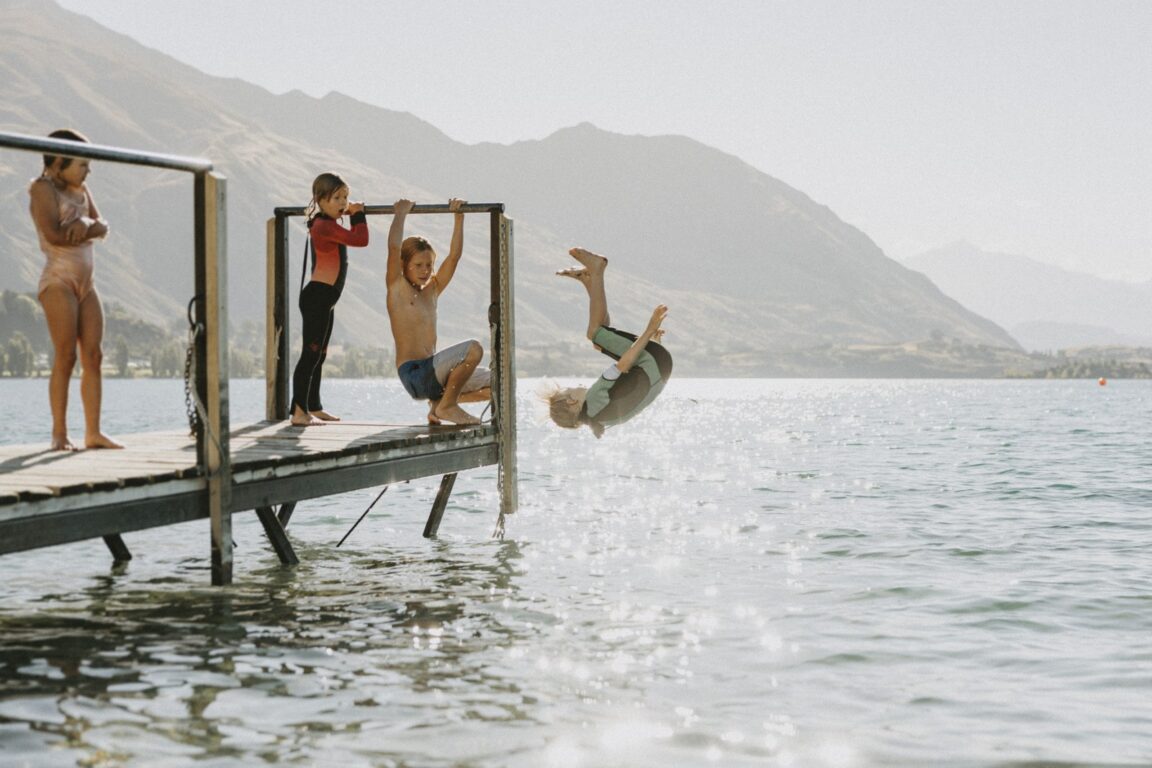
Featured image: Children diving from the lakefront wharf pontoon on Lake Wanaka, by Dee Gerlach, via Lake Wanaka Tourism’s official website, wanaka.co.nz. Distances, seasons and airport details checked 25 November 2026 against Lake Wanaka Tourism, Destination Queenstown and the Department of Conservation.