 Thandiwe Nkosi
Tswalu Kalahari earns its headline honestly: at about 1,200 square kilometres, it is South Africa’s largest private game reserve, and this guide is about the two experiences that use that scale best, walking with researchers’ knowledge toward the elusive pangolin, and sleeping out at Malori, the reserve’s under-canvas sleep-out deck above the dunes. Everything else about Tswalu, the private vehicle with every booking, the malaria-free status, the three small camps sharing a wilderness with room for no more than about 60 guests, exists to make those two encounters possible.
Quick Facts
- Where: Southern Kalahari, Northern Cape, South Africa, below the Korannaberg mountains
- Size: About 1,200 square kilometres (120,000 hectares), South Africa’s largest private reserve
- Camps: The Motse, Tarkuni and Loapi share the reserve; Malori is the sleep-out experience
- Guiding model: Private vehicle, guide and tracker included with every booking
- Malaria: Malaria-free
- Signature wildlife: Temminck’s pangolin, aardvark, aardwolf, brown hyena, bat-eared fox, black-maned Kalahari lion, habituated meerkats
- Access: Flights to the reserve’s private airstrip, including from Johannesburg and Cape Town
Why does the pangolin define a Tswalu stay?
The ground pangolin is the animal serious safari travellers organise whole trips around and usually fail to see: nocturnal, solitary, shy and heavily threatened by poaching elsewhere. Tswalu is regarded as one of the best places in Africa to encounter one, not because pangolins are staged, they are not, but because the reserve’s size, low guest density and research presence stack the odds. Pangolins are studied here, trackers read their sign in the red sand, and a private vehicle means a sighting can be followed at the animal’s pace, on foot where the guides judge it right, for as long as the pangolin allows. The reserve groups its shyest residents as the Elusive Five: pangolin, aardvark, aardwolf, brown hyena and bat-eared fox, all present, all mostly nocturnal, all far easier here than in busier reserves. The official account of the Tswalu experience on the reserve’s own website makes the same point in the reserve’s words: unlimited time at sightings, no other camps’ vehicles, and days shaped entirely around the guest’s chosen quarry. Our earlier, broader Tswalu overview, the first Always Packed guide to Tswalu Kalahari, covers the camps and seasons in general; this piece deliberately stays with the pangolin and the sleep-out.
What actually happens on a pangolin walk?
Forget the vehicle-bound rhythm of a Kruger drive. A pangolin-focused outing starts with intelligence: where sign was found, what the research and tracking teams have seen, which drainage lines and burrow systems are active. Much of the search happens in the cool of the evening and after dark, when the Elusive Five move, and a successful encounter often ends on foot, standing quietly in torch-filtered light while a pangolin unrolls, sniffs the air and sets off about its ant-hunting business with an armour-plated indifference to its audience. Nothing is guaranteed, and the reserve does not pretend otherwise. What is guaranteed is effort and expertise, plus the supporting cast that fills any search: aardvark digging in the open, bat-eared foxes listening for termites, brown hyena on the prowl and, at dawn, the habituated meerkat colonies that let guests stand among foraging sentries at eye level. Travellers comparing safari styles should set this beside our Londolozi Game Reserve safari guide, where leopards, not pangolins, are the covenant species, and the guiding culture is equally intense about a completely different animal.
What is the Malori sleep-out?
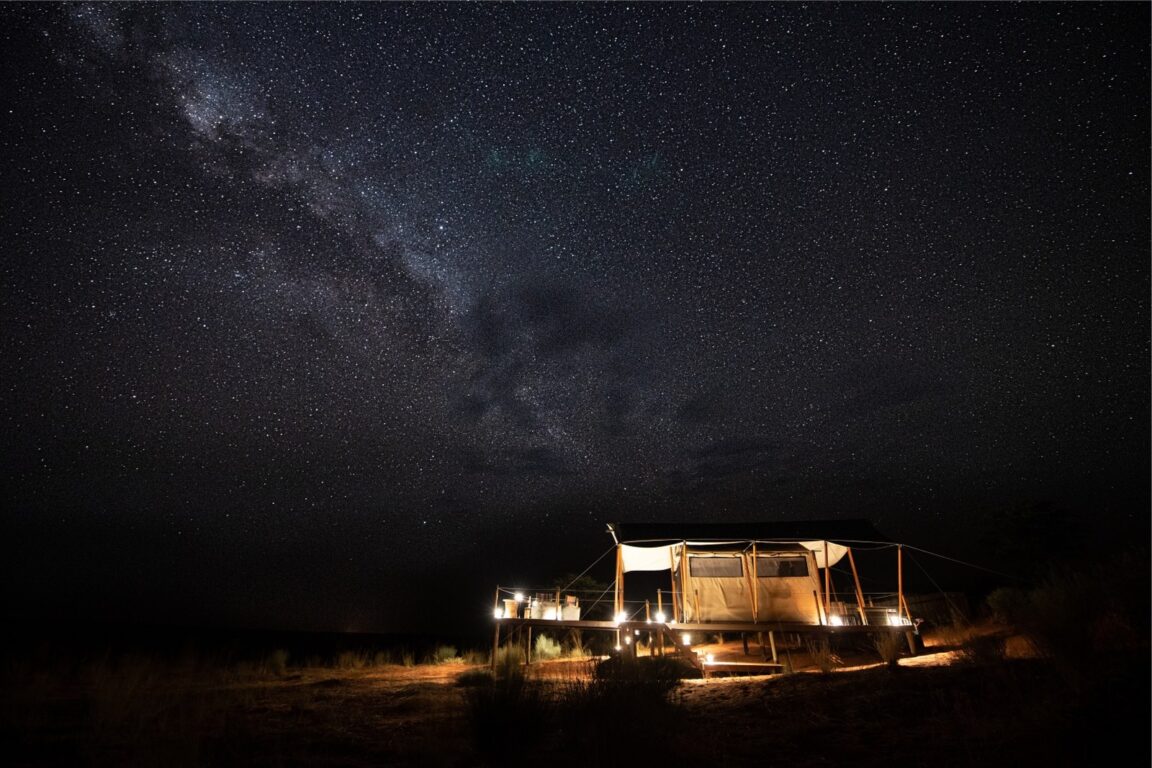
Malori, a Setswana word the reserve translates as dreamer, is Tswalu’s sleep-out: a deck and under-canvas camp set out in the dunes with panoramic views over the veld to the horizon, built for one party at a time. The format is simple and complete. Arrive for sundowners, eat a private dinner under the sky, sleep in a proper bed in the open or under canvas, and wake to the Kalahari dawn with coffee as the light reaches the Korannaberg. The reserve’s guest information describes Malori as part of a stay’s bespoke design rather than a separate excursion, and that is the right way to book it: one night out in the middle of a longer camp stay, chosen for a clear, dark night where possible. In a reserve with almost no light pollution, the night sky is not a backdrop. It is the main event, with the sounds of the same nocturnal cast, hyena whoops, fox calls, the wind in the camelthorn trees, providing the soundtrack the pangolin walks go looking for.
How do the camps and the guiding model support all this?
Three camps, the Motse, the private homestead Tarkuni and the tented Loapi, share 1,200 square kilometres, and the reserve states a ceiling of about 60 guests at any time, which works out at roughly 2,000 hectares per guest, the lowest bed-to-space ratio in South African private conservation. Every booking carries its own vehicle, guide and tracker for the whole stay, so a pangolin obsession never competes with another party’s bird list, and a Malori night can be slotted around weather rather than a roster. Families are unusually well served for a reserve of this seriousness, because malaria-free status removes the medication question and the private guiding model absorbs children’s rhythms without negotiation. Practical planning, flights to the private airstrip, seasons and what to pack for Kalahari winter nights that drop toward freezing even after hot days, is covered on Tswalu’s official website, which is also the only place to book. Readers weighing a South Africa trip’s legal landscape for cannabis should read our South Africa cannabis private-use explainer for visitors before travelling, and those building a longer safari circuit can use our New Zealand Great Walks booking guide as the model for how far ahead flagship nature experiences should be secured.
Who should book Tswalu, and who should not?
Book Tswalu if your safari ambition is specific: the shy, the nocturnal and the rare, pursued slowly in near-total privacy, with one night spent sleeping out in the dunes. It is among the most expensive safaris in South Africa, and the honest counter-argument is density: a first-time traveller determined to tick off the Big Five in three days will see more headline animals, faster, in the greater Kruger. Tswalu’s wager is different. It trades density for depth, and for travellers who have done the classic circuit, or who care about conservation research they can stand inside, that trade is the whole point.
For an independent conservation-magazine overview of the reserve’s habitats, species list and access, see Africa Geographic’s Tswalu Kalahari Reserve profile, which corroborates the 1,200 square kilometre figure and the Elusive Five from outside the reserve’s own channels.
Frequently asked questions
Is Tswalu really the largest private reserve in South Africa?
Yes. The reserve covers about 1,200 square kilometres (120,000 hectares) in the Northern Cape, which the reserve and conservation sources describe as South Africa’s largest privately protected reserve.
Can you really see a pangolin at Tswalu?
Tswalu is considered one of the best places in Africa for pangolin sightings, helped by research presence, expert trackers and private guiding. Sightings are never guaranteed, because the animals are wild and nocturnal.
What is the Malori sleep-out?
Malori is Tswalu’s sleep-out experience, a private deck and under-canvas camp in the dunes for one party, with dinner, a proper bed under the sky and a Kalahari dawn wake-up, booked as part of a stay.
Is Tswalu malaria-free?
Yes. The reserve is malaria-free, which makes it a strong option for families and travellers who prefer not to take antimalarial medication.
Image credit: The Malori sleep-out deck at Tswalu Kalahari. Photo from Tswalu Kalahari official website (tswalu.com).