 Omar Haddad
AlUla is Saudi Arabia’s great open air museum, an oasis valley in the northwest of the kingdom where more than a hundred Nabataean tombs stand carved into sandstone outcrops at Hegra, the country’s first UNESCO World Heritage Site. Around the tombs sit an ancient oasis that has been farmed for millennia, a mudbrick old town now under careful restoration, desert canyons, and Maraya, a mirrored concert hall that reflects the cliffs back at themselves. Visits run on booked tours and timed shuttles rather than free wandering, so AlUla rewards travellers who plan a day ahead instead of turning up and hoping.
Quick Facts
- Where: AlUla County, northwestern Saudi Arabia, about 325 km north of Medina.
- Headline sight: Hegra, also called Al-Hijr or Mada’in Salih, inscribed by UNESCO in 2008 as Saudi Arabia’s first World Heritage Site.
- The tombs: More than 110 monumental tombs survive, 94 of them with decorated facades, carved mainly in the 1st century BCE to 1st century CE.
- Access rule: Heritage sites are visited on pre booked tours with official transport from a central visitor hub. Book through Experience AlUla before you arrive.
- Steward: The Royal Commission for AlUla, established in 2017, manages conservation and tourism development.
- Best months: October to March, when desert temperatures are workable for outdoor sites.
- How long: Two to three days covers Hegra, Dadan and Jabal Ikmah, the old town and the oasis without rushing.
What was Hegra, and why does it look like Petra?
Because the same kingdom built both. The Nabataeans, Arab traders who mastered desert water engineering and taxed the incense routes, made Petra their capital and Hegra their southern city, the largest Nabataean settlement after Petra itself. Their masons cut tomb facades into isolated sandstone outcrops across a desert basin, topping doorways with eagles, sphinxes, medusas and stepped crowstep friezes, and carving inscriptions that name the tomb’s owner and, unusually, the masons who did the work, along with legal warnings to anyone who might sell or reuse the burial chambers.
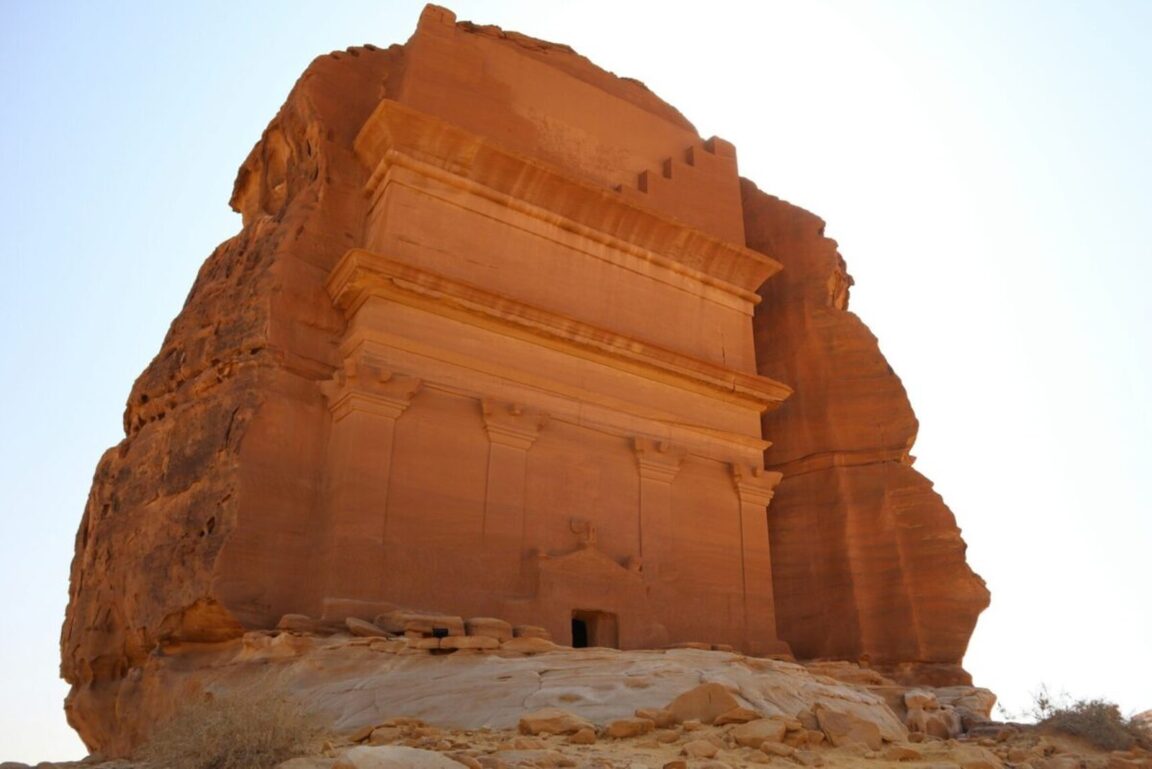
The landmark tomb is Qasr al-Farid, the Lonely Castle, a huge unfinished facade standing alone in the sand, its isolation and scale making it the image on almost every AlUla brochure. Other clusters, including Jabal AlAhmar and Jabal AlBanat, reward the full tour loop rather than a single stop. Travellers who know Jordan will find the comparison instructive, and our guide to visiting Petra makes the natural companion read, because Hegra shows the same civilisation working smaller, quieter and, for now, with far fewer visitors.
How does a visit to Hegra actually work?
On rails, politely. You book a tour slot in advance, check in at the visitor hub, and ride official transport out to the site, where a guide leads the group between tomb clusters on a fixed loop. Independent wandering between outcrops is not the model here, and dwell time at each facade is set by the tour. That structure frustrates photographers used to roaming, but it protects a fragile site that sat largely undisturbed for well over a thousand years, and the guides, many of them local storytellers trained for the role, add the inscriptions and family histories that a silent facade cannot tell you.
Practical consequences follow. Book Hegra before you book anything else in AlUla, choose an early or late slot for raking light on the carvings, and carry water and sun protection even in winter, because shade at the outcrops is minimal. The same booking system covers Dadan, the earlier Dadanite and Lihyanite capital with its lion tombs, and Jabal Ikmah, a rock face dense with inscriptions in several ancient scripts that researchers call an open air library.
What else fills an AlUla day?
The old town and the oasis
AlUla Old Town is a dense maze of mudbrick houses, several hundred of them, occupied into the late 20th century and now being stabilised and restored in phases, with guided entry to parts of the labyrinth. Below the old town runs the oasis itself, a working belt of date palm groves and citrus plots watered for thousands of years, with shaded trails that make the green half of AlUla’s story as compelling as the stone half. Go in the late afternoon, when the light drops into the valley and the palms turn the temperature down.
Maraya and the desert beyond
In the Ashar Valley stands Maraya, a concert and events hall clad entirely in mirrors and billed as the largest mirrored building in the world, a claim backed by a Guinness World Records title. It appears and disappears against the cliffs depending on your angle, and even travellers who never attend a performance inside tend to stop for the photograph. Beyond it, the county opens into canyon country, the Sharaan nature reserve, and formations such as Elephant Rock, Jabal AlFil, where the sandstone has weathered into a trunked giant best seen at sunset. Hot air balloon flights and stargazing run in season for those who want the valley from above or after dark.
How is AlUla changing, and how should a visitor respond?
AlUla’s opening is deliberate and recent. The Royal Commission has run conservation, archaeology and tourism as one programme since 2017, visitor numbers are being grown in stages, and new hotels are arriving in the valley, from tented camps under the cliffs to large international brands announced for the coming years. The respectful response is simple. Dress modestly, ask before photographing people, follow the tour rules at heritage sites even when they feel restrictive, and treat the oasis farms and old town as living places rather than sets. Travellers continuing through the region can pair AlUla with our guide to Salalah and Oman’s green season for the Arabian Peninsula’s other great landscape surprise.
How do you get to AlUla and get around?
AlUla has its own airport, Prince Abdul Majeed bin Abdulaziz International Airport, with flights from Riyadh, Jeddah and Dubai among other routes, and the drive from Medina takes roughly four hours. Once in the valley, distances are deceptive. Hegra lies about 20 km north of town, the old town and oasis sit in the valley floor, and Maraya and the Ashar Valley resorts spread along the canyon roads, so most visitors combine the official site tours and shuttles with a rental car or hotel transfers for everything in between. Winter festival season, anchored by the Winter at Tantora programme of concerts and events, fills hotels and tour slots weeks ahead, and shoulder weeks outside the festival calendar are the calmest time to come.
Frequently Asked Questions
Is Hegra the same place as Mada’in Salih?
Yes. Hegra, Al-Hijr and Mada’in Salih are names for the same Nabataean archaeological site north of AlUla town, inscribed by UNESCO in 2008.
Can you visit Hegra without a tour?
No. Entry runs through pre booked official tours with set transport and a guide. Book through Experience AlUla, ideally before you travel, because popular slots fill.
How does Hegra differ from Petra?
The same Nabataean kingdom built both, but Hegra is a tomb landscape spread across open desert rather than a city hidden in a gorge. Its facades are generally plainer than Petra’s Treasury, its inscriptions richer, and its crowds far smaller.
When is the best time to visit AlUla?
October to March, when daytime temperatures suit outdoor touring. Summer heat sharply limits time at exposed sites.
How many days do you need in AlUla?
Two days is the working minimum for Hegra plus Dadan and Jabal Ikmah. Three days adds the old town, oasis trails, Elephant Rock and a desert excursion at a humane pace.
What should you wear at the heritage sites?
Modest, sun smart clothing, closed shoes for sand and rock, a hat and water. There is little shade at the tomb clusters.
Featured image: Qasr al-Farid tomb at Hegra, AlUla. Photo by Hatem Boukhit on Unsplash, Unsplash License, via Skift. Facts checked 14 November 2026 against UNESCO and Royal Commission for AlUla sources.