 Jordan Ellis
Christchurch rewards travellers who give it two days rather than a night either side of a South Island road trip. The city that has emerged since the earthquakes of 2010 and 2011 is not a restored version of the old one but a new centre built at a human scale: a riverside market hall, a Spanish Mission shopping street, a transitional cathedral built partly from cardboard tubes, and the 21 hectare Botanic Gardens that anchor the west of the centre as they have since 1863. This plan spends day one inside that rebuilt centre and the gardens, and day two crossing the Port Hills to Lyttelton, the harbour town that was Christchurch’s original port and still feels like a separate place with its own weather and its own opinions.
Quick Facts
- The gardens: Christchurch Botanic Gardens cover 21 hectares in a bend of the Avon River, known in te reo Maori as Otakaro, inside Hagley Park. Entry is free. The gardens open at 7am daily, with closing that varies by season, as late as 9pm in the summer months and earlier in winter. Conservatories keep shorter hours, roughly 10am to 4pm.
- The founding date: The gardens were founded in 1863 with the planting of an English oak, which is why Christchurch calls itself the Garden City.
- The rebuild landmarks: The Transitional Cathedral, widely known as the Cardboard Cathedral, was designed by architect Shigeru Ban and opened in 2013. New Regent Street, with its Spanish Mission facades, is the centre’s prettiest survival and carries the heritage tram through its middle.
- The market hall: Riverside Market, on the corner of Oxford Terrace and Cashel Street beside the Avon, is a covered indoor market of food stalls, produce shops and small restaurants, open daily.
- The Lyttelton run: Lyttelton sits on the far side of the Port Hills, reached through the Lyttelton road tunnel or over the hills by bus and road. Its farmers market is a Saturday institution, which is worth knowing when you choose which of your two days goes over the hill.
- The walking logic: The rebuilt centre is compact and flat. Almost everything on day one is within a 15 minute walk of Cathedral Square, and the gardens begin where the centre ends.
Day one: the rebuilt centre, street by street
Where does the rebuilt centre actually start?
Start at Cathedral Square, still the city’s mental centre, and read the rebuild from there. The damaged Anglican cathedral remains the square’s complicated centrepiece, while around it the working centre has reorganised itself south and west toward the river. Walk down to Oxford Terrace, known locally as the Terrace, where the Avon runs green and slow between lawns and restaurant terraces, and where punting boats slide out from the Antigua Boatsheds a few minutes upstream. This riverfront strip, unimaginable in the old city, is the clearest statement of what the rebuild chose to value.
From the Terrace, Riverside Market is a minute away and is the right first interior. It works as breakfast, as a provisions stop and as an orientation tool: Canterbury produce, bakeries, butchers, coffee and a mezzanine of small eateries under one roof, busy from morning with locals rather than only visitors. If you are self catering or building a picnic for the gardens, this is where you do it.
What should you see before the gardens?
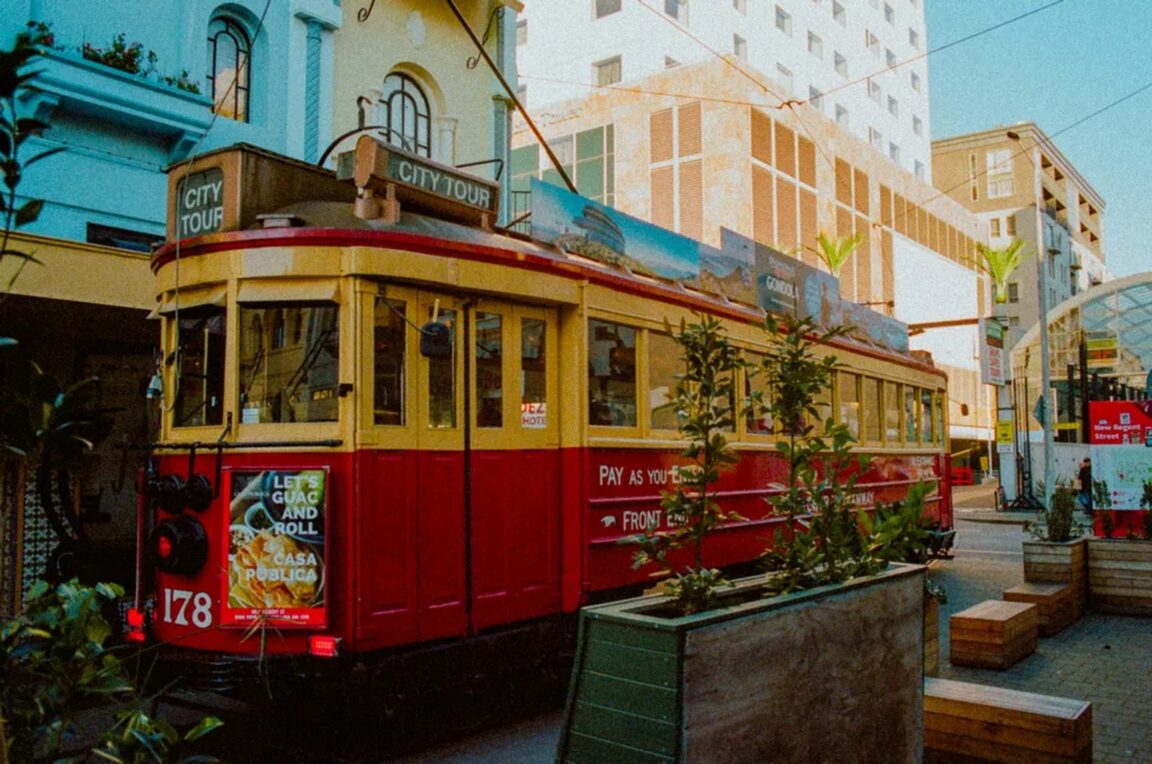
Two buildings carry the rebuild story best. The first is the Transitional Cathedral on Madras Street, a few blocks east, where Shigeru Ban’s A-frame of cardboard tubes, timber and a polycarbonate roof was meant to be temporary and has instead become one of the most loved buildings in the country. It is a working parish church, so visits fit around services, and the interior light on a bright morning justifies the detour on its own. The second is not a single building but New Regent Street, the 1930s Spanish Mission terrace of pastel facades that survived the quakes and reopened as cafes, small shops and a theatre, with the heritage tram threading through it. The tram, whose City Tour cars run a loop of the central sights, is worth riding once for orientation if your time is tight and worth simply watching from a cafe table if it is not.
Between the two, cross the Bridge of Remembrance at the end of Cashel Street and spend a few minutes in the Cashel Mall precinct, where the post quake container mall has given way to permanent lanes and courtyards. The pattern to notice is how much of the new centre is lanes, yards and river edge rather than big blocks, a deliberate smallness that makes day one feel unhurried even when you cover a lot of it. Travellers continuing south will find the same rebuilt with nature balance handled differently in Dunedin, where the heritage survived and the wildlife is the headline.
Day one, afternoon: the Botanic Gardens done properly
How long do the gardens need?
Half a day, and they repay it. Enter from Rolleston Avenue beside Canterbury Museum and work through the gardens as a sequence rather than a wander. The rose garden and the herbaceous borders sit near the visitor centre, the conservatory complex holds the tropical and desert houses, and the New Zealand garden section, with its native planting along the river, is the part visitors most often miss and locals most value. The gardens’ 21 hectares sit inside a loop of the Avon, so the river keeps reappearing as a reference point, with Hagley Park’s 165 hectares wrapped around the outside for anyone who wants to keep walking.
Practicalities are gentle. Entry is free, the gates open at 7am, and the visitor centre, with its cafe and shop, keeps daytime hours that shorten in winter. A caterpillar style garden tour runs for those who want the botany explained, and punting on the Avon from the Antigua Boatsheds, just outside the gardens’ edge, makes a calm final hour. In spring the cherry blossom along Harper Avenue draws the whole city; in autumn the exotic tree collection, some of it dating to the gardens’ first decades, turns the place into an arboretum walk. Either way, end the day back on the Terrace as the riverside terraces fill for the evening.
Day two: over the Port Hills to Lyttelton
Why does Lyttelton feel like a different town?
Because it is one. Lyttelton was the port of entry for Canterbury’s first organised settlers in 1850, and it grew up facing the sea and the ships, with its back to the hills that separate it from the city. The road tunnel cut the journey to a few minutes, but the Port Hills still work as a psychological border: the weather is often different on the harbour side, the streets climb steeply from the water in an amphitheatre around the port, and the town’s cafes, bars and Saturday farmers market serve a community that treats Christchurch as the place across the hill rather than the other way round.
Give the town a slow half day at minimum. London Street, the main street, runs with cafes, a well regarded set of small eateries and shops in a rebuilt streetscape that mixes new timber buildings with surviving facades. The working port is visible everywhere and is part of the point. Walk up into the residential streets for the harbour views, and if the day is fine, the harbour itself offers the best add on: ferries cross to Quail Island, the largest island in the harbour, with walking tracks, swimming beaches and a leprosy colony and quarantine history that its interpretation panels explain plainly. Check ferry days and times before you build the island into the plan, as sailings are seasonal.
What if your Lyttelton day is not a Saturday?
The farmers market is a Saturday pleasure and worth scheduling around if your two days allow the swap, putting the centre and gardens on the other day instead. On any other day the town still justifies the trip for the harbour setting, the main street and the island ferry, and you gain quieter cafes for your flexibility. An alternative afternoon, if the harbour weather turns, is the Christchurch Gondola on the city side of the hills at Heathcote Valley, whose summit station looks straight down on Lyttelton and the harbour from 500 metres up, letting you read the whole geography of day two from above. Walkers with a third half day to spare could also look at how the region’s serious tracks are organised in our guide to New Zealand’s Great Walks booking system, since several of the country’s best known walks sit within reach of a Canterbury base.
Where should you base yourself?
Inside the rebuilt centre, within a few streets of the Avon, is the obvious answer for this itinerary: day one becomes entirely walkable, the Terrace covers evenings, and day two starts with a short bus or drive to the tunnel. The west end near Hagley Park suits travellers who want the gardens at dawn and do not mind a slightly longer walk to dinner. Staying in Lyttelton itself is the romantic option and works if you reverse the days, but it makes the centre day a commute and the gardens an expedition, so for a first two day visit the city side of the hill wins.
Frequently Asked Questions
Are the Christchurch Botanic Gardens free?
Yes. Entry to the gardens is free, and they open at 7am every day. Closing times vary with the season, running as late as 9pm in summer and earlier in winter, and the conservatories keep shorter hours than the grounds. The visitor centre cafe and shop are the main costs unless you add a garden tour or a punt on the river.
Is the Cardboard Cathedral still open?
Yes. The Transitional Cathedral on Madras Street remains a working Anglican church and a visitor sight in its own right, more than a decade after it opened as a temporary replacement. Visits fit around services and events, so mornings on weekdays are usually the easiest time to see the interior quietly.
How do you get to Lyttelton without a car?
By bus through the Lyttelton tunnel, which runs regularly from the city centre bus interchange, or by taxi and rideshare over the same route. The trip is short. Once there, the town centre is walkable, though its residential streets are steep, and the Quail Island ferry leaves from the Lyttelton wharf area in season.
Which day should be the Lyttelton day?
Saturday, if one of your two days is a Saturday, because the Lyttelton Farmers Market fills London Street that morning and gives the town its fullest expression. The centre and gardens day loses nothing by moving to the Sunday or weekday instead.
How much of the old Christchurch survived?
Less in the centre than visitors expect, and more in pockets than the rebuild story suggests. New Regent Street, the Arts Centre’s Gothic Revival buildings on Worcester Boulevard and stretches of the Avon corridor carry the old city clearly, while the blocks between them are new. The interest of the centre now is precisely that mixture, read street by street.
Is two days enough for Christchurch?
Two days cover the rebuilt centre, the gardens and Lyttelton comfortably, which is the right first visit. A third day opens up the Banks Peninsula and Akaroa, the Antarctic Centre near the airport, or a Port Hills walking day, all of which are additions rather than corrections to this plan.