 Maya Chen
Eat three things well in Bangkok and the city makes sense: pad thai cooked over fierce heat with tamarind doing the work that sugar should never do alone, boat noodles in small dark bowls that you stack as you go, and a night walk down Yaowarat Road in Chinatown, where fish balls, rolled noodle soup, grilled seafood and fried dough carry the evening from dusk to midnight. Everything else, the mango sticky rice, the crab omelettes, the curry rice stalls, builds out from those three anchors. This guide works dish by dish, then strings the Chinatown stops into one walkable night circuit.
Quick Facts
- The three anchors: Pad thai, boat noodles and the Yaowarat night circuit in Chinatown.
- Pad thai benchmark: Thipsamai, long listed by the Michelin Guide Bangkok with a Bib Gourmand, wraps its pad thai in a thin omelette near the Golden Mount.
- Boat noodle home turf: The canal side alleys by Victory Monument, where small bowls are ordered in rounds.
- Yaowarat anchor street: Yaowarat Road, Samphanthawong district, served by Wat Mangkon MRT station.
- Michelin thread: Chinatown holds Bib Gourmand fish balls at Lim Lao Ngow and a one star kitchen at Jay Fai, north of the old town.
- How to pace it: One noodle district by day, Yaowarat after dark. Chinatown stalls peak in the evening.
- Prices checked: 14 November 2026. Stall prices move often, so this guide describes dishes, not baht figures, except where a venue publishes its own menu.
What makes a proper pad thai?
Tamarind first. A real pad thai sauce balances tamarind sourness against palm sugar and fish sauce, and the noodles, flat rice noodles soaked to pliability, should taste of the wok, with egg, firm tofu, garlic chives, crushed peanut and a lime wedge that is not decoration. Bean sprouts go in late so they stay crisp. Prawns are the classic topping in Bangkok, though chicken and plain versions fill most stall menus.
The benchmark plate is at Thipsamai, the long running shophouse by the Golden Mount whose pad thai comes wrapped in a lacy omelette and whose name appears in the Michelin Guide Bangkok as a Bib Gourmand. Queues form early and move fast. The lesson the plate teaches is restraint: the sauce coats rather than floods, and the sweetness sits behind the tamarind. Once you have eaten it there, the sugary, ketchup tinted versions sold to tourists read as what they are, a different and lesser dish wearing the same name. For the wider shape of a first trip, our first time in Bangkok itinerary pairs the old town sights with these eating districts.
Why are boat noodles served in such small bowls?
Because they were once sold from boats. Boat noodles, kuay teow reua, began as canal food, and the small bowl was practical on water: less to spill, quick to serve, cheap to buy in multiples. The broth is the point. It is dark, aromatic with cinnamon, star anise and galangal, and traditionally enriched to a deep savoury body, then sharpened at the table with chilli flakes, vinegar chillies, fish sauce and sugar. You season it yourself, and you order in rounds, three or four small bowls being a normal lunch, the empties stacking beside you.
The densest cluster sits in the alleys by the canal at Victory Monument, where rival shops, including the long established Pa Yak row, serve bowl after bowl to office workers and students. Order one with beef, one with pork, try the dry version once, and stop when the stack stops being fun. The format rewards grazing, which is the correct Bangkok mode: no single dish should finish you, because the next street always has another.
How does the Yaowarat night circuit work?
Yaowarat Road, the spine of Bangkok Chinatown, changes after dark. Gold shops shutter, neon in Chinese and Thai script lights up, and pavement kitchens take over the edges of the road. The circuit below runs the greatest hits in walking order, and it works because portions are small and queues, while real, move quickly. Start hungry, carry small notes, and treat each stop as one course.
Stop one: fish balls at Lim Lao Ngow
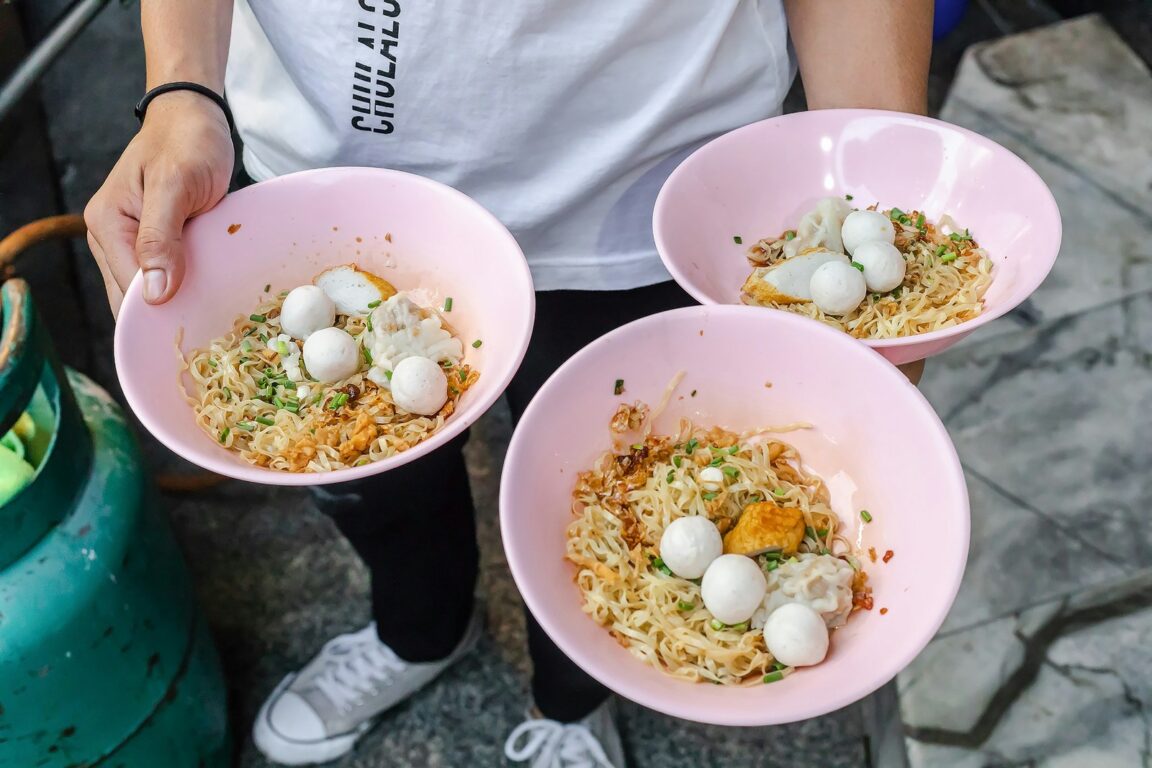
Down a side alley off Song Sawat Road, Lim Lao Ngow makes fish balls of a springiness that has earned the shop a Michelin Bib Gourmand and a devoted local following. The balls, made without flour filler by the family’s own account, come in a clear broth with flat rice noodles, or dry, tossed and salad like. The baseline seasoning is deliberately gentle; the table condiments are there so you can tune the bowl yourself. A side of chicken satay, burnished and gnarly, is the regulars’ second order.
Stop two: rolled noodles, two ways
Yaowarat’s signature soup is guay jub, rolled rice noodle sheets in a peppery pork broth with slices of offal and crisp pork belly. Two shops define it. Guay Jub Ouan Pochana, at 408 Yaowarat Road, ladles a silky, assertively peppered broth that carried a Bib Gourmand for years. A few minutes away, Nai Ekk Roll Noodles answers with an even punchier pepper heat and pork handled with care. Pick one per night; the comparison trip is a fine excuse to return.
Stop three: seafood at T and K
At 49 and 51 Phadung Dao Road, T and K Seafood is Yaowarat’s green shirted arena: tanks at the front, plastic stools on the pavement, woks flaming within arm’s reach of the traffic. Clams stir fried with chilli jam, grilled prawns and crab fried rice are the standard order, washed down with big bottles of local lager and pitchers of ice. It is loud, fast and exactly the theatre the road promises.
Stop four: fried dough and something sweet
End with pa tong go, the Chinese style fried dough sticks crisped in a vast wok on the pavement at Pa Tong Go Savoey, a stall whose Michelin badges from its guide listings still hang on display, served with pandan custard for dipping. If a second sweet is possible, the toasted buns filled with butter and jam or custard from the famous Yaowarat toasted bread stall close the night the way locals close it, standing up, in the neon, already planning the next visit.
What about Jay Fai, and is it worth the planning?
North of Chinatown near the Golden Mount, Jay Fai holds one Michelin star for wok cooking of extraordinary precision, above all the crab omelette, a golden roll packed with lump crab, and drunken noodles with seafood. It is the most demanding booking in Bangkok street food: tiny capacity, long waits, prices far above stall level. Treat it as a special occasion lunch rather than a circuit stop. Travellers who love this dish by dish format will also enjoy our companion guide to what to eat in Hanoi, which works the same way through pho and bun cha.
How should a first timer order without overdoing it?
- Graze by design: Small bowls and shared plates are the system. Order half what you think, then order again.
- Season at the table: Chilli, vinegar, fish sauce and sugar sit on every noodle table. Taste first, then tune.
- Carry small notes: Pavement stalls are cash first, and small denominations keep queues moving.
- Respect the Monday lull: Many Bangkok street stalls rest on Mondays, when pavements are traditionally swept. Yaowarat is quieter, not closed.
- Water and ice: Established stalls use factory ice, the cylindrical tubes with a hole through the middle. That is the ice to trust.
Frequently Asked Questions
How many nights does Yaowarat deserve?
Two. One for the circuit in this guide, and a second to repeat favourites and try the curry rice stalls and dessert shops you walked past the first time.
Is Bangkok street food safe for a cautious stomach?
Choose stalls with high turnover, eat what is cooked to order and hot, and use the tube ice established vendors serve. A busy queue is the best hygiene certificate the city issues.
What is the difference between boat noodles and regular noodle soup?
Boat noodles have a darker, spice led broth with cinnamon and star anise, a much smaller bowl, and a seasoning ritual at the table. Regular kuay teow broths are clearer and lighter.
Can vegetarians eat well on this circuit?
Yes, with effort. Tofu pad thai without fish sauce on request, vegetable stir fries in Chinatown’s Chinese kitchens, and fried dough and soy milk desserts all work, but broths are rarely vegetarian by default, so ask before ordering.
When does Yaowarat wind down?
Most pavement kitchens peak between 6 pm and 10 pm and thin out towards midnight, though the road itself stays busy later on weekends.