 Thandiwe Nkosi
Two days in Livingstone work best when the falls get a full, unhurried day and everything else is arranged around the water. Base in Livingstone town, about 10 kilometres from the falls entrance, spend day one on the Zambian walkways of Mosi-oa-Tunya National Park, crossing the Knife Edge Bridge, looking down into the Boiling Pot and timing the spray, then give day two to Livingstone Island and, only in the low water season, a swim in Devil’s Pool, with the Livingstone Museum, a Zambezi sunset cruise or a game drive filling the hours the river does not. The single most important planning fact is seasonal: Devil’s Pool is a low water experience, usually open from late August to late December, and no itinerary should promise it outside that window.
Quick Facts
- Base: Livingstone, Zambia, about 10 kilometres from the falls, with the widest choice of lodges, restaurants and tour operators
- The falls: Victoria Falls, known locally as Mosi-oa-Tunya, about 1,708 metres wide and 108 metres high, shared between Zambia and Zimbabwe
- Zambian entrance: The falls viewing area inside Mosi-oa-Tunya National Park, managed by Zambia’s National Heritage Conservation Commission; the Livingstone Island operator quotes a US$20 heritage fee, so budget US$20 to US$30 and confirm on the day
- Signature walk: The cliff path to the Knife Edge Bridge, facing the Eastern Cataract, with the Boiling Pot visible far below
- Devil’s Pool season: Usually late August to late December, reached by boat to Livingstone Island with the licensed operator; it closes whenever the Zambezi runs too high
- Visa help: The KAZA UniVisa, US$50 for eligible nationalities, covers Zambia and Zimbabwe for up to 30 days and makes a cross-border falls day simple
- Fullest water: Roughly February to May, when spray can hide the rock face; clearest cliff views and pool season run from about September to December
How should the two days be divided?
Give the falls the first day, while energy and curiosity are highest, and keep it entirely on foot. The Zambian side is a walking experience: a network of paved paths and viewpoints along the top of the gorge, opposite the Eastern Cataract, connected by the Knife Edge Bridge. It rewards a slow pace, because the character of the place changes with the light and the wind. Morning brings rainbows in the spray when the sun is behind you; midday flattens the colour but gives the clearest photographs of the gorge; late afternoon warms the rock and thins the crowds.
Keep day two flexible until the season decides it for you. In low water, the morning belongs to Livingstone Island and Devil’s Pool, booked well ahead. In high water, replace the pool with the island’s high water alternative or drop the island entirely and use the day for the museum, the town and the river above the falls, where sunset cruises operate all year. Either way, protect one late afternoon for the Zambezi itself. The river above the falls is calm, wide and full of birdlife, and seeing it drift peacefully toward a 108 metre drop is the context that makes the falls make sense.
Day 1 morning: the walkway, the Eastern Cataract and the Knife Edge Bridge
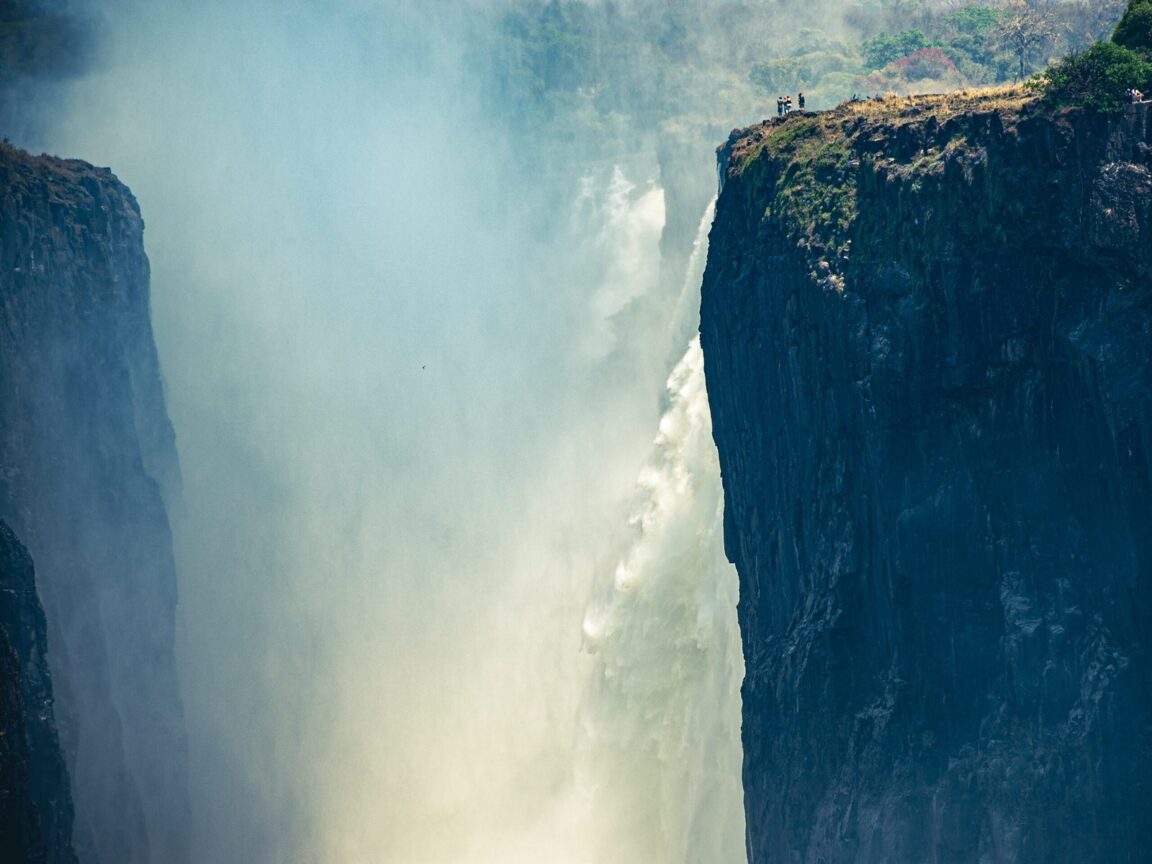
Arrive at the park entrance early, pay the heritage fee, and walk the circuit in the order the path suggests, saving the Knife Edge Bridge for when you have already understood the layout from the first viewpoints. The Zambian walkways face the Eastern Cataract, the section of the falls closest to Livingstone Island. At high water this is a wall of white noise and drifting spray; at low water the flow concentrates in channels and the basalt cliff, the zigzag gorge and the river below become the real subject. Both versions are worth seeing, and neither is the lesser experience. They are simply different falls.
The Knife Edge Bridge is the moment everyone remembers. The narrow footbridge crosses a side gorge to a rocky point directly in front of the cataract, and in the wet months the spray here is total. Expect to be soaked within a minute, whatever the weather overhead, because the falls make their own rain, which falls upward as often as down. Waterproof everything that matters before the bridge, not after: phone and camera in a dry bag, a light rain jacket over clothes, and shoes with grip, because the path runs wet and green. In the dry months the same bridge is dramatic but passable, with the clearest downward view to the Boiling Pot, the churning pool where the falling water turns into the gorge.
Allow two hours for the full circuit without rushing, longer at high water when viewpoints need patience between gusts of spray. There is no bad order in which to take the viewpoints, but there is a bad wardrobe. Cotton jeans stay wet for hours, and the walk back to town in them is the classic first day mistake. Quick drying clothes, sandals or shoes that can get wet, and a dry layer waiting in the bag solve the entire problem.
Day 1 midday: the Boiling Pot hike, honestly assessed
The Boiling Pot is the pool at the foot of the falls, directly below the Knife Edge viewpoint, and a marked trail descends to it from the Zambian side. It is the only way to stand at river level and look up at the full height of the cliff, the bridge small overhead and the water arriving in a permanent, thundering churn. The view justifies the effort. The effort, however, is real: the descent is steep, uneven and slippery in spray season, and whatever goes down must climb back up in warm, humid air.
Treat the hike as the day’s serious exercise, not a stroll between viewpoints. Take water, go slowly, wear shoes that grip wet rock, and allow generous time for the climb out. Travellers with knee problems, vertigo or any doubt about the descent should enjoy the Boiling Pot from the bridge above, where it is clearly visible, and keep their effort for the rest of the circuit. Conditions on the trail vary with the river, and the park authorities close or discourage the descent when it is unsafe. Their word on the day overrides any itinerary, including this one.
Day 1 afternoon: Livingstone town and the museum
Back in town, the Livingstone Museum is the right second act. It is Zambia’s oldest and largest museum, and its galleries cover the region’s archaeology and cultures, the natural history of the falls area, and a substantial collection connected to David Livingstone, the Scottish explorer whose 1855 account introduced the falls to European readers and whose name the town carries. An hour inside converts the morning’s spectacle into a story: how people have lived along this river for centuries, and how recently the falls became a destination at all.
Use the rest of the afternoon at town pace. Livingstone’s main street carries the practical layer of the trip, tour desks, cafes, curio markets and the everyday life of a working Zambian town that predates the resort strip. This is also the moment to confirm day two logistics in person: island tour check in times, cruise departure points, and road conditions if a game drive is planned. Travellers sorting out entry rules for a wider regional trip should read our explainer on Zambia’s visa waiver and which nationalities now enter without a visa before assuming the border will be simple.
Day 2: Livingstone Island and the Devil’s Pool warning
Livingstone Island sits in the middle of the Zambezi at the very lip of the falls, and tours reach it by boat from the Zambian bank with the licensed operator, Green Safaris. From the island, guides lead swimmers a short distance across the top of the falls to Devil’s Pool, a natural rock pool at the edge itself, where a submerged rock lip holds bathers in place while the river pours over beside them. It is as extraordinary as it sounds, and it exists only because, for a few months a year, the river drops low enough for the rock barrier to do its work.
Those months are the warning in this guide’s title. Devil’s Pool usually operates from late August to late December, with exact opening and closing set by water levels, not by the calendar. From roughly January, rising water closes the pool, and the island programme switches to its high water alternative, Angel’s Pool, for part of the year, with island visits themselves paused at the very highest water. The practical rules follow from that. Book the island as early as the operator allows, treat the pool as a probability rather than a promise until the operator confirms close to the date, and never build a trip whose success depends on a November swim happening in March. Children must be at least 12 to swim in the pools and at least 8 to visit the island, under the operator’s current rules.
If the pool is closed, the day is not lost. The island viewpoint alone, standing at the lip with the gorge opening in front, is one of the great views in African travel, and the hours it frees can go to the river or the bush instead.
Day 2 alternatives: the river above the falls and the game drive
The Zambian side of Mosi-oa-Tunya National Park is two parks in one. Beside the falls section lies a game area along the Zambezi, small by safari standards but rich for its size, with elephants, buffalo, giraffe, zebra and hippos, and a population of white rhinos that rangers guard closely and that guided walks set out to see on foot. A half day game drive or rhino walk pairs naturally with the falls, because it shows the landscape the river creates upstream: floodplain, woodland and riverbank, all within a short drive of town.
End the second day on the water. Sunset cruises depart from Livingstone’s jetties in the late afternoon and run on the calm river above the falls, with drinks, snacks and the near certainty of hippos, crocodiles and excellent birdlife along the banks. The cruise is sometimes dismissed as a soft option. On a two day trip it earns its place, because it is the only scheduled moment that faces upstream, toward the wide, quiet Zambezi, rather than down into the gorge. Travellers continuing south afterwards will find a useful contrast in our two days in Cape Town itinerary, another short stay built around one overwhelming natural landmark.
Crossing to the Zimbabwe side: worth it on two days?
It is possible, and with the KAZA UniVisa it is administratively easy for eligible visitors: walk or ride across the Victoria Falls Bridge, the 1905 steel arch between the two border posts, and enter the Zimbabwean park, whose longer walkway faces most of the falls’ width. The honest advice for a two day Zambian stay is to cross only if the season argues for it. At low water, much of the flow sits on the Zimbabwean side, and the view from across the gorge is the fuller one. At high water, the Zambian side is already spectacular, and the crossing costs half a day of border formalities and second entry fees that the island, the museum or the game area would use better.
Practical notes: spray, money and safety
Pack for two climates in one morning: sun on the town streets, rain on the walkways. A light waterproof jacket, a dry bag, footwear that grips when wet and a change of clothes at the lodge cover both. Carry small denomination US dollars and Zambian kwacha; card acceptance is good at lodges and patchy at gates and markets, and fees quoted in dollars should be confirmed at payment, because the Zambian falls fee has been under review and may change. Finally, respect the obvious: cliff edges, wet rock and a river of this power leave no margin for improvisation. Stay on the paths, obey closures, and swim only in the guided pools.
Frequently Asked Questions
When is Devil’s Pool open?
Usually from late August to late December, when the Zambezi is low enough for the natural rock lip to hold swimmers safely at the edge of the falls. The operator opens and closes it by water level, so confirm close to your dates and never assume a swim outside the low water season.
How much does it cost to enter Victoria Falls from Zambia?
The Livingstone Island operator quotes a US$20 heritage fee for the Zambian falls viewing area. Zambia has signalled a rise for international visitors, so budget US$20 to US$30 per person, pay in the currency requested at the gate, and treat any higher quote from unofficial sellers with suspicion.
Is the Boiling Pot hike difficult?
Yes, by the standards of a sightseeing walk. The trail is steep, uneven and often slippery, and the climb back up in humid heat is the hard part. Fit walkers with good shoes manage it comfortably; anyone with knee, balance or vertigo concerns should view the Boiling Pot from the Knife Edge Bridge instead.
Which side of Victoria Falls is better, Zambia or Zimbabwe?
They show different falls. Zambia gives the Eastern Cataract close up, the Knife Edge Bridge, the Boiling Pot and the boats to Livingstone Island and Devil’s Pool. Zimbabwe gives the longer frontal walkway facing most of the width. At high water Zambia is superb; at low water Zimbabwe holds more of the flow.
Can I visit both sides on a two day trip?
Yes, especially with a KAZA UniVisa, which covers both countries for eligible nationalities at US$50 for up to 30 days. Allow half a day for the bridge crossing, both border posts and the second park entry, and weigh it against the island tour, museum and game drive competing for the same hours.
When is the best time to visit Livingstone?
February to May brings the fullest falls and the most spray, with viewpoints sometimes hidden by mist. September to December brings clear cliff views, the Boiling Pot at its most visible and Devil’s Pool season. June to August sits between the two, with strong flow and improving visibility.
Fees, pool seasons and park details checked 14 November 2026 against operator and park information. River conditions set the final word on Devil’s Pool and the Boiling Pot trail, so recheck both close to travel.